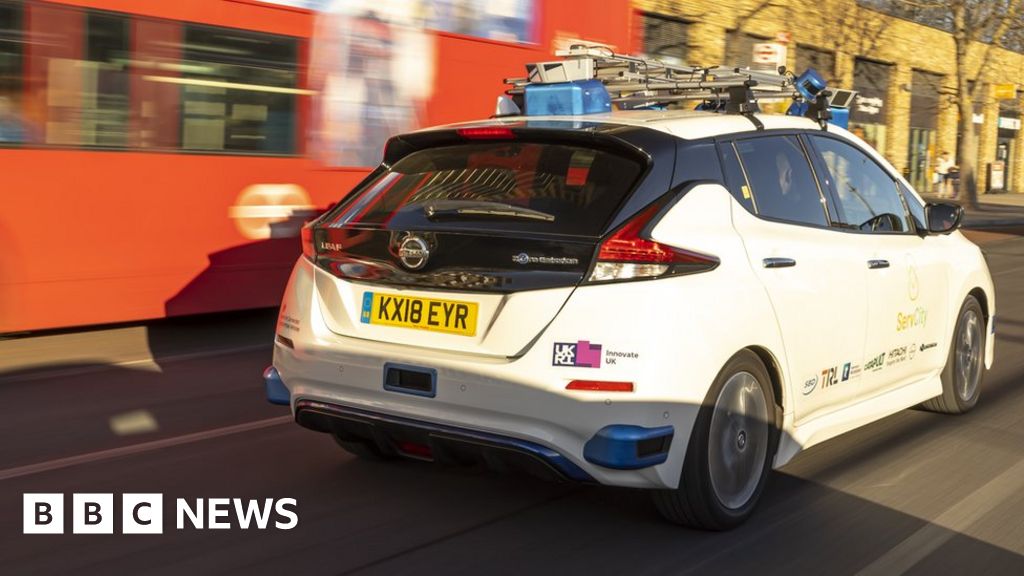















The project uses Nissan’s electric Leaf model. Each car is festooned with cameras and sensors, many of them bolted to a perfectly ordinary roof rack. The boot is full of computers and electronics. It all looks rather rough and ready.
But out on the road, following a circuit between roundabouts on the A206, it feels smooth and controlled. Sitting in the back seat, it’s remarkably easy to forget the car is guiding itself.
Such precision is helped by guidance systems using precise 3D mapping, highly accurate GPS, radar, and Lidar – a laser-based sensing method.
Over the past three years, ServCity’s cars have racked up some 1,600 miles of autonomous driving, without a serious incident – though on every outing a safety driver has been in position to take control if necessary.
It is an impressive record. The roads of Woolwich are busy and unpredictable. Buses dice with taxis, delivery drivers stop without warning, and cyclists weave through heavy traffic.
“What we’re actually trying to do is expand the boundaries of autonomous drive,” explains David Moss, Nissan’s senior vice president for research and development in the UK and Europe.
“So we want to be able to improve not just the ability to drive on the highway, but also to take on complex environments in the city.”
Trials of self-driving vehicles are nothing new. There are even commercial services using them as taxis, on a strictly controlled basis, in some cities in the US, China and South Korea.