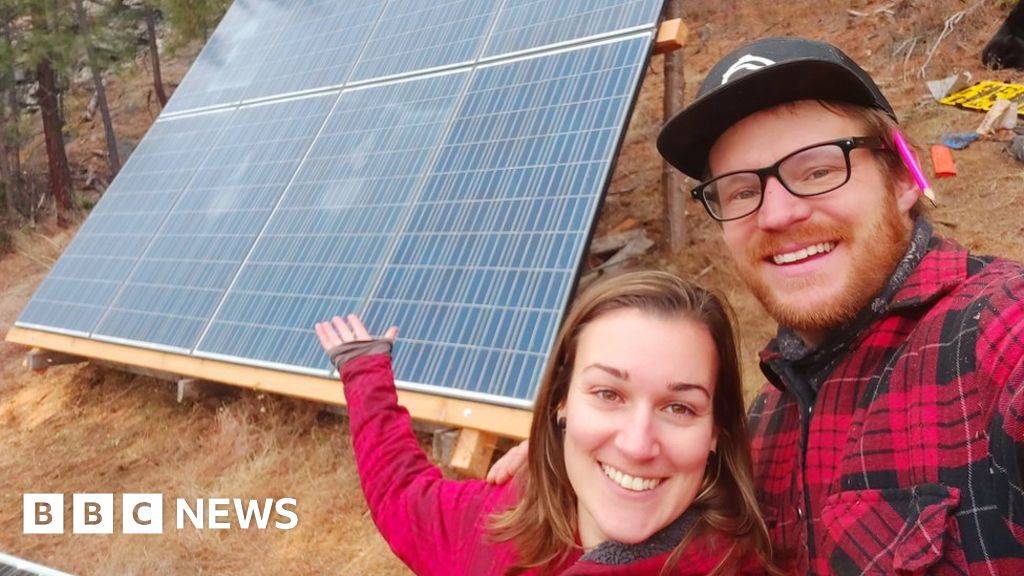








You might think that this approach is only suited to a handful of mavericks who dream of living by themselves in the forest.
But climate change is making extreme weather events more commonplace and prompting many people to reconsider the security of supply.
With the cost of energy soaring in many parts of the world, thanks in part to the war in Ukraine, it’s possible that more people will consider installing solar panels and battery systems to lower their costs – or even go off-grid entirely.
Institutions and communities are already installing miniature power grids that can keep going after severe weather or other disasters have interrupted the main supply.
It’s called “islanding” or “island mode”. When an extreme winter storm hit Texas in February 2021, the University of Texas at Austin relied on its own energy sources and microgrid, external to avoid losing power, despite widespread blackouts nearby.
What if your local school could do this too? Or even your own house?
“I think we are inching our way to the point where every neighbourhood could have a microgrid,” says Katherine Hammack, director of special projects at Green Business Certification Inc. “Climate change is driving people to look at alternate solutions.”
It is increasingly common in the US. Take the town of Fairfield in Connecticut, for instance. After Hurricane Irene in 2011, officials began looking for ways of ensuring that some essential services could continue to function in the event of a similar disaster.
If the main grid fails, the town now has a microgrid system, external, including a gas generator and solar panels, which can provide power to the police and fire headquarters, a homeless shelter, emergency communications centre and a mobile phone mast.