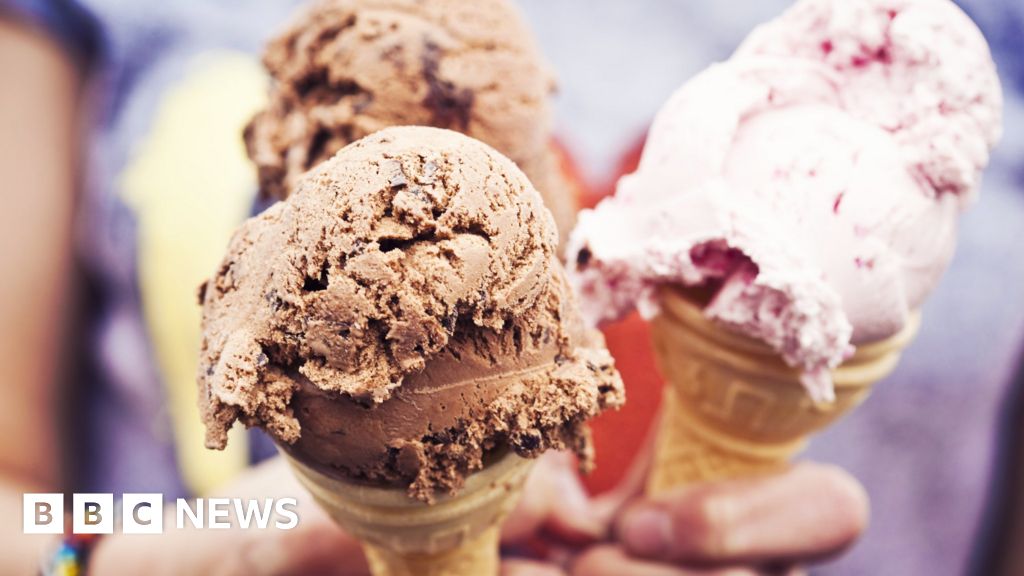












But just how is this delicious treat made?
Production starts with the mix. Milk or water is combined with dry ingredients such as milk solids, sugars and dairy or vegetable fats. The liquid is heated and homogenised, then cooled and “aged”.
Dressed in a white lab coat, Mr Vilsgaard walks me through the process. “We add functional ingredients like flavours and colours, but also stabilisers and the emulsifier.
“They give some viscosity. That is the mouthfeel, when it’s consumed and melting down.”
Next it’s pumped to a continuous freezer. “This is the heart of any ice cream production facility,” he says.
This “small” unit can make 700 litres an hour, but commercial-scale freezers can produce up to 4,000.
Inside a rotating cylinder the mix is rapidly cooled and beaten, while incorporating air. The ice cream emerges slightly soft, so it can be pumped into a tub or mould, then stored at a lower temperature.
While the recipe sounds simple, ice cream has a complex chemistry consisting of ice crystals, air bubbles and fat globules, held in a water and sugar solution.