














Over the past year or more, there has been a recalibration when it comes to autonomous driving, on which in excess of $100bn, external (£83bn) is estimated to have been spent.
Back in the 2010s some thought we would be doing most of our trips in autonomous vehicles by now.
Argo AI, the self-driving tech start-up backed by carmakers Ford and Volkswagen, announced it was shutting late last year.
Many traditional car companies are now saying private self-driving cars, unconstrained by where they can travel, are a long way off and have switched their attention to advanced driver assistance systems instead.
More limited use cases, like self-driving shuttle services, that would operate along short fixed routes are also getting more attention, including from the UK government, external.
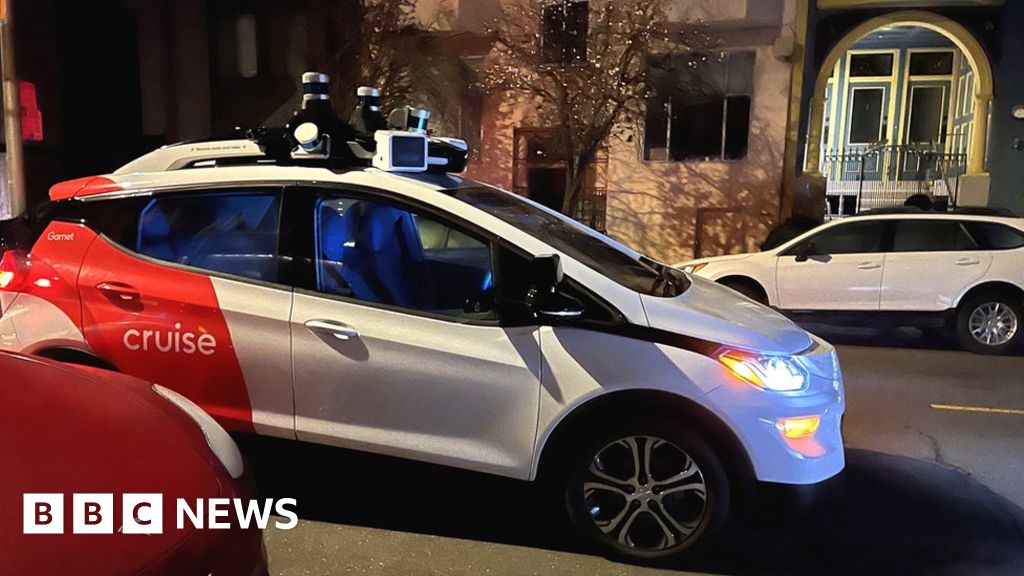
But Cruise and Waymo appear to be staying the course, ploughing resources in and incrementally making progress. Cruise is pursuing both ride-hail and last-mile driverless delivery, which it has been trialling in Phoenix. Additionally, Waymo is developing long-haul autonomous trucking.
Touted benefits of autonomous taxis range from being safer – though that is still being proved – to more reliable, to more relaxing as customers don’t have to worry about being sociable with a driver.
Yet, for such benefits to be realised, the service needs to become financially sustainable. And analysis by Mr Nunes, external, published in 2020 but which he believes still holds true, shows autonomous ride-hailing doesn’t make economic sense, even with generous assumptions.
Firstly, behind the scenes there is still a human requirement. Automation changes the type of labour that is required, but it doesn’t eliminate the need for labour.
Transport consultant Nick Reed says that robotaxi services will need customer support agents, fleet operators to monitor where the cars are, engineers to troubleshoot specific problems the vehicles encounter, and people to physically rescue the cars if needed as well as clean and charge them.
Secondly, there is plenty of time when taxis are empty. While a driver isn’t paid for that time, those working behind the scenes in the autonomous taxi model still need to be.
Yet the companies remain confident they can scale up and become profitable.