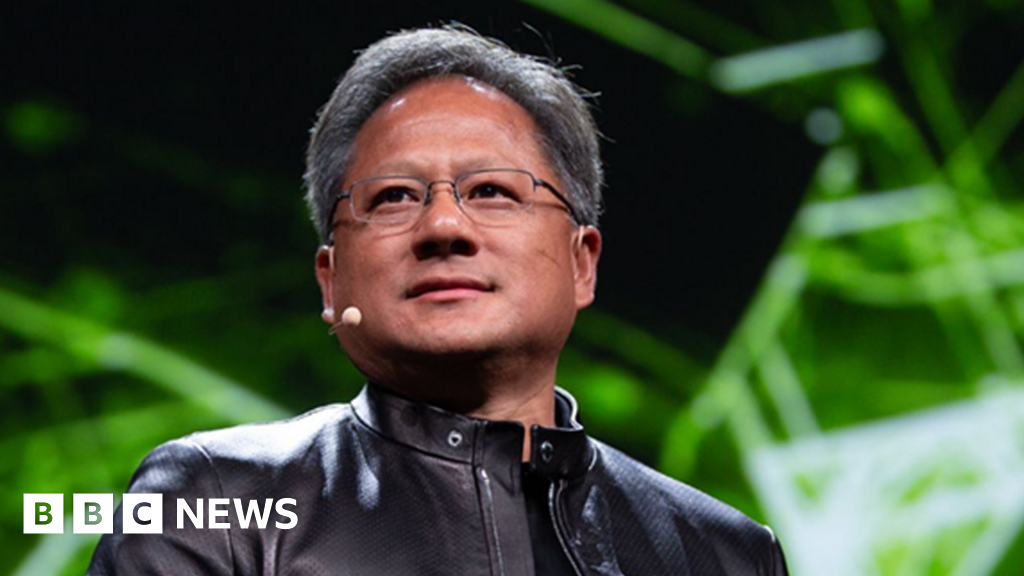












Jensen Huang, now the chief executive of Nvidia, was one of its founders back in 1993. Then, Nvidia was focused on making graphics better for gaming and other applications.
In 1999 it developed GPUs to enhance image display for computers.
GPUs excel at processing many small tasks simultaneously (for example handling millions of pixels on a screen) – a procedure known as parallel processing.
In 2006, researchers at Stanford University discovered GPUs had another use – they could accelerate maths operations, in a way that regular processing chips could not.
It was at that moment that Mr Huang took a decision crucial to the development of AI as we know it.
He invested Nvidia’s resources in creating a tool to make GPUs programmable, thereby opening up their parallel processing capabilities for uses beyond graphics.
That tool was added to Nvida’s computer chips. For computer games players it was a capability they didn’t need, and probably weren’t even aware of, but for researchers it was a new way of doing high performance computing on consumer hardware.
It was that capability that helped sparked early breakthroughs in modern AI.
In 2012 Alexnet was unveiled – an AI that could classify images. Alexnet was trained using just two of Nvidia’s programmable GPUs.
The training process took only a few days, rather than the months it could have taken on a much larger number of regular processing chips.
The discovery – that GPUs could massively accelerate neural network processing – began to spread among computer scientists, who started buying them to run this new type of workload.
“AI found us,” says Mr Buck.
Nvidia pressed its advantage by investing in developing new kinds of GPUs more suited to AI, as well as more software to make it easy to use the technology.
A decade, and billions of dollars later, ChatGPT emerged – an AI that can give eerily human responses to questions.