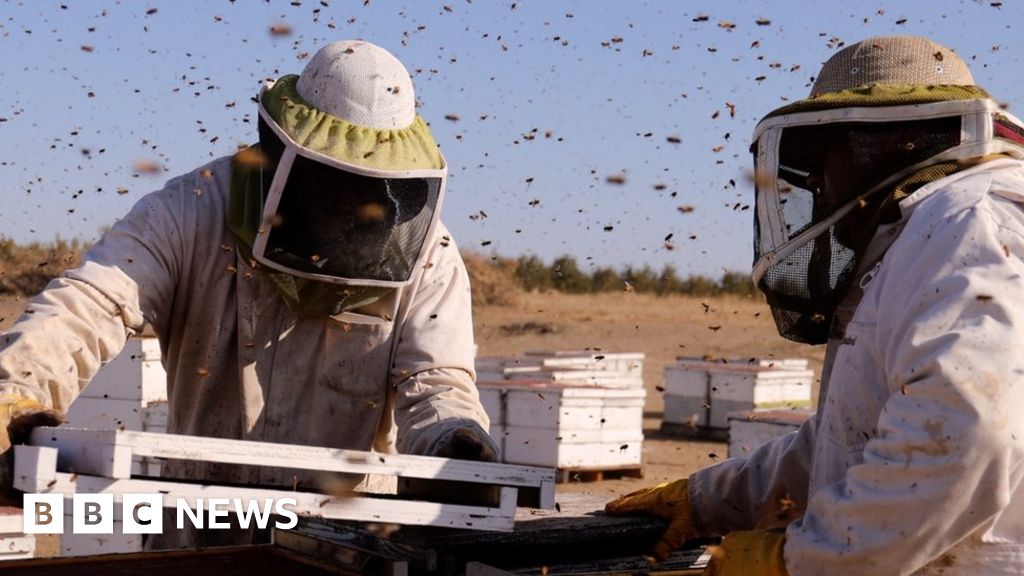











Michael Roberts, executive director at the Resnick Centre for Food Law and Policy at the University of California Los Angeles School of Law, says the government must do more to police the US honey sector.
“There is insufficient coordination between government agencies to police honey fraud in a way that would make it effective,” he says.
This lack of coordination is quickly revealed when the USDA was asked whether its honey grading system should be strengthened. It replied to the BBC that “overall authority for food labelling is the responsibility of the FDA [the US Food and Drug Administration, which is part of the US Department of Health and Human Services]”.
Its response was similar when it was asked what it was doing about the problem of adulterated honey: “Again this is ultimately the authority of the FDA.”
A spokesman for the FDA said that it “does not have any regulations governing country of origin labelling.” Instead it said it was a matter for the USDA.
However, he added that regarding honey adulteration: “The FDA considers product labelling, and the statements and representations made therein, on a case-by-case basis. [And] all statements on a food label must be truthful and not misleading.”
The problem of adulterated foreign honey coming into the US is the biggest issue, says Ron Phipps, of the International Federation of Beekeepers Associations.
“The reality is not that American beekeepers are non-competitive,” he says. “The problem is other countries are using means of production, which have been observed and documented, that allow production of huge quantities of adulterated honey whose production costs are extremely low.”