











Reporting from Kyiv
 BBC
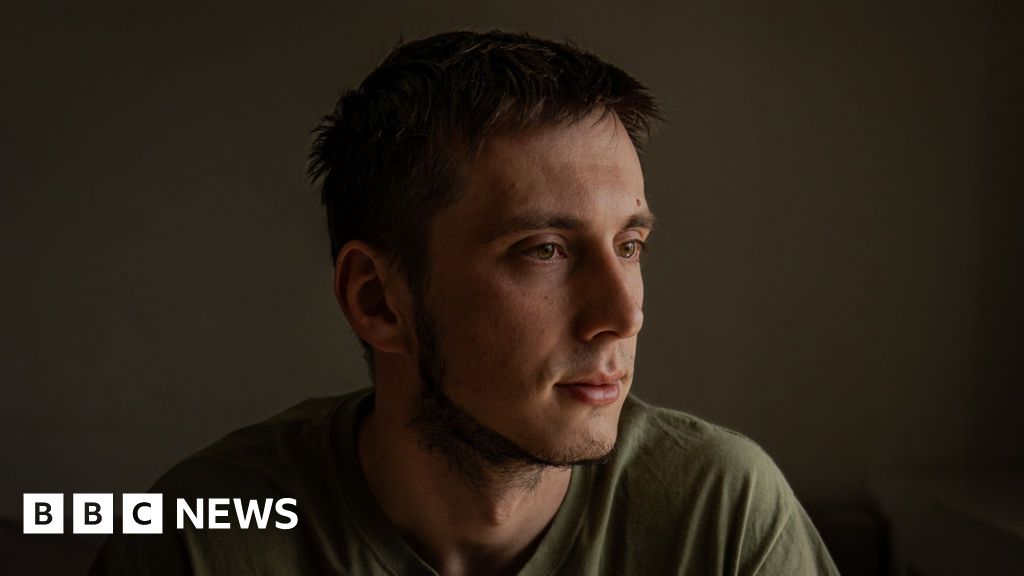
BBCIn a cramped apartment in the Ukrainian capital Kyiv, Pavlo, a 30-year-old drone operator who had recently returned from the front, unzipped a black case about the size of a pizza box. Inside, there was a four-rotor drone he intended to fly around the room.
He pressed buttons on the control unit and pushed the antenna to different positions. Nothing happened. “Sorry, not today,” he said, with a smile. The unit looked fine, but something was broken.
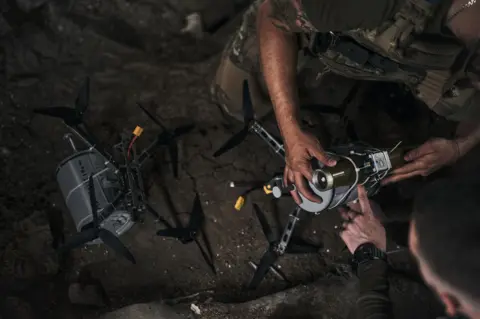
At the front, Pavlo, who asked to be identified only by his first name, was a pilot of first-person view (FPV) drones. These small, highly manoeuvrable drones have front-facing cameras that allow them to be flown remotely. Over the past year or so, bomb-laden FPVs have become ubiquitous on the frontlines in Ukraine, replacing the heavy weapons that characterised the war’s first phase.
The FPVs chase armoured vehicles, hunt infantry units through treelines and stalk individual soldiers to their deaths. “You cannot hide from the FPV, and to run is useless,” Pavlo said. “You try to be as calm as possible, and you pray.”
Even when an FPV is too high to see clearly, or hidden behind foliage, soldiers can hear its distinctive, high-pitched whine.
“Bzzzzzzzzzz,” Pavlo said. “You are being hunted.”

 Getty Images
After more than a year at the front, Pavlo has returned home to the Kyiv apartment he shares with his wife. But the sound of the drones has followed him. Everyday mechanical tools like lawnmowers, motorcycles and air conditioners remind him of the FPVs that hunted him and his unit mates.
And nature is not an escape. Pavlo can no longer hear the sound of bees and flies buzzing near him without a creeping panic. “I don’t like to go into nature anymore and hear this sound, because it reminds me so hard of the drones,” he said.
Trauma associated with sound is not new – generations of soldiers have been affected by sudden noises after returning to civilian life. But as the war in Ukraine has evolved into a conflict driven by drone technology, the trauma has evolved with it.
“Over the past year, the majority of patients – if they are not physically wounded – have mental health injuries as a result of being under drone activity,” said Dr Serhii Andriichenko, chief psychiatrist at Kyiv’s military hospital. “We call this droneophobia.”
Many thousands of men are now returning from the front like Pavlo, with acute stress disorders associated with the sounds of drones, Dr Andriichenko said. The droneophobia can be triggered by an array of ordinary urban sounds – small motorcycles and scooters, lawnmowers, air conditioners – anything mechanical that whirrs.
“If it’s a moped or a lawnmower, my first thought is that it might be a drone,” said another returned frontline soldier, Savur, who lost his arm in an FPV drone attack.
At the front line the drones were a “permanent sound”, said Savur, who in accordance with military protocol asked to be identified by his callsign. “The sound of a shell lasts just a few seconds, but the sound of the drone is there most of the time,” he said.
“You can lay in your position, in your foxhole, and listen to it for hours. I remember that sound all of the time.”
Or sometimes the problem was the opposite – silence. “Silence is always the start,” Dr Andriichenko, the psychiatrist, said. “When the soldiers go on rotation to combat positions, they start listening carefully to make sure there are no drones. There is constant tension, constant fear. They are always looking up.”

In many cases, that constant sense of tension has not been dispelled by the return to civilian life. Soldiers have been observed suddenly switching off lights at home, moving away from windows and hiding under furniture.
Later, if a soldier is seen for treatment, Dr Andriichenko describes how he often has no memory of any trigger sound, but his wife or family member will reveal that an extractor fan or air conditioner had just been turned on.
Soldiers from the earlier phases of the war – which was characterised more by brutal, direct combat – came home fearful of being in forests, where much of the fighting had taken place. But drone warfare has reversed the phenomenon. Now soldiers “feel safest in forests, under dense tree canopies”, the psychiatrist said. “And in their free time, they try to avoid wooded areas.”
The rise in drone use has had another terrorising effect for combat troops – it has extended the danger zone far back from the front line. Soldiers operating up to 40km (25 miles) away, or pulling back after a heavy rotation, can no longer let their guard down.
Nazar Bokhii, a commander of a small drone unit, was about 5km from the contact line in a dugout one day when his unit scored a direct hit on a Russian mortar position 22km away. Buoyed by the success, Bokhii bounded out of the dugout, forgetting the usual protocol of stopping first to listen for a telltale buzz.
Metres away, a Russian FPV was loitering in the air. As it sped towards him, Bokhii only had time to raise his arms. When it detonated, it took both his hands and his left eye and badly burned his face.

Bokhii’s own PTSD was limited, he said, to an occasional fear response to motorcycles and lawnmowers. But he knew about the effect of the sound, he said, because his unit had used it to inflict terror on others.
“We were the side that caused fear with sound, not the side that suffered from it,” Bokhii said.
They had realised at some point that the sound could be used to force Russian soldiers into exposed areas. “You buzz around them and it becomes a test of the enemy’s psychological resilience,” Bokhii said. “The sound of the drone itself is a serious psychological attack.”
According to Bokhii, buzz above a soldier for long enough and he will leave a strong shelter and simply run into open terrain. “Our psychology works in such a way that we need to do something to calm ourselves,” Bokhii said. “So you hover nearby and psychologically suppress him… and he starts running and becomes easier to hit.”
And the psychological terror of the FPV is no longer just a problem on the front line. It has reached beyond even the areas behind the front lines. Russia has begun using FPVs to drop munitions on civilians in Ukrainian cities nearby.
Among the worst hit is Kherson, a southern city occupied for a time by Russian forces and still comfortably within drone range. According to Human Rights Watch, Russian forces have deliberately targeted civilians in the city with FPV drones and killed or maimed them – a war crime.
According to the regional military administration, at least 84 civilians have been killed in the Kherson region as a result of Russian drone attacks so far this year.
Residents say the tiny FPVs are a daily terror.
“There is no such thing as a safe place anymore,” said Dmytro Olifirenko, a 23-year-old border guard who lives in Kherson city. “You always have to be alert, focused, and because of that, the body is constantly under stress,” he said.
 Stanislav Ostrous/BBC
Olifirenko was waiting at a bus stop in September when he heard the familiar sound of a Russian drone overhead. “We thought it would follow the bus, because they had been hunting civilian buses,” he said.
Instead, the drone simply dropped its munition on the bus stop, sending shrapnel into Olifirenko’s head, face and leg. Video of the incident, filmed by a bystander, captured the buzz of the drone followed by Olifirenko’s screams as he bled onto the pavement.
Olifirenko now heard the drones “constantly”, he said, whether they were there or not. “It hits your mental and psychological health hard,” he said. “Even when you leave for Mykolaiv or another city, you are constantly trying to listen.”
For civilians like Oliferenko, the drones have transformed the ordinary sounds of a populated area – cars, motorcycles, generators, lawnmowers, air conditioners – into a psychological gauntlet for civilians to run every day, even as they contend with the real danger of the drones themselves.
For the soldiers coming back from the front, like Pavlo, the drones have created a new and specific type of fear, one that is not easy to shake.
“You see the world as a battlefield,” Pavlo said. “It can become a battlefield any second.”
And of all the triggers, hearing – the human sense drones are exploiting so effectively – was the most insidious, he said.
“When you see something, your brain can check it in a second, you can realise what it is very fast.
“But an unknown sound is different. Your brain has been changed. You cannot ignore it, you must respond. Because at the frontline, it could save your life.”
Svitlana Libet contributed to this report. Photographs by Joel Gunter.