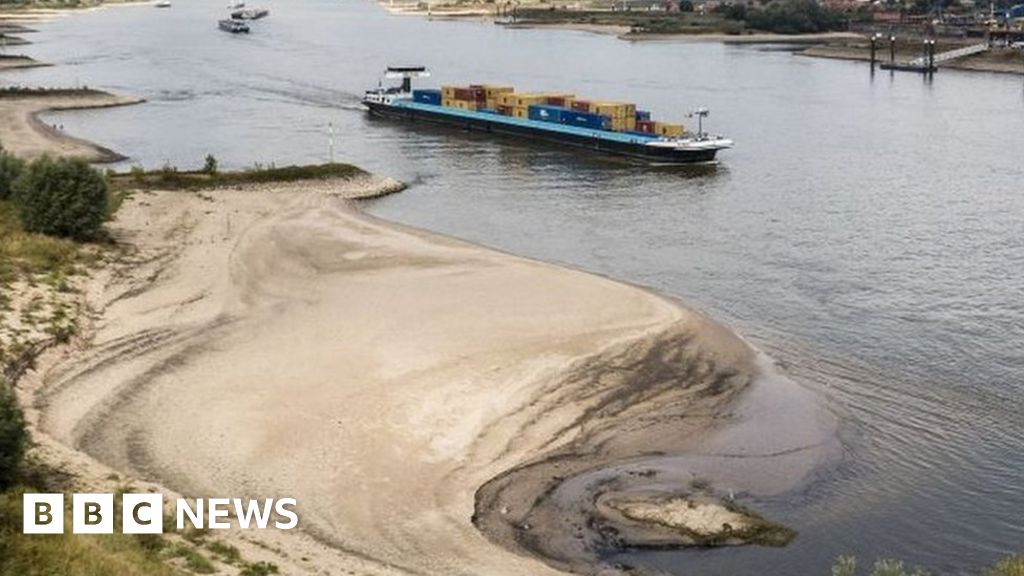











However, when the Rhine’s levels fell last summer, Maersk says its existing partnerships with rail providers meant they were able to “jump in with extra capacity”.
Rail, says Ms Sloek-Andersen, is the preferred alternative to river as they have a similarly low CO2 footprint,, external at around 20-30g of CO2 per tonne-km per year (gCO2e/tkm), as opposed to trucks that emit almost 140 gCO2e/tkm.
However, she adds that other companies had to switch to road freight.
And it wasn’t just Europe that found itself high and dry last year.
“You could walk across the mighty Mississippi River, external – that’s not something we were prepared for,” says Sarah Schiffling, a supply chain expert, and assistant professor at Hanken School of Economics, Helsinki, Finland.
The Mississippi River is used to transport more than 500 million tonnes of freight a year,, external but last year record low water levels, external were estimated to have cost $20bn (£16.7bn) in economic damage., external
“Droughts are not a new phenomenon,” says Prof Schiffling, “but [last year] we saw droughts in multiple areas across the world, all at the same time. It had a massive impact on inland shipping.”
In China, parts of the Yangtze River, whose surrounding provinces produce 45% of the country’s economic output,, external were closed to ships because water levels were more than 50% below average., external
Meanwhile, two-thirds of Europe experienced drought conditions in 2022, as the continent saw its worst dry spell in at least 500 years., external
It comes as studies show that drought conditions are only expected to worsen in the years ahead., external