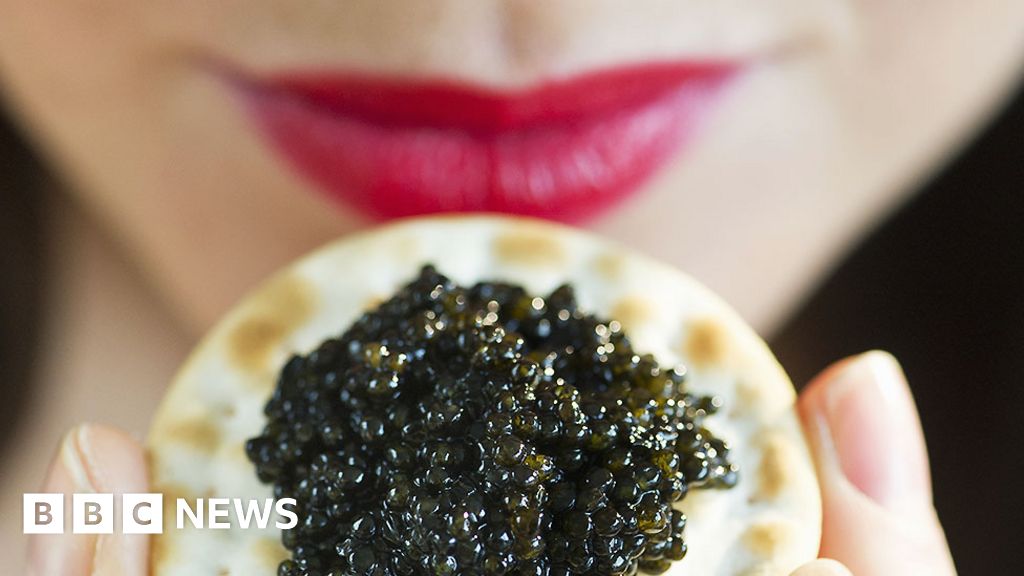










But why is caviar so expensive? At Exmoor, its cheapest tin costs £14, but that only gets you 10 grams – less than a teaspoon’s worth. By contrast, its most expensive costs £4,800 for one kilogram.
Much of the high cost is down to the fact that female sturgeon take a long time to reach egg-laying maturity. For the Siberian sturgeon, the main species farmed at Exmoor, this takes between four and five years. For the white sturgeon at Agroittica Lombarda the females don’t start laying eggs until they are 14 years old.
Critics of sturgeon farms, such as People for the Ethical Treatment of Animals, argue that farming any fish is cruel, as it keeps them in an artificially confined space. The female sturgeons are also generally killed before their eggs are harvested.
“Caviar is something no-one needs,” says Sascha Camilli, Peta’s senior PR coordinator. “On fish farms, sturgeons are smashed together to swim in crowded, barren tanks, or netted areas polluted with the waste from thousands of fish.”
The caviar industry counters that the sturgeon meat is also sold for eating, that farmed stocks can bolster critically endangered wild numbers, and that the welfare of the fish has to be their main priority.
Exmoor’s chief executive Kenneth Benning says that, despite the recent boom, there is no certainty that caviar sales will continue to rise so strongly because demand for the expensive premium product is greatly affected by economic uncertainty.
“The reality is that disposable income is [likely] going to be less, particularly in the UK,” he says. “There’s a lot of people out there in the world who basically cannot justify spending £20 on a 10 gram tin.
“We’ve been on an upward trajectory, but I think that that’s from the marketing perspective, and from building customers who’ve come back to buy the product again.”