


 PA Media
The prime minister has rejected any suggestion that the UK must choose between closer ties with the US or the European Union, when Donald Trump returns to the White House.
Sir Keir Starmer said his government would “never turn away” from its partnership with the US, and also promised to build stronger bonds with Europe.
He also stressed the world faced “dangerous times”, saying stability was essential for growth, so the UK must continue to back Ukraine against Russia.
There’s long been speculation the US president-elect may launch a trade war against Europe and reduce support for Ukraine, even Nato.
In such circumstances, analysts suggest Britain would come under pressure to take sides.
Starmer’s comments came after a close ally of Donald Trump said Britain would have to choose between the US and UK’s “special relationship” and closer ties to the EU – which Trump describes as a “mini China”.
Sir David Manning, former UK ambassador to the US, said it was “in the national interest” to have a good relationship with the US and Europe.
“It’s going to be a question of steering our interests between the two poles,” he told the BBC’s Today Programme.
But he said it was “no good pretending to see eye to eye” on issues such as Ukraine and the Middle East, saying the UK will have to respond to what Trump imposes.
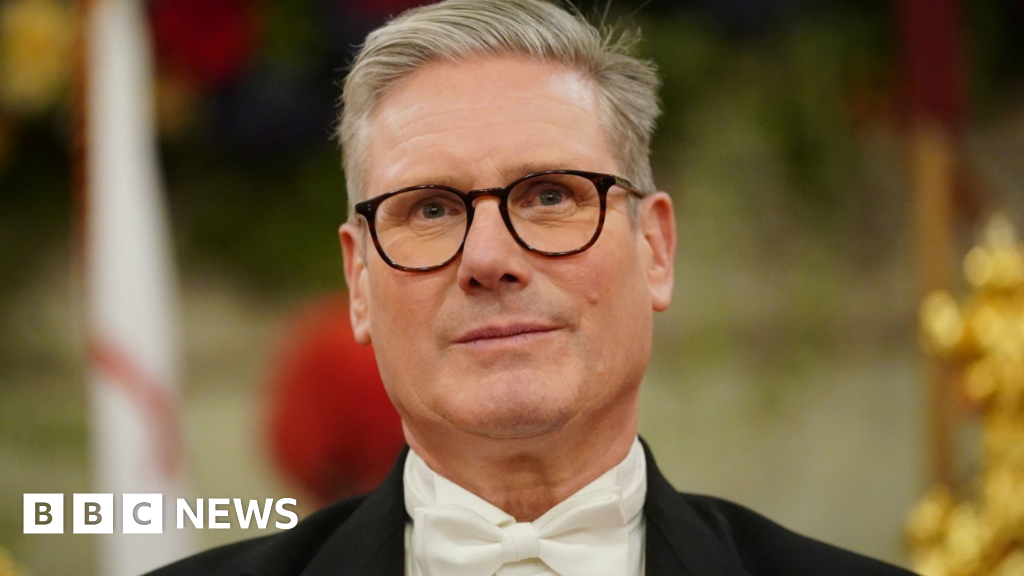
Speaking at the Lord Mayor’s Banquet in London’s Guildhall, an annual event held by the City of London Corporation and where the PM traditionally speaks on international issues, Sir Keir set out how the UK would now “stand tall on the world stage”.
“Against the backdrop of these dangerous times, the idea that we must choose between our allies, that somehow we’re with either America or Europe, is plain wrong,” he said.
“I reject it utterly. Attlee did not choose between allies. Churchill did not choose.
“The national interest demands that we work with both.”
He added: “There is no growth without security – and no security without alliances.”
Earlier this month, a senior economic adviser to Trump urged the UK to align itself with the US on trade, rather than pursue closer ties with the EU.
Stephen Moore suggested the US would be “less interested” in a free trade deal with Britain if the government put its economic relations with Brussels ahead of those with Washington.
Sir Keir praised the incoming US leader as gracious, adding that he told him during their meeting in New York in September that the UK “will invest more deeply than ever in this transatlantic bond with our American friends in the years to come”.
The PM also repeated his promise to rebuild and renew ties with Europe, which he said were vital to Britain’s security and prosperity.
He insisted it is “deeply in our self-interest” to support Ukraine against Russian president Vladimir Putin because “the future of freedom in Europe is being decided today”.
The UK is now “determined to fight harder on the world stage for our national interests and ready to dig deeper to defend them”, he said, because a win for Putin would damage “our own security, stability and prosperity”.
“So we must continue to back Ukraine and do what it takes to support their self-defence for as long as it takes,” he said.
Supporting allies was what former prime ministers Clement Attlee and Winston Churchill had done, he said, adding that he thought of the Attlee government of 1945 and its ambition to build “a country fit for heroes”.
“And they saw that maintaining our strength abroad gave us the foundation to succeed at home. That is as true today as it was then,” he said.
Now was the time, Sir Keir said, to “strengthen our security as the bedrock on which the economy rests – and the ultimate guarantor of everything we hold dear”.
Such words may be tested come January if the US imposes tariffs on European goods and demands the continent trades less with China, all while forcing Ukraine to cede territory.
However, Conservative Party co-chair Nigel Huddleston said it was Sir Keir’s government that had “set our country back” since Labour took power five months ago.
He said: “From driving business confidence to near-record lows, working people punished with a jobs tax, growth projections slashed, and a dash to surrender British interests overseas – it’s no wonder he’s been forced into a desperate reset.”


