












 BBC
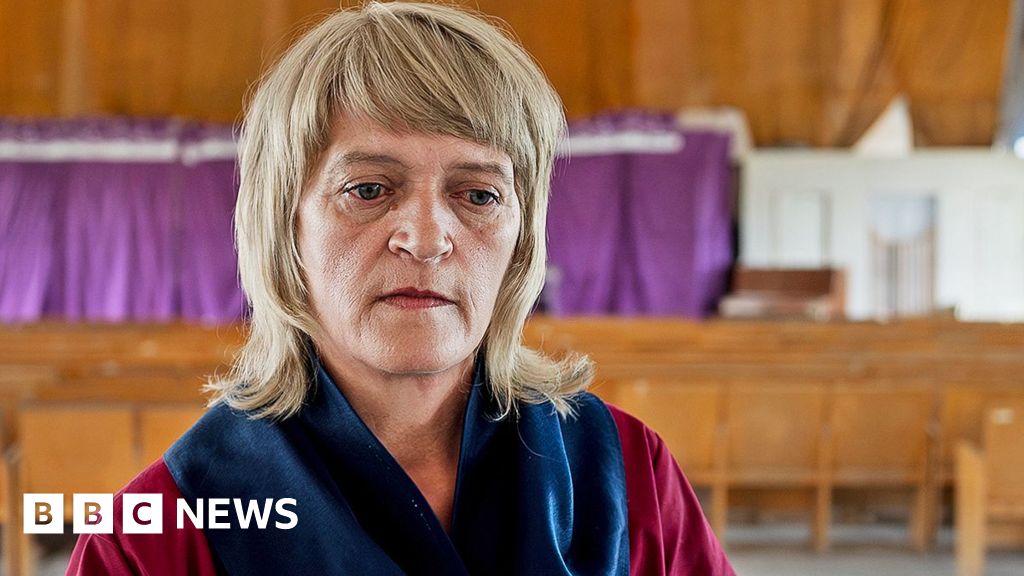
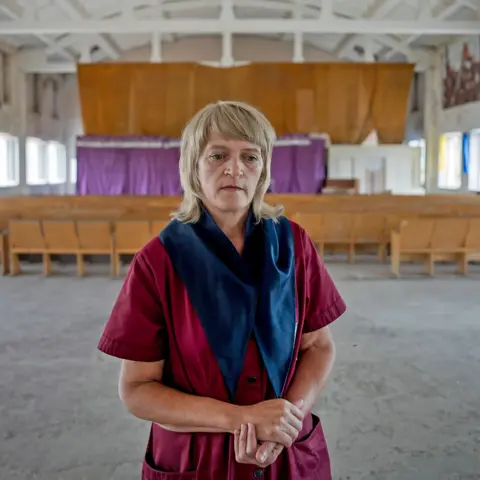
BBC“I don’t deserve to be here at all” is a protestation you would expect to hear from someone in prison. But, as she sits in her maroon overalls, Tetyana Potapenko is adamant that she is not who the Ukrainian state says she is.
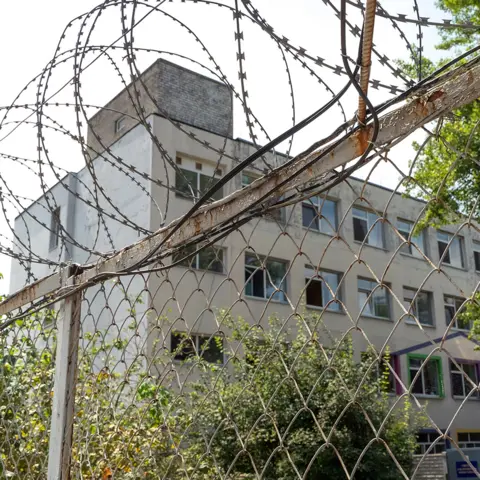
One year into a five-year sentence, she is one of 62 convicted collaborators in this prison, held in isolation from other inmates.
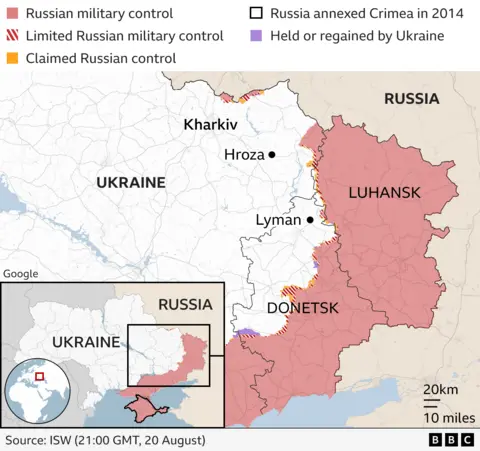
The prison is near Dnipro, about 300km (186 miles) from Tetyana’s home town of Lyman. Close to the front lines of the Donbas, Lyman was occupied for six months by Russia and liberated in 2022.
As we sit in the pink-walled room where inmates can phone home, Tetyana explains that she had been a neighbourhood volunteer for 15 years, liaising with local officials – but that carrying on those duties once the Russians arrived had cost her dearly.
Ukrainian prosecutors claimed she had illegally taken an official role with the occupiers, which included handing out relief supplies.
“Winter was over, people were out of food, someone had to advocate,” she says. “I could not leave those old people. I grew up among them.”

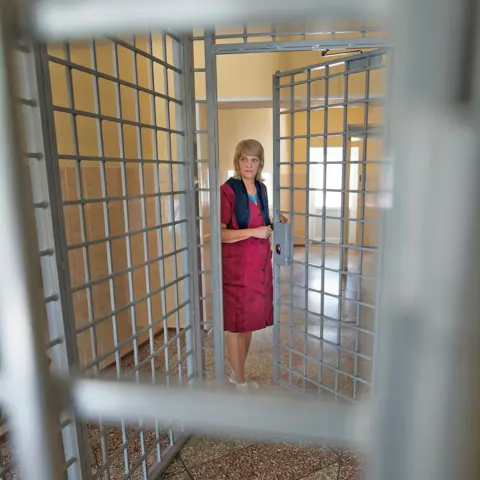
The 54-year-old is one of almost 2,000 people convicted of collaborating with the Russians under legislation drafted nearly as quickly as Moscow’s advance in 2022.
Kyiv knew it had to deter people from both sympathising and co-operating with the invaders.
And so, in a little over a week, MPs passed an amendment to the Criminal Code, making collaboration an offence – something they had failed to agree on since 2014, when Russia annexed Ukraine’s Crimean peninsula.
Before the full-scale invasion, Tetyana used to liaise with local officials to provide her neighbours with materials such as firewood.
Once the new Russian rulers were in place, she says she was convinced by a friend to also engage with them to secure much-needed medicines.
“I didn’t co-operate with them voluntarily,” she says. “I explained disabled people couldn’t access the drugs they needed. Someone filmed me and posted it online, and Ukrainian prosecutors used it to claim I was working for them.”
After Lyman was liberated, a court was shown documents she had signed that suggested she had taken an official role with the occupying authority.
She suddenly becomes animated.
“What’s my crime? Fighting for my people?” she asks. “I never worked for the Russians. I survived and now find myself in prison.”
The 2022 collaboration law was drawn up to prevent people from helping the advancing Russian army, explains Onysiya Syniuk, a legal expert at the Zmina Human Rights Centre in Kyiv.
“However, the legislation encompasses all kinds of activities, including those which don’t harm national security,” she says.
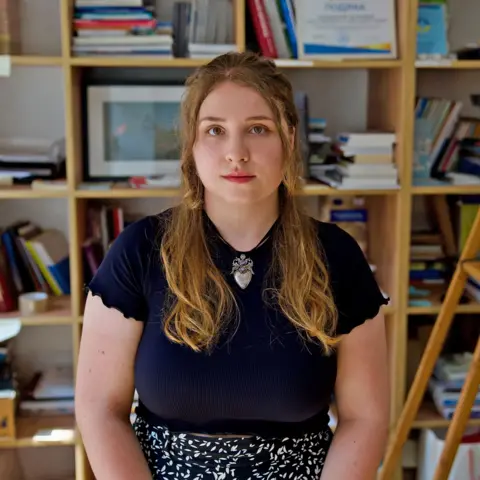
Collaboration offences range from simply denying the illegality of Russia’s invasion, or supporting it in person or online, to playing a political or military role for the occupying powers.
Accompanying punishments are tough too, with jail terms of up to 15 years.
Out of almost 9,000 collaboration cases to date, Ms Syniuk and her team have analysed most of the convictions, including Tetyana’s, and say they are concerned the legislation is too broad.
“Now people who are providing vital services in the occupied territories will also fall liable under this legislation,” says Ms Syniuk.
She thinks lawmakers should take into account the reality of living and working under occupation for more than two years.
We drive to Tetyana’s home town to visit her frail husband and disabled son. As we near Lyman, the scars of war are clear.
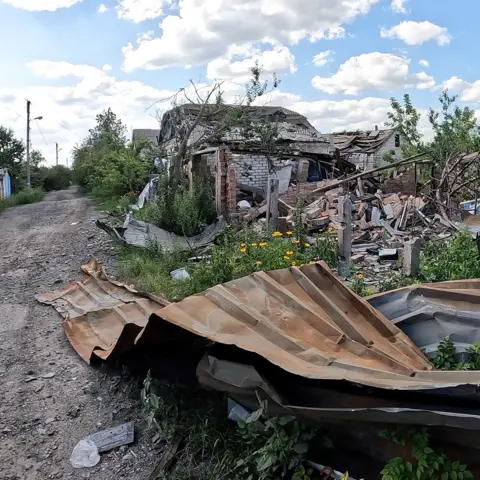
Civilian life drains away and vehicles gradually turn a military green. Droopy power lines hang from collapsed pylons and the main railway has been swallowed by overgrown grass.
While the sunflower fields are unscathed, the town isn’t. It has been bludgeoned by airstrikes and fighting.
The Russians have now moved back to within nearly 10km (6 miles). We were told they usually start shelling at about 15:30, and the day we visited was no exception.
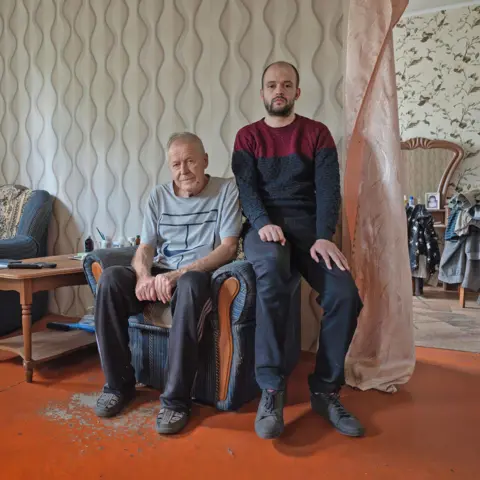
Tetyana’s husband, Volodymyr Andreyev, 73, tells me he is “in a hole” – the household is falling apart without his wife, and he and his son only manage with the help of neighbours.
“If I were weak, I would burst into tears,” he says.
He struggles to understand why his wife is not with him.
Tetyana might have received a shorter sentence had she admitted her guilt, but she refuses. “I will never admit that I am an enemy of state,” she says.
But there have been enemies of state – and their actions have had deadly consequences.
Last autumn, we walked on the bloodstained soil of the liberated village Hroza in the Kharkiv region of eastern Ukraine. A Russian missile had hit a cafe where the funeral of a Ukrainian soldier was taking place – it had been impossible to hold the service while Hroza was under Russian occupation.
Fifty-nine people – almost a quarter of Hroza’s population – were killed. We knocked on doors to find children alone at home. Their parents weren’t coming back.
The security service later revealed that two local men, Volodymyr and Dmytro Mamon, had tipped off the Russians.
The brothers were former police officers who had allegedly begun working for the occupying force.
When the village was liberated they fled across the border with Russian troops, but stayed in touch with their old neighbours – who unwittingly told them about the upcoming funeral.
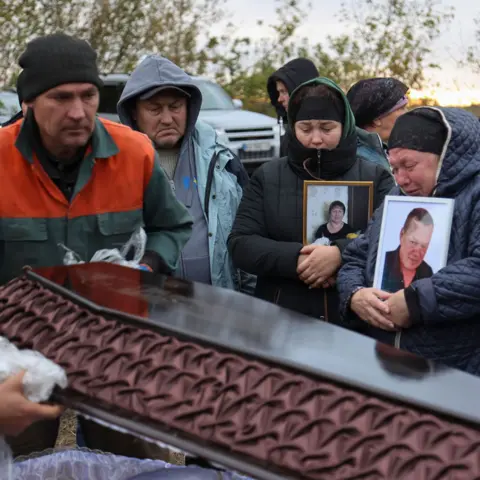 YAKIV LIASHENKO/EPA-EFE/REX
The brothers have since been charged with high treason – but are unlikely to be jailed in Ukraine.
That is broadly the story of Kyiv’s battle with collaborators. Those who commit more serious crimes – guiding attacks, leaking military information or organising sham referendums to legitimise occupying forces – are mostly tried in absentia.
Those facing less serious charges are often the ones who end up in the dock.
Under the Geneva Convention, occupying Russian forces have to allow and provide the means for people to continue living their lives.
Just as Tetyana Potapenko says she tried to do, when troops moved into Lyman in May 2022.
Her case is one of several we have uncovered across eastern Ukraine.
They include a school principal jailed for accepting a Russian curriculum – his defence, his lawyer says, was that although he had accepted Russian materials, he didn’t use them. And in the Kharkiv region, we heard about a sports stadium manager facing 12 years in prison for continuing to host matches while under occupation. His lawyer says he had only organised two friendly matches between local teams.
In the eyes of the United Nations (UN), these collaboration convictions breach international humanitarian law. A third of those handed down in Ukraine from the start of the war in February 2022 until the end of 2023 lacked a legal basis, it says.
“Crimes have been carried out on occupied territory, and people need to be held to account for the harm they’ve done to Ukraine – but we’ve also seen the law applied unfairly,” says Danielle Bell, the head of the UN’s Human Rights Monitoring Mission in the country.
Ms Bell argues that the law doesn’t consider someone’s motive, such as whether they are actively collaborating, or trying to earn an income, which they are legally allowed to do. She says everyone is criminalised under its vague wording.
“There are countless examples where people have acted under duress and performed functions to simply survive,” she says.
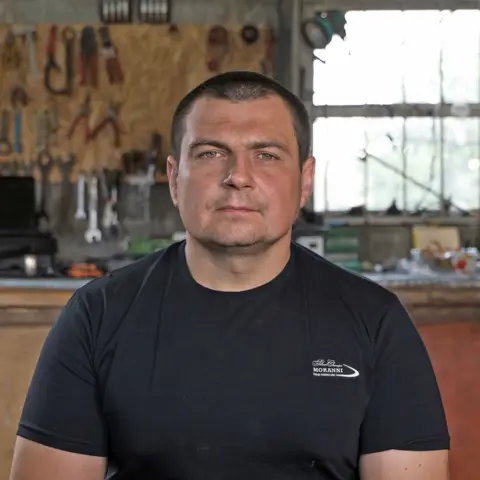
This is exactly what happened to Dmytro Herasymenko, who is from Tetyana’s home town of Lyman.
In October 2022, he emerged from his basement after artillery and mortar fire had subsided. The front line had passed through Lyman, and it was under Russian occupation.
“By that time people had been living without power for two months,” he recalls. Dmytro had worked as an electrician in the town for 10 years.
The occupying authorities asked for volunteers to help restore power, and he stuck up his hand. “People had to survive,” he says. “[The Russians] said I could work like this or not at all. I was afraid of turning them down and being hunted by them.”
For Dmytro and Tetyana, the relief of liberation was brief. After Ukraine took back control of the town, officers from the country’s security service – the SBU – brought them in for questioning.
After admitting to having provided power to the Russian occupiers, Dmytro was swiftly handed a suspended sentence and banned from working as a state electrician for 12 years.
We found him at the garage where he now works as a mechanic. Shiny tools reflect his enforced career change. “I can’t be judged in the same way as collaborators who help guide missiles,” he says.
His protests echoed Tetyana’s. “What can you feel when a foreign army moves in?” she asked. “Fear of course.”
Such fear is justified. The UN has found evidence of Russian forces targeting and even torturing people supporting Ukraine.
“We’ve had cases of individuals being detained, tortured, disappeared, simply for expressing pro-Ukrainian views,” says the UN’s Ms Bell.
From the moment Moscow invaded Crimea in 2014, the definition of being “pro-Russian” changed in the eyes of Ukrainian lawmakers – from simply favouring closer national ties, to supporting a Russian invasion seen as genocidal.
That same year, Russian proxy forces – funded by the Kremlin – also occupied a third of the Donetsk and Luhansk regions.
It is often the elderly who choose to, or are forced to, live under occupation. Some may be too frail to leave.
There will also be those with Soviet nostalgia or sympathy with modern-day Russia.
But given how Ukraine might one day have to reunite, does the collaboration law come down too hard?
The message from one MP who helped draw it up is blunt: “You’re either with us, or against us.”
Andriy Osadchuk is the deputy head of the parliamentary committee on law enforcement. He strongly disagrees that the legislation breaks the Geneva Convention, but accepts it needs improvement.
“The consequences are extremely tough, but this isn’t a regular crime. We are talking about life and death,” he says defiantly.
Mr Osadchuk believes it is, in fact, international law which has to catch up with the war in Ukraine, not the other way round.
“We need to build Ukraine on liberated territories, and not make someone happy from the outside world,” he says.
The UN monitoring mission admits there have been some improvements. Ukraine’s prosecutor general has recently instructed his offices to comply with international humanitarian law while investigating collaboration cases.
Ukraine’s parliament is also planning to add more amendments to the legislation in September. One suggested change would see some people issued with fines instead of prison sentences.
For now, Kyiv sees the likes of Tetyana and Dmytro as acceptable recipients of tough justice, if it means Ukraine can finally be free of Russia’s grasp.
The pair claim they only regret not escaping when the Russians moved in the first time.
But with the state breathing down their necks and Lyman at risk of falling once more, it’s not clear how candid they can be.
Additional reporting by Hanna Chornous, Aamir Peerzada and Hanna Tsyba.
All BBC images by Lee Durant.