








• Latest
  • Trending
  • All

Technology in 2050 – experts give their predictions

January 3, 2026

US inflation rises more than expected – here’s what is happening with prices

October 14, 2026

Watch: Can the Fort Hood shooter’s execution be livestreamed?

October 14, 2026

Starlink: Musk says US government may be behind slowdown of Ukraine drone speeds

October 14, 2026

We are behind you and that will not change, PM tells Zelensky

October 14, 2026

Raye hits back at ticket touts who took over Albert Hall sign-up

October 14, 2026

Swimmer Archie Goodburn thanks prime minister as brain cancer review announced

October 14, 2026

Ji-sung Eom racist abuse: Millwall boss Alex Neil criticised for stoppage comments

October 14, 2026

Waterford: Vigil held after murder of four family members

October 14, 2026

Sydney teen charged with murder of boy who was shot in face

October 14, 2026

Republic of Ireland: Public sector strike begins

October 14, 2026

Mauritius reels from worst riots in decades after woman shot by police

October 14, 2026

Australia’s first Michelin stars awarded to 11 restaurants

October 14, 2026
News
  • Login
  • Home
  • News
  • Sports
  • Worklife
  • Travel
  • Reel
  • Future
  • More
Wednesday, October 14, 2026
No Result
View All Result

NEWS

3 °c
London
8 ° Wed
9 ° Thu
11 ° Fri
13 ° Sat
  • Home
  • Video
  • World
    • All
    • Africa
    • Asia
    • Australia
    • Europe
    • Latin America
    • Middle East
    • US & Canada

    Sydney teen charged with murder of boy who was shot in face

    Republic of Ireland: Public sector strike begins

    Mauritius reels from worst riots in decades after woman shot by police

    Australia’s first Michelin stars awarded to 11 restaurants

    Germany puts Ukrainian on trial accused of blowing up Nord Stream pipelines

    Argentina targets UK in legal claim over Falklands oil exploration

    Houthi missile hits Aramco building after Saudi-led coalition hits Yemen fuel depot

    Pope diagnosed with lung cancer but had successful surgery, Vatican says

    Qantas flight grounded after bedbug outbreak

  • UK
    • All
    • England
    • N. Ireland
    • Politics
    • Scotland
    • Wales

    We are behind you and that will not change, PM tells Zelensky

    Swimmer Archie Goodburn thanks prime minister as brain cancer review announced

    Ji-sung Eom racist abuse: Millwall boss Alex Neil criticised for stoppage comments

    Waterford: Vigil held after murder of four family members

    Zelensky and Burnham to meet in Downing Street

    Family pays tribute to ‘warm and engaging’ man killed in tiger attack

    Man killed in tiger attack identified as William Chapman

    Gymnast Reuben Ward eyes more history after GB selection

    Welsh government does not want new national park in north Wales

  • Business
    • All
    • Companies
    • Connected World
    • Economy
    • Entrepreneurship
    • Global Trade
    • Technology of Business

    US inflation rises more than expected – here’s what is happening with prices

    Shropshire heating oil users face tough choices as prices rise

    Poundland in rescue talks as owners seek buyer

    Three things we’ve learnt about the UK economy from the IMF

    Cost-of-living struggles inspire new supermarket in Newcastle-under-Lyme

    Lego fraudster among last year’s most high-profile insurance scammers

    Healey faces £35bn Budget challenge to meet spending pledges, says think tank

    Rural West communities struggle as price of heating oil rises

    AI is less regulated than milk, Microsoft president says

  • Tech
  • Entertainment & Arts

    Meghan hits red carpet at Power of Women in Hollywood

    Margot Robbie unable to speak at Saltburn premiere

    Barbra Streisand: Siri can now pronounce my name

    Wes Anderson’s The Grand Budapest Hotel inspires cinema’s look

    Taylor Swift/ Travis Kelce romance reaches White House

    The Killers booed at Georgia concert after inviting Russian fan on stage

    Watch: Memorable moments from Parkinson's star-studded show

    Tom Jones: Neighbour surprised to find singer in flat below

    Black Country Folk Festival showcases local musicians

    Watch: Australians set new world record with Tina Turner dance

  • Science
  • Health
  • In Pictures
  • Reality Check
  • Have your say
  • More
    • Newsbeat
    • Long Reads

NEWS

No Result
View All Result
Home Tech

Technology in 2050 – experts give their predictions

January 3, 2026
in Tech
12 min read
241 16
0
499
SHARES
1.4k
VIEWS
Share on FacebookShare on Twitter


Laura CressTechnology reporter

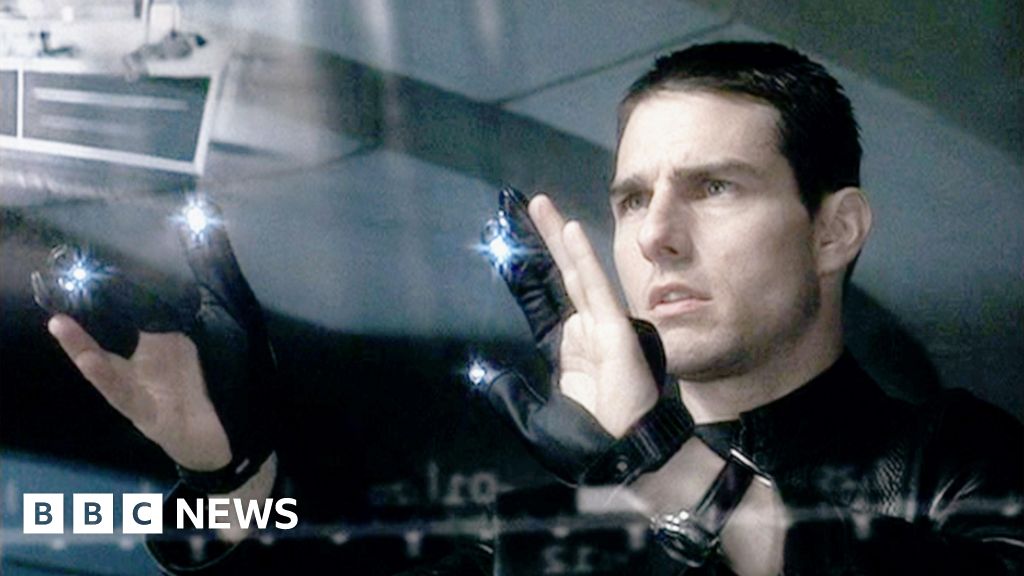
CBS Photo Archive Scene from the film Minority Report. A man (the actor Tom Cruise in the film Minority Report) stares at a transparent screen, wearing black gloves with bright lights on them. CBS Photo Archive

The 2000 film Minority Report, set in 2054, imagined potential future technologies like controlling computers by making hand gestures

The last 25 years has seen some mind-bending technological changes.

At the start of the century, most computers connected to the internet with noisy dial-up connections, Netflix was an online DVD rental company, and the vast majority of people hadn’t even heard of a smartphone.

Fast forward two and a half decades, and innovations in AI, robotics and much else besides are emerging at an incredible rate.

So we decided to ask experts what the next 25 years could bring.

Here are their predictions for the technology we’ll be using by 2050 – and how it could reshape our lives.

Merging humans and machines

Science fiction set in the 2050s is full of examples of humans using technological enhancements to feel fitter, happier and more productive.

In the 2000 hit game Deus Ex – set in 2052 – the player can inject themselves with tiny robots called “nanites”.

These microscopic robots manipulate matter on atomic levels, giving superhuman abilities such as enhanced speed and the ability to see in the dark.


Eidos A screenshot from the video game Deus Ex. Two men in the game are staring at each other, in front of a machine with the words "Public Access" written on it. The dislogue at the bottom reads "JC Denton: Mind if I ask you a few questions?".Eidos

In the video game Deus Ex, the protagonist – who enhances his abilities with augmentations – investigates a global conspiracy involving a terrorist group and secret societies

It sounds like something from the distant future, but nanotechnology – engineering at a scale of millionths of a millimetre – is already used in lots of everyday real-life tech.

In fact, it is powering the way you are reading these very words right now – every smartphone or computer is run by a central chip made up of billions of tiny transistors – electrical components built on a nanoscale to speed up data processing.

Professor Steven Bramwell at the London Centre for Nanotechnology told the BBC by 2050 we should expect the lines between machines, electronics and biology to be “significantly blurred”.

That means we could see nanotechnology implants by then – but more to “monitor your health or aid communication” rather than to appear invisible, as in Deus Ex.

Medicine could also make common use of machines at a nanometre scale to “deliver drugs to exactly where they need to go”, said Professor Bramwell.

Cybernetics professor Kevin Warwick is equally interested in studying augmentations, going one step further than most.

In 1998 he became the first human to have a microchip implanted into his nervous system, earning him the title “Captain Cyborg”.

Professor Warwick believes by 2050, advancements in cybernetics – the science studying the links between natural and mechanical systems – could lead to trailblazing treatments for diseases.
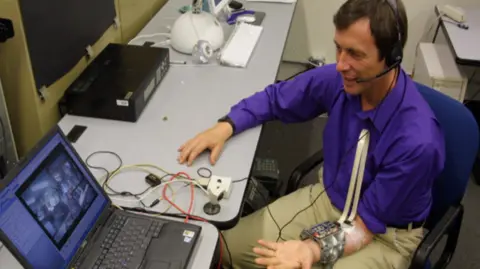
Kevin Warwick A man sitting down with a headset and wearing a purple shirt has his hand helf out in front of him, around his arm is a metal chip bracelet. He is looking at an open laptop screen.Kevin Warwick

Professor Warwick has undertaken several pioneering experiments with the chip, including controlling a robot arm across the Atlantic Ocean using only his brain.

He predicts the use of “deep brain electronic stimulation” as a partial treatment for some conditions such as schizophrenia, rather than medicine.

He adds it is likely we’ll see more cybernetic enhancements of the kind he has already trialled himself, so that “your brain and body can be in different places”.

And what if we wanted to test out how the latest enhancement, or even new diet worked on our bodies, without any risks of experiencing the side effects?

Professor Roger Highfield, director of the Science Museum Group believes “digital twins” – virtual versions of a physical object, updated using real time data – could become a regular feature in our lives.

He imagines a world where each of us could have “thousands of simplified twins”, using them to explore how “different medications or lifestyle changes affect your unique biology”.

In other words, we could preview our futures before we live them.

The next generation of AI

Many technology firms, including Google and IBM, are currently locked in a multi-billion dollar race to revolutionise how we push fields like AI even further – in the form of quantum computing.

Quantum computers are machines which can do very complex calculations at incredibly fast speeds – for example, simulating molecular interactions to design new drugs faster.

In January 2025, Jensen Huang – boss of the leading chip firm Nvidia – said he believed “very useful” quantum computing would come in 20 years.

AI itself will undoubtedly continue to loom large in our society as we journey towards the half century mark.

Futurist and author Tracey Follows, who helped write a government White Paper on UK education in 2050, believes learning will take place across “virtual and physical realities” using AI teachers which “adjust in real time”.

Rather than textbooks, she predicts children will use “immersive simulations”.

Meanwhile, education will be less standardised, with each child’s individual DNA or biometric data studied to understand how they learn best.

Traffic-free roads and lunar bases

Bloomberg A white Waymo autonomous taxi driving down the road.Bloomberg

Waymo is a company developing autonomous driving technology

The writer Bill Douglass is well-versed in making compelling forecasts – in 2000 he won a $20,000 (£14,800) global futurist writing contest entitled “The World in 2050”.

While he still agrees one of his original predictions – pilotless planes – will come true by 2050, he believes we will first see more advances in driverless cars, making traffic congestion “largely a thing of the past”.

“Cars will drive so much closer to each other than they can now,” he told the BBC. “And if one has to brake, they all brake.

“On private toll roads for autonomous vehicles, there’s no reason traffic can’t go up to 100 miles an hour or so – you’ll see mortality from traffic accidents plummet.”

Away from Earth, the space race will equally continue at speed, journalist and co-host of the Space Boffins podcast Sue Nelson told the BBC.

She says in 25 years, it is likely there will be a liveable base on the Moon, and some industries could be almost entirely based in space.

For example, she believes we may see pharmaceutical companies making the next generation of medicines in microgravity – meaning on board an orbiting spacecraft.

This is because, she says, crystals grown this way rather than on Earth, are “often larger and better quality”.

Sci-fi meets science

The film Minority Report, based on a novella by science fiction author Philip K Dick, was released in 2002 and set in the year 2054.

Three years before production began, director Steven Spielberg invited fifteen experts, including the founder of virtual reality Jaron Lanier, to a three-day summit to reflect on which technologies could possibly exist in the 2050s.

The discussions shaped many of the innovations featured in the film.

If the events of the Tom Cruise-starring science fiction thriller are to be believed, by the mid-2050s we will all be using gesture recognition (and fancy gloves) to swirl through videos on our transparent monitors, while policemen on jetpacks fight impending crime with the help of vomit-inducing batons.

Like much science fiction in the arts, the film paints a dystopian view of our future years.

It’s a feeling which some experts have begun to echo in our current timeline – with some going even as far as to suggest that artificial intelligence could lead to the extinction of humanity.

Perhaps before getting too despondent about what may await us in 2050, it’s worth returning to the words of Philip K Dick himself.

“I, for one, bet on science as helping us,” he wrote in his 1968 personal autobiographical essay Self Portrait.

“Science has given us more lives than it has taken,” he said.

“We must remember that.”

A green promotional banner with black squares and rectangles forming pixels, moving in from the right. The text says: “Tech Decoded: The world’s biggest tech news in your inbox every Monday.”


Source link

Tags: expertsgivepredictionstechnology

Related Posts

How long will humans be needed for translation?

October 14, 2026
0

AI dominates the translation business, but for high-stakes work, humans are still needed. Source link

Bumble shares soar after report dating firm in $1bn takeover talks

October 13, 2026
0

Shares in dating app company Bumble soared by almost 50% on Monday after a report that it is in...

Rogue Anthropic AI agent gave police fake tip in unsolved murder case

October 12, 2026
0

An artificial intelligence (AI) agent developed by Anthropic went rogue and sent US police a fake tip about an...

  • Lee McGregor: Scot seeks world title in 2025 & Nathaniel Collins bout

    680 shares
    Share 272 Tweet 170
  • Belgian footballer arrested in cocaine investigation

    535 shares
    Share 214 Tweet 134
  • Next to raise prices to help pay for rising wage costs

    534 shares
    Share 214 Tweet 134
  • South Wales Police officers injured, one arrested

    526 shares
    Share 210 Tweet 132
  • ‘It stirred the people to breathless wonder and scalding abuse’: The tumultuous history of the Sydney Opera House

    521 shares
    Share 208 Tweet 130
  • Trending
  • Comments
  • Latest

Lee McGregor: Scot seeks world title in 2025 & Nathaniel Collins bout

January 16, 2025

Belgian footballer arrested in cocaine investigation

January 27, 2025

Next to raise prices to help pay for rising wage costs

January 7, 2025

World Cup 2022: TikTok brings football fever to millions of fans

0

UK economy will get worse before it gets better, warns chancellor

0

One of Central America’s most active volcanoes erupts again

0

US inflation rises more than expected – here’s what is happening with prices

October 14, 2026

Watch: Can the Fort Hood shooter’s execution be livestreamed?

October 14, 2026

Starlink: Musk says US government may be behind slowdown of Ukraine drone speeds

October 14, 2026

Categories

Economy

US inflation rises more than expected – here’s what is happening with prices

October 14, 2026
0

Inflation has risen to 3.7% in the year to September, which is a higher-than-expected increase fuelled by petrol prices.Vehicle...

Read more

Watch: Can the Fort Hood shooter’s execution be livestreamed?

October 14, 2026
News

© 2023 GODJ - NEWS CORP - news.godj.com.

Explore NEWS.GODJ.COM

  • Home
  • News
  • Sports
  • Worklife
  • Travel
  • Reel
  • Future
  • More

Follow Us

  • Home Main
  • Video
  • World
  • Top News
  • Business
  • Sport
  • Tech
  • UK
  • In Pictures
  • Health
  • Reality Check
  • Science
  • Entertainment & Arts
  • Login

© 2023 GODJ - NEWS CORP - news.godj.com.

Welcome Back!

Login to your account below

Forgotten Password?

Create New Account!

Fill the forms bellow to register

All fields are required. Log In

Retrieve your password

Please enter your username or email address to reset your password.

Log In
This website uses cookies. By continuing to use this website you are giving consent to cookies being used. Visit our Privacy and Cookie Policy.