







• Latest
  • Trending
  • All

New bone test could rewrite British history, say scientists

January 1, 2025

Business Daily – Taking Stock: The cost of heatwaves

August 14, 2026

Major oil slick washes up on Iran coast after Hormuz ship strike

August 14, 2026

Rare breeding bat found roosting near South Yorkshire reservoir

August 14, 2026

Killer who will not say where wife's body is to stay in prison

August 14, 2026

Amy Hunt: Can getting glammed up really improve your performance?

August 14, 2026

Arrests and road closed over suspected abduction in East Lothian

August 14, 2026

Tân mawr ger Llanymddyfri yn gorfodi nifer o bobl i adael eu tai

August 14, 2026

Ardoyne: Police defend response to north Belfast incidents

August 14, 2026

Australia v Bangladesh: Steve Smith benefits from reprieve but tourists dominate day one of first Test

August 14, 2026

Builders unearth €9m gold loot sealed in walls of Belgian property

August 14, 2026

Chad’s Succès Masra: Former prime minister given state pardon

August 14, 2026

Japan: Record rain in Chiba kills eight as thousands stranded at Narita Airport

August 14, 2026
News
  • Login
  • Home
  • News
  • Sports
  • Worklife
  • Travel
  • Reel
  • Future
  • More
Friday, August 14, 2026
No Result
View All Result

NEWS

3 °c
London
8 ° Wed
9 ° Thu
11 ° Fri
13 ° Sat
  • Home
  • Video
  • World
    • All
    • Africa
    • Asia
    • Australia
    • Europe
    • Latin America
    • Middle East
    • US & Canada

    Australia v Bangladesh: Steve Smith benefits from reprieve but tourists dominate day one of first Test

    Builders unearth €9m gold loot sealed in walls of Belgian property

    Chad’s Succès Masra: Former prime minister given state pardon

    Japan: Record rain in Chiba kills eight as thousands stranded at Narita Airport

    Engine parts smashed Ryanair window that man’s head was sucked out of, report says

    Stolen Matisse artworks recovered by police in Brazil

    Israeli settlers besieging Palestinian families in West Bank village

    Concern grows over conditions on USS Abraham Lincoln

    Australian army whistleblower released on parole after more than two years in jail

  • UK
    • All
    • England
    • N. Ireland
    • Politics
    • Scotland
    • Wales

    Killer who will not say where wife's body is to stay in prison

    Arrests and road closed over suspected abduction in East Lothian

    Tân mawr ger Llanymddyfri yn gorfodi nifer o bobl i adael eu tai

    Ardoyne: Police defend response to north Belfast incidents

    'Welcome to one of the most bizarre by-elections in recent history'

    European Athletics Championships 2026: Amy Hunt wins 200m gold as Dina Asher-Smith claims bronze

    'Releasing my son's killer early would be a slap in the face'

    Richie Berrington and Lyle Robertson star as Scotland crush Canada

    Wrexham XL bully owner Chanel Fong says dog not type to savage anyone

  • Business
    • All
    • Companies
    • Connected World
    • Economy
    • Entrepreneurship
    • Global Trade
    • Technology of Business

    Business Daily – Taking Stock: The cost of heatwaves

    US says dozens of countries helped China dodge Trump’s tariffs

    RBSI announces around 50 job cuts in Jersey

    UK economy grows but experts warn of challenging months ahead

    Twitch users can now block Amazon from using their content to train AI

    Burnham warned Iran war could hit UK growth next year

    First wave of ‘pounds for pylons’ energy discount sites revealed

    Trump Media reports $238m loss as crypto falls

    You could be missing out on £150 off your energy bill – here’s how to check

  • Tech
  • Entertainment & Arts

    Meghan hits red carpet at Power of Women in Hollywood

    Margot Robbie unable to speak at Saltburn premiere

    Barbra Streisand: Siri can now pronounce my name

    Wes Anderson’s The Grand Budapest Hotel inspires cinema’s look

    Taylor Swift/ Travis Kelce romance reaches White House

    The Killers booed at Georgia concert after inviting Russian fan on stage

    Watch: Memorable moments from Parkinson's star-studded show

    Tom Jones: Neighbour surprised to find singer in flat below

    Black Country Folk Festival showcases local musicians

    Watch: Australians set new world record with Tina Turner dance

  • Science
  • Health
  • In Pictures
  • Reality Check
  • Have your say
  • More
    • Newsbeat
    • Long Reads

NEWS

No Result
View All Result
Home Science

New bone test could rewrite British history, say scientists

January 1, 2025
in Science
8 min read
251 2
0
492
SHARES
1.4k
VIEWS
Share on FacebookShare on Twitter


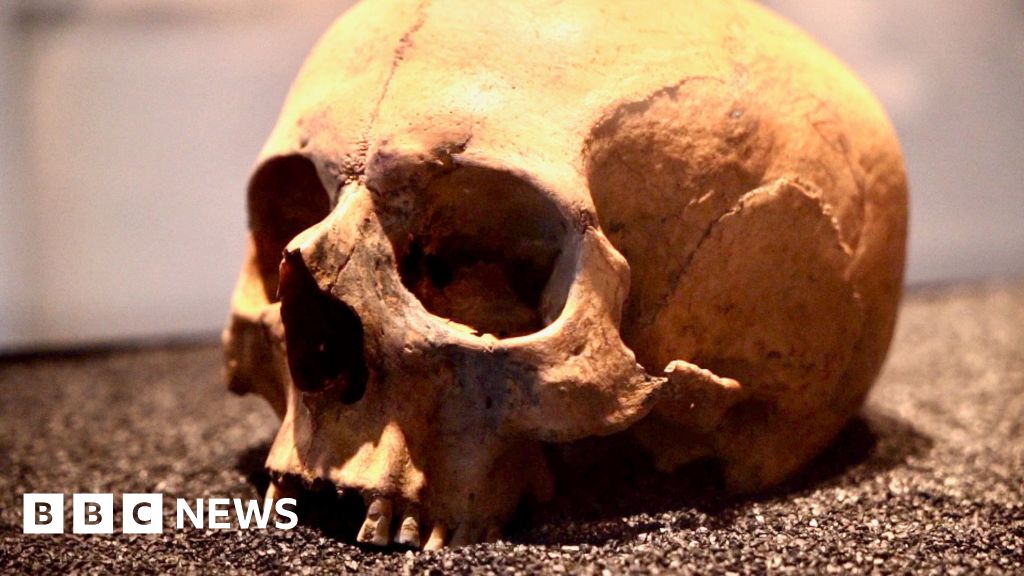
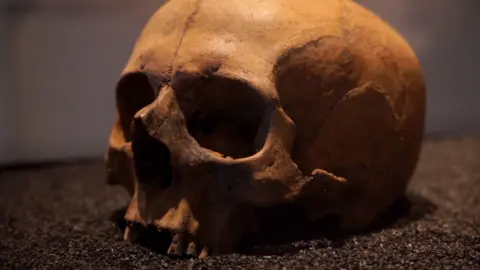
London Museum from 2015 A skull from the Museum of London's collection which is thought to be from shortly after the period Romans occupied Britain. The top half without the bottom jaw, it's bathed in a yellow light and resting on what looks like black earth or sand.London Museum from 2015

A skull from shortly after the period Romans occupied Britain

From the end of the Roman occupation through the Anglo-Saxon and Viking invasions – a new way of testing DNA in ancient bones could force a rethink of key moments in Britain’s early history, say researchers.

Scientists could already track big alterations in DNA that occur over thousands or millions of years, helping us learn, for example, how early humans evolved from ape-like creatures.

Now researchers can identify subtler changes over just hundreds of years, providing clues as to how people migrated and interacted with locals.

They are using the new method to analyse human remains found in Britain, including from the time when Romans were replaced by an Anglo-Saxon elite from Europe.

Prof Peter Heather, from Kings College London, who is working on the project with the developers of the new DNA technique at the Francis Crick Institute in London, said the new technique could be “revolutionary”.

While the project will analyse the DNA of more than 1,000 ancient human remains of people who lived in Britain during the past 4,500 years, researchers have homed in on the time after the Romans left as a particularly interesting era to study.

What happened in this period more than 1,500 years ago is unclear from written and archeological records. Historians are divided in their views about the scale and nature of the Anglo-Saxon invasion, whether it was large or small, hostile or co-operative.

“It is one of the most contested and therefore one of the most exciting things to work on in the whole of British history,” according to Prof Heather.

“[The new method] will allow us to see the type of relations that are being found with the native population,” he said. “Are they co-operative, is there interbreeding, are the locals able to make their way into the elite?”

They are optimistic about the success of the technique, known as Twigstats, after testing it on human remains found in mainland Europe between the years 1 and 1,000 CE.

Much of what they gleaned from the DNA about the spread of the Vikings into Scandinavia tallied with historical records.

This result, published in the journal Nature, confirmed the method worked while showing how powerful it could be at shedding new light on accepted facts when findings didn’t match what was written in the history books.

“That was the moment we got really excited,” said Dr Leo Speidel, who developed the technique with his group leader Dr Pontus Skoglund. “We could see that this could really change how much we can find out about human history.”

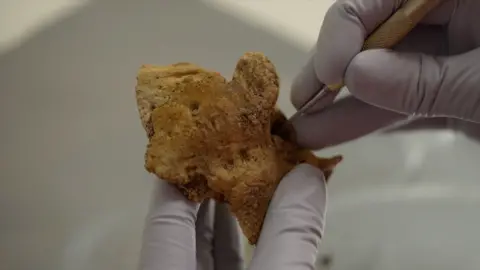
A scientist using an instrument to poke into the ear socket of a skull fragment

Researchers extracting tiny bones from the ear of a skull fragment of a person that lived more than 1,500 years ago in Yorkshire

The problem the researchers were trying to overcome is that a human’s genetic code is extremely long – consisting of 3 billion separate chemical units.

Spotting the small genetic changes in that code which occur over a few generations, for example, as a result of new arrivals interbreeding with the local population, is like looking for a needle in a haystack.

The researchers solved the problem by, as it were, taking away the haystack and leaving the needle in plain sight – they found a way to identify the older genetic changes, disregard them and look only at the most recent alterations.

They combed the genetic data of thousands of human remains from an online scientific database, then calculated how closely they were related to each other, which chunks of DNA were inherited from which groups and when.

This created a family tree with older changes appearing in earlier branches, and more recent changes showing up in newer ‘twigs’, hence the name Twigstats.
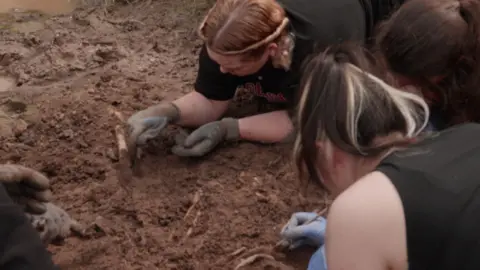
Francis Crick Institute Archaeologists lying in the mud carefully sifting through human remainsFrancis Crick Institute

Archaeologists carefully sifting through bones at an Anglo-Saxon burial site in Poulton in Cheshire which will be analysed using the new technique

Each of the people whose remains will be studied have their own tales to tell and soon scientists and historians will be able to hear their stories, said Dr Skoglund.

“We want to understand many different epochs in European and British history, from the Roman period, when the Anglo-Saxons arrived, through the Viking period and see how this shapes the ancestry and diversity of this part of the World,” he said.

As well as showing up interbreeding with different populations, embedded in the ancient DNA are hugely important details on how people coped with key historical moments, such epidemics, shifts in diet, urbanisation, and industrialisation.
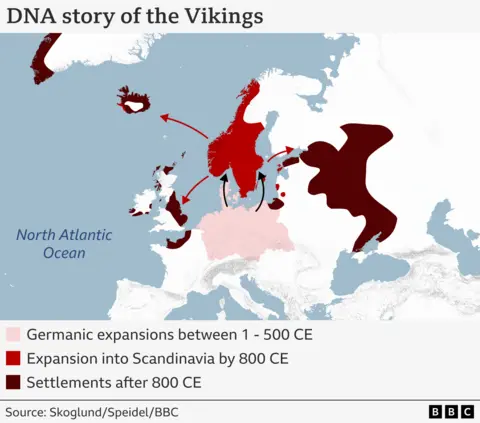
Map of Europe showing three phases of Viking migration based on the new DNA evidence: 1. Expansion out of Germanic regions southwards between 1 - and 500 CE, 2. Movement north to Scandanavia by 800 CE and then settlements after 800 CE.

The spread of the Vikings – one of the key European migrations researchers are studying using the new method

The technique can potentially be applied to any part of the world for which there are a large collection of well preserved human remains.

Prof Heather wants to use it to investigate what he describes as one of European history’s biggest mysteries: why central and eastern Europe changed from being Germanic speaking to Slavic speaking, 1,500 years ago.

“Historical sources show what was the case before and what was the case after, but there is nothing about what happened in between,” he said.

Follow Pallab on Blue Sky and X

The new series of Digging for Britain, featuring one of the Anglo-Saxon burial sites, Poulton Farm, will be available to watch on BBC iPlayer from 7th January 2025.




Source link

Tags: boneBritishhistoryrewriteScientiststest

Related Posts

Rare breeding bat found roosting near South Yorkshire reservoir

August 14, 2026
0

The company said monitoring the bat boxes at the site helped confirm the conservation measures were working and could...

Romania shuts only nuclear plant as heat causes drop in Danube River level

August 13, 2026
0

Romania has shut down its only nuclear power station because of extremely low water levels in the Danube river...

How the West watched most historic solar eclipse since 1999

August 12, 2026
0

Thousands of people from across the West of England stood or sat completely still on Wednesday evening to watch...

  • Lee McGregor: Scot seeks world title in 2025 & Nathaniel Collins bout

    677 shares
    Share 271 Tweet 169
  • Belgian footballer arrested in cocaine investigation

    533 shares
    Share 213 Tweet 133
  • Next to raise prices to help pay for rising wage costs

    532 shares
    Share 213 Tweet 133
  • South Wales Police officers injured, one arrested

    525 shares
    Share 210 Tweet 131
  • Charities to get £15m fund to save surplus farm food

    516 shares
    Share 206 Tweet 129
  • Trending
  • Comments
  • Latest

Lee McGregor: Scot seeks world title in 2025 & Nathaniel Collins bout

January 16, 2025

Belgian footballer arrested in cocaine investigation

January 27, 2025

Next to raise prices to help pay for rising wage costs

January 7, 2025

World Cup 2022: TikTok brings football fever to millions of fans

0

UK economy will get worse before it gets better, warns chancellor

0

One of Central America’s most active volcanoes erupts again

0

Business Daily – Taking Stock: The cost of heatwaves

August 14, 2026

Major oil slick washes up on Iran coast after Hormuz ship strike

August 14, 2026

Rare breeding bat found roosting near South Yorkshire reservoir

August 14, 2026

Categories

Economy

Business Daily – Taking Stock: The cost of heatwaves

August 14, 2026
0

Available for over a yearHow is climate change reshaping the global economy? Rahul Tandon is joined by Carsten Brzeski...

Read more

Major oil slick washes up on Iran coast after Hormuz ship strike

August 14, 2026
News

© 2023 GODJ - NEWS CORP - news.godj.com.

Explore NEWS.GODJ.COM

  • Home
  • News
  • Sports
  • Worklife
  • Travel
  • Reel
  • Future
  • More

Follow Us

  • Home Main
  • Video
  • World
  • Top News
  • Business
  • Sport
  • Tech
  • UK
  • In Pictures
  • Health
  • Reality Check
  • Science
  • Entertainment & Arts
  • Login

© 2023 GODJ - NEWS CORP - news.godj.com.

Welcome Back!

Login to your account below

Forgotten Password?

Create New Account!

Fill the forms bellow to register

All fields are required. Log In

Retrieve your password

Please enter your username or email address to reset your password.

Log In
This website uses cookies. By continuing to use this website you are giving consent to cookies being used. Visit our Privacy and Cookie Policy.