






• Latest
  • Trending
  • All

How Trump’s Africa strategy may become a double-edged sword

June 14, 2025

Does Reform’s plan to cut £50bn in welfare spending add up?

August 17, 2026

Watch: Flood sweeps vehicle away in Hawaii after Hurricane Lala

August 17, 2026

Cambridge chancellor criticises ‘racist feeding frenzy’ around Jason Arday

August 17, 2026

What will ticket arrangements be for Rangers v Celtic in Scottish League Cup?

August 17, 2026

Matthew Rhys: Star Wars yn Gymraeg ‘yr union beth roeddwn i eisiau’n blentyn’

August 17, 2026

Kildare: Boy, seven, among four injured after crash that killed five teenagers

August 17, 2026

Sydney Swans: Aussie rules footy players under investigation as police probe sexual assault claim

August 17, 2026

Russia and Ukraine trade more deadly strikes

August 17, 2026

Zambia elections: Top opposition figures arrested days after presidential vote

August 17, 2026

Indonesia earthquake: Aid shortages and fears of starvation as aftershocks continue

August 17, 2026

Mount Etna: US hiker dies after being struck by lightning on Italian volcano

August 17, 2026

UK diplomats no longer get hardship bonus for being posted to Buenos Aires

August 17, 2026
News
  • Login
  • Home
  • News
  • Sports
  • Worklife
  • Travel
  • Reel
  • Future
  • More
Monday, August 17, 2026
No Result
View All Result

NEWS

3 °c
London
8 ° Wed
9 ° Thu
11 ° Fri
13 ° Sat
  • Home
  • Video
  • World
    • All
    • Africa
    • Asia
    • Australia
    • Europe
    • Latin America
    • Middle East
    • US & Canada

    Sydney Swans: Aussie rules footy players under investigation as police probe sexual assault claim

    Russia and Ukraine trade more deadly strikes

    Zambia elections: Top opposition figures arrested days after presidential vote

    Indonesia earthquake: Aid shortages and fears of starvation as aftershocks continue

    Mount Etna: US hiker dies after being struck by lightning on Italian volcano

    UK diplomats no longer get hardship bonus for being posted to Buenos Aires

    Trump envoy Kushner meets Netanyahu after Hamas talks

    Burnham exchanged messages with person posing as Trump’s chief of staff

    Australian state to begin gun buyback after Bondi Beach attack

  • UK
    • All
    • England
    • N. Ireland
    • Politics
    • Scotland
    • Wales

    Cambridge chancellor criticises ‘racist feeding frenzy’ around Jason Arday

    What will ticket arrangements be for Rangers v Celtic in Scottish League Cup?

    Matthew Rhys: Star Wars yn Gymraeg ‘yr union beth roeddwn i eisiau’n blentyn’

    Kildare: Boy, seven, among four injured after crash that killed five teenagers

    Reform UK benefits ban for foreign nationals would include EU citizens

    The Hundred final: Manchester Super Giants seal victory over Trent Rockets after Tim Seifert’s 72

    Soldiers praised for helping crews tackle wildfires in south Wales

    Scotland: Belgian Sebastien Pocognoli confirmed as new head coach

    Actor Nathan Sussex ’emotional’ over Coronation Street role

  • Business
    • All
    • Companies
    • Connected World
    • Economy
    • Entrepreneurship
    • Global Trade
    • Technology of Business

    Ferrari’s first ever electric car sold for record $40m at auction

    Why is Selena Gomez being sued by investors in her mental health company?

    Jaguar Land Rover profits drop to £66m in first quarter of 2026

    Ice cream: How the big firms innovate to stay ahead

    Electric vehicle sales targets could be cut after pressure from car makers

    Business Daily – Taking Stock: The cost of heatwaves

    US says dozens of countries helped China dodge Trump’s tariffs

    RBSI announces around 50 job cuts in Jersey

    UK economy grows but experts warn of challenging months ahead

  • Tech
  • Entertainment & Arts

    Meghan hits red carpet at Power of Women in Hollywood

    Margot Robbie unable to speak at Saltburn premiere

    Barbra Streisand: Siri can now pronounce my name

    Wes Anderson’s The Grand Budapest Hotel inspires cinema’s look

    Taylor Swift/ Travis Kelce romance reaches White House

    The Killers booed at Georgia concert after inviting Russian fan on stage

    Watch: Memorable moments from Parkinson's star-studded show

    Tom Jones: Neighbour surprised to find singer in flat below

    Black Country Folk Festival showcases local musicians

    Watch: Australians set new world record with Tina Turner dance

  • Science
  • Health
  • In Pictures
  • Reality Check
  • Have your say
  • More
    • Newsbeat
    • Long Reads

NEWS

No Result
View All Result
Home World Africa

How Trump’s Africa strategy may become a double-edged sword

June 14, 2025
in Africa
11 min read
248 5
0
492
SHARES
1.4k
VIEWS
Share on FacebookShare on Twitter


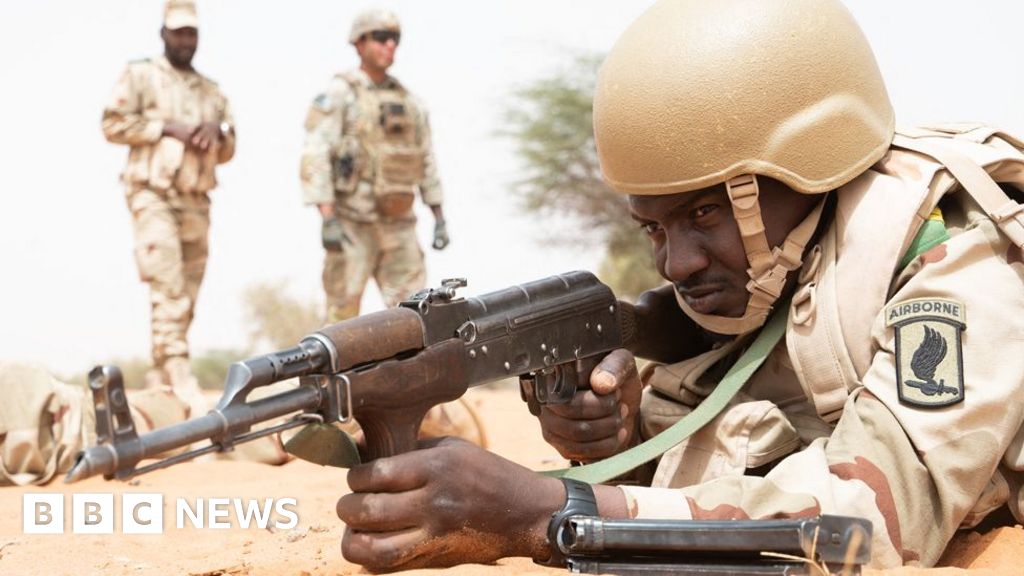
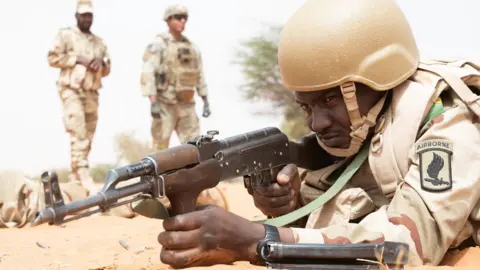
AFP/Getty Images A US Airborne division soldier in camouflage and wearing a helmet lies on the ground pointing a gun during joint multinational exercise African Lion 2025 in Dodji, Senegal - May 2025.AFP/Getty Images

The focus of US military strategy in Africa is changing under Trump

With US President Donald Trump on a cost-cutting warpath since starting his second term, aid to Africa has been slashed and now defence spending is in his sights – but could these approaches cost more in the long run?

The phrase his administration presses on Europe to assume more of the costs of its own defence is “burden sharing”. This is the challenge that Washington is now throwing down to African armies too – and they are far less comfortably resourced to take it on.

Moreover, having paid dearly in lives and money, in the struggle to hold back the spreading reach of jihadist armed groups across the Sahel, the Lake Chad basin and Somalia over recent years, they could be forgiven for feeling that they already carry much of the burden – and for the sake not just of their own continent but the wider international community too.

Benin, which has lost more than 80 soldiers in jihadist attacks since the start of the year, is just one example.

“The epicentre of terrorism on the globe” is how the Sahel was described a few days ago by Gen Michael Langley, who as head of US Africa Command (Africom) oversees the American military presence south of the Sahara.

In briefings and interviews over the past few weeks, he has graphically outlined the threat that jihadist groups will present if their push southward towards the Gulf of Guinea succeeds.

“One of the terrorists’ new objectives is gaining access to West African coasts. If they secure access to the coastline, they can finance their operations through smuggling, human trafficking and arms trading. This not only puts African nations at risk but also raises the chance of threats reaching US shores.”

Gen Langley has admitted that the current upsurge in militant attacks is “deeply concerning”.

Yet he has also repeatedly hammered home a core message: the US is minded to rein back its own sub-Saharan military operations, leaving local armies to take on more of the defence burden.

Some 6,500 personnel are currently deployed in Africa by the US military and a 2019 list published by Africom mentioned 13 “enduring” American bases across the continent and a further 17 more temporary facilities.

But some of these installations, including the purpose-built drone base at Agadez in Niger, have already been shut down, in particular after military juntas seized power in Niger, Mali and Burkina Faso since 2020.

And it now looks as if the once-ambitious American operational footprint will be pruned back quite a lot more.

Perhaps we will see more air power deployed from offshore to hit militant targets – Gen Langley says there have been 25 strikes in Somalia this year, double the 2024 total – but a much thinner permanent on-the-ground military presence.

“Some things that we used to do, we may not do anymore,” he recently told a conference in Kenya’s capital, Nairobi, that brought together chiefs of defence staff and other senior officers from 37 countries.

“Our aim is not to serve as a permanent crutch, but to achieve US security objectives that overlap with our partners. We should be able to help African nations build the self-reliance they need to independently confront terrorism and insurgencies.”

In the bluntness of his language Gen Langley reflects the stark change of outlook and policy that has come from January’s change of power at the White House.

“We have set our priorities now – protecting the homeland.”

What matters to the no-longer-so-new Trump II administration, the general made clear in a Pentagon publication last week, is fighting terrorists – particularly those who might attack the US.

Other priorities are countering the spread of Chinese military influence across Africa and protecting freedom of maritime navigation through key trade choke points such as the Strait of Gibraltar and the Mediterranean, the Suez Canal and the Bab el-Mandab Strait at the southern end of the Red Sea.

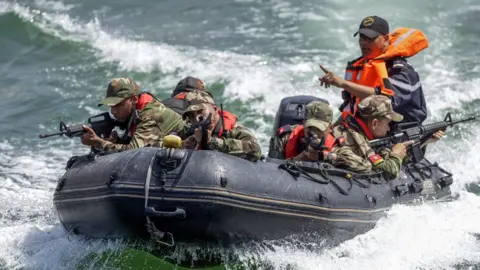
AFP/Getty Images Members of Morocco's military in a rubber dingy simulate securing the port during the joint multinational African Lion 2025 war games in Agadir - May 2025.AFP/Getty Images

The US is involved in annual war games known as Africa Lion – here Moroccan troops took part last month in an exercise to secure a port

In some respects, the focus on training and capacity building that Gen Langley now expounds is not so very different from the approach of previous American administrations, Republican as well as Democrat.

He lauds the National Guard State Partnership Program, through which individual US states have been helping to build the capacity of government security forces across Africa and other parts of the world – for the past three decades.

France too is pursuing this approach, with the closure of bases in Chad and Senegal, while those in Ivory Coast and Gabon have been handed over to their governments, with only small French training teams left behind to work alongside African colleagues.

However, in other respects, the Trump administration’s Africa strategy represents a drastic shrinkage in outlook and – critics might argue – a conscious retreat from addressing the factors that drive instability, conflict and terrorism, particularly in the Sahel, which is among the poorest regions on the planet.

For under President Joe Biden the US looked far beyond the military realm alone in its efforts to counter the both the growing reach of jihadist groups and other sources of violence. And Gen Langley, as Africom chief, was an articulate exponent of this much broader thinking.

Only last year, in an interview with the Associated Press news agency, he outlined what he described as a “whole of government” response to the proliferation of conflict, stressing the importance of good governance and action to tackle the fragilities of African states and the impacts of desertification, crop failure and environmental change.

This approach openly recognised that recruitment by armed groups and the spread of violence is fuelled not only by jihadist ideology, but also by a host of social and economic factors, including the stresses now afflicting farming and pastoralist livelihoods.

Gen Langley himself does not seem to have abandoned this analysis, recently noting how Ivory Coast had countered the jihadist threat to its northern border areas by complementing security force deployments with development projects.

He could equally have pointed to the success of a similar approach pursued by the president of Niger, Mohamed Bazoum, before he was deposed in the July 2023 coup.
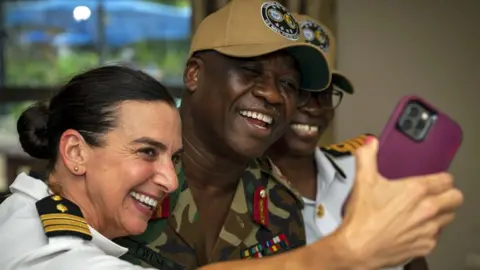
Africom US Navy Commander Carla Pappalardo takes a photo with partners at the Africa Malaria Task Force (AMTF) conference - 18 July 2023.Africom

Delegates seen here at a 2023 conference in Ghana of the Africa Malaria Task Force, an Africom-established initiative to help co-ordinate the fight against the killer disease

But of course, these days Africom must operate within the context of a US foreign policy radically reshaped under Trump.

There are even rumours that it could be downgraded to become a subsidiary of the US command in Europe and Gen Langley suggests African governments should tell Washington what they thought of this idea.

Already the separate Africa unit at the radically slimmed down National Security Council at the White House is reportedly being wound up and integrated into the Middle East-North Africa section.

Its director, Gen Jami Shawley, an Africa specialist appointed to the role only in March, has now been assigned to more general strategic functions.

Addressing Congress this week, Gen Langley warned about China’s and Russia’s African ambitions: Beijing’s agility at capitalising on the US’s absence and Moscow’s ability to seize military opportunities created by chaos and instability.

Given these concerns, some might wonder if the general is discreetly signally his doubts about a slimmed down Africa strategy.

Meanwhile, under the “efficiency drive” led, until recently, by tech billionaire Elon Musk, the American government’s main international development agencies, USAID and the Millennium Challenge Corporation, have been effectively shut down.

The spine of the new US economic engagement with Africa is now private sector trade and investment.

But business generally needs to operate in a stable and secure context – which Africa’s most fragile and violence-prone regions cannot offer.

And in winding up the American development agencies, the Trump administration has stepped aside from funding the rural projects and social programmes that sought to address land and water pressures and lack of economic opportunity, the key drivers of conflict – and the jihadist groups’ recruitment of frustrated rural young people.

For the fragile regions that are the main sources of jihadist violence the US response is reduced to the purely military, and now it is seeking to shift even most of that on to the shoulders of African states that already struggle to respond adequately to a plethora of challenges and responsibilities.

Paul Melly is a consulting fellow with the Africa Programme at Chatham House in London.
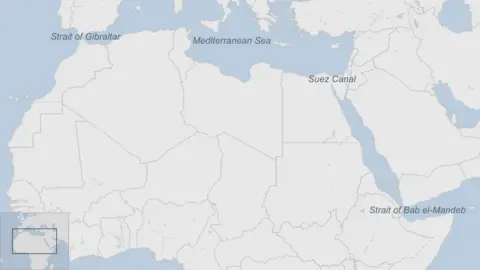
A map marking certain maritime areas around Africa: Strait of Gibraltar,  the Mediterranean, the Suez Canal and the Strait of Bab el-Mandeb

The US is keen to keep these areas navigable – the Strait of Gibraltar, the Mediterranean, the Suez Canal and the Strait of Bab el-Mandeb

You may also be interested in:

Getty Images/BBC A woman looking at her mobile phone and the graphic BBC News AfricaGetty Images/BBC


Source link

Related Posts

Zambia elections: Top opposition figures arrested days after presidential vote

August 17, 2026
0

Security forces in Zambia have seized weapons and arrested 11 people, including senior opposition figures, allegedly involved in an...

Morocco detains dozens of migrants trying to cross into Ceuta – reports

August 16, 2026
0

The crisis had calmed since breaking out in late July, but it has sparked tensions between EU nations that...

Michaely Bihina: The Cameroon goalkeeper making waves at Wafcon 2026

August 15, 2026
0

One name has become the toast of Cameroon following her heroics at the 2026 Women's Africa Cup of Nations...

  • Lee McGregor: Scot seeks world title in 2025 & Nathaniel Collins bout

    677 shares
    Share 271 Tweet 169
  • Belgian footballer arrested in cocaine investigation

    533 shares
    Share 213 Tweet 133
  • Next to raise prices to help pay for rising wage costs

    532 shares
    Share 213 Tweet 133
  • South Wales Police officers injured, one arrested

    525 shares
    Share 210 Tweet 131
  • Charities to get £15m fund to save surplus farm food

    516 shares
    Share 206 Tweet 129
  • Trending
  • Comments
  • Latest

Lee McGregor: Scot seeks world title in 2025 & Nathaniel Collins bout

January 16, 2025

Belgian footballer arrested in cocaine investigation

January 27, 2025

Next to raise prices to help pay for rising wage costs

January 7, 2025

World Cup 2022: TikTok brings football fever to millions of fans

0

UK economy will get worse before it gets better, warns chancellor

0

One of Central America’s most active volcanoes erupts again

0

Does Reform’s plan to cut £50bn in welfare spending add up?

August 17, 2026

Watch: Flood sweeps vehicle away in Hawaii after Hurricane Lala

August 17, 2026

Cambridge chancellor criticises ‘racist feeding frenzy’ around Jason Arday

August 17, 2026

Categories

Reality Check

Does Reform’s plan to cut £50bn in welfare spending add up?

August 17, 2026
0

Another big element of Reform's planned cuts comes from taking away benefits from foreign nationals. It claims around £20bn...

Read more

Watch: Flood sweeps vehicle away in Hawaii after Hurricane Lala

August 17, 2026
News

© 2023 GODJ - NEWS CORP - news.godj.com.

Explore NEWS.GODJ.COM

  • Home
  • News
  • Sports
  • Worklife
  • Travel
  • Reel
  • Future
  • More

Follow Us

  • Home Main
  • Video
  • World
  • Top News
  • Business
  • Sport
  • Tech
  • UK
  • In Pictures
  • Health
  • Reality Check
  • Science
  • Entertainment & Arts
  • Login

© 2023 GODJ - NEWS CORP - news.godj.com.

Welcome Back!

Login to your account below

Forgotten Password?

Create New Account!

Fill the forms bellow to register

All fields are required. Log In

Retrieve your password

Please enter your username or email address to reset your password.

Log In
This website uses cookies. By continuing to use this website you are giving consent to cookies being used. Visit our Privacy and Cookie Policy.