









• Latest
  • Trending
  • All

How climate change affects hurricanes, typhoons and cyclones

October 28, 2025

Ice cream: How the big firms innovate to stay ahead

August 15, 2026

Temporary disposable barbecue ban over wildfire risk

August 15, 2026

Why tech bosses keep sharing their manifestos about AI

August 15, 2026

European Athletics Championships 2026: Keely Hodgkinson takes 800m silver behind Swiss rival Audrey Werro

August 15, 2026

Electric vehicle sales targets could be cut after pressure from car makers

August 14, 2026

Business Daily – Taking Stock: The cost of heatwaves

August 14, 2026

Major oil slick washes up on Iran coast after Hormuz ship strike

August 14, 2026

Rare breeding bat found roosting near South Yorkshire reservoir

August 14, 2026

Killer who will not say where wife's body is to stay in prison

August 14, 2026

Amy Hunt: Can getting glammed up really improve your performance?

August 14, 2026

Arrests and road closed over suspected abduction in East Lothian

August 14, 2026

Tân mawr ger Llanymddyfri yn gorfodi nifer o bobl i adael eu tai

August 14, 2026
News
  • Login
  • Home
  • News
  • Sports
  • Worklife
  • Travel
  • Reel
  • Future
  • More
Saturday, August 15, 2026
No Result
View All Result

NEWS

3 °c
London
8 ° Wed
9 ° Thu
11 ° Fri
13 ° Sat
  • Home
  • Video
  • World
    • All
    • Africa
    • Asia
    • Australia
    • Europe
    • Latin America
    • Middle East
    • US & Canada

    Australia v Bangladesh: Steve Smith benefits from reprieve but tourists dominate day one of first Test

    Builders unearth €9m gold loot sealed in walls of Belgian property

    Chad’s Succès Masra: Former prime minister given state pardon

    Japan: Record rain in Chiba kills eight as thousands stranded at Narita Airport

    Engine parts smashed Ryanair window that man’s head was sucked out of, report says

    Stolen Matisse artworks recovered by police in Brazil

    Israeli settlers besieging Palestinian families in West Bank village

    Concern grows over conditions on USS Abraham Lincoln

    Australian army whistleblower released on parole after more than two years in jail

  • UK
    • All
    • England
    • N. Ireland
    • Politics
    • Scotland
    • Wales

    Temporary disposable barbecue ban over wildfire risk

    European Athletics Championships 2026: Keely Hodgkinson takes 800m silver behind Swiss rival Audrey Werro

    Killer who will not say where wife's body is to stay in prison

    Arrests and road closed over suspected abduction in East Lothian

    Tân mawr ger Llanymddyfri yn gorfodi nifer o bobl i adael eu tai

    Ardoyne: Police defend response to north Belfast incidents

    'Welcome to one of the most bizarre by-elections in recent history'

    European Athletics Championships 2026: Amy Hunt wins 200m gold as Dina Asher-Smith claims bronze

    'Releasing my son's killer early would be a slap in the face'

  • Business
    • All
    • Companies
    • Connected World
    • Economy
    • Entrepreneurship
    • Global Trade
    • Technology of Business

    Ice cream: How the big firms innovate to stay ahead

    Electric vehicle sales targets could be cut after pressure from car makers

    Business Daily – Taking Stock: The cost of heatwaves

    US says dozens of countries helped China dodge Trump’s tariffs

    RBSI announces around 50 job cuts in Jersey

    UK economy grows but experts warn of challenging months ahead

    Twitch users can now block Amazon from using their content to train AI

    Burnham warned Iran war could hit UK growth next year

    First wave of ‘pounds for pylons’ energy discount sites revealed

  • Tech
  • Entertainment & Arts

    Meghan hits red carpet at Power of Women in Hollywood

    Margot Robbie unable to speak at Saltburn premiere

    Barbra Streisand: Siri can now pronounce my name

    Wes Anderson’s The Grand Budapest Hotel inspires cinema’s look

    Taylor Swift/ Travis Kelce romance reaches White House

    The Killers booed at Georgia concert after inviting Russian fan on stage

    Watch: Memorable moments from Parkinson's star-studded show

    Tom Jones: Neighbour surprised to find singer in flat below

    Black Country Folk Festival showcases local musicians

    Watch: Australians set new world record with Tina Turner dance

  • Science
  • Health
  • In Pictures
  • Reality Check
  • Have your say
  • More
    • Newsbeat
    • Long Reads

NEWS

No Result
View All Result
Home Science

How climate change affects hurricanes, typhoons and cyclones

October 28, 2025
in Science
11 min read
253 3
0
497
SHARES
1.4k
VIEWS
Share on FacebookShare on Twitter


Mark PoyntingClimate reporter
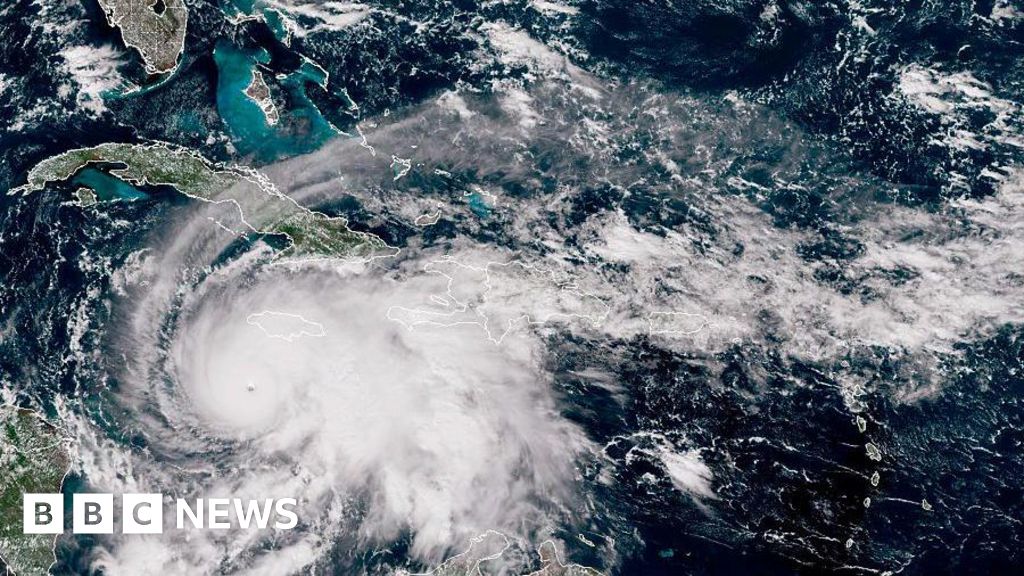
NOAA via Getty A satellite image provided by the National Oceanic and Atmospheric Administration (NOAA) shows Hurricane Melissa moving northwest through the Caribbean Sea towards Jamaica on 27 October 2025.NOAA via Getty

A satellite image of Hurricane Melissa moving over the Caribbean Sea

Hurricane Melissa, one of the strongest Atlantic storms ever recorded, created “extremely dangerous and life-threatening” conditions in Jamaica, according to the US National Hurricane Center.

Climate change is not thought to increase the number of hurricanes, typhoons and cyclones worldwide.

But warmer oceans coupled with a warmer atmosphere – fuelled by climate change – have the potential to make those that do form even more intense.

That can potentially lead to higher wind speeds, heavier rainfall, and a greater risk of coastal flooding.

What are hurricanes and where do they happen?

Hurricanes are powerful storms which develop in warm tropical ocean waters.

In other parts of the world, they are known as cyclones or typhoons. Collectively, these storms are referred to as “tropical cyclones”.

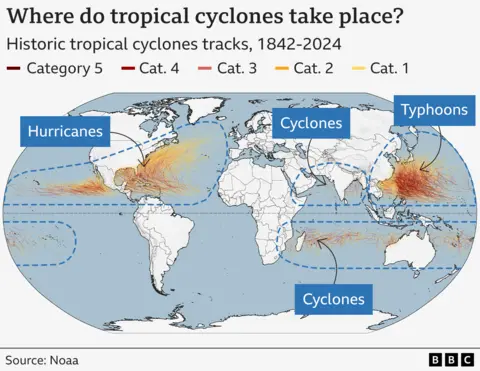
Graphic showing storm tracks of tropical cyclones from 1842-2024. These storms are called hurricanes in the Atlantic and north-east Pacific, typhoons in the north-west Pacific, and a cyclone in the south-west Pacific and Indian Ocean.

Tropical cyclones are characterised by very high wind speeds, heavy rainfall, and storm surges – short-term rises to sea-levels. This often causes widespread damage and flooding.

Hurricanes can be categorised by their peak sustained wind speed.

Major hurricanes are rated category three and above, meaning they reach at least 111mph (178km/h).
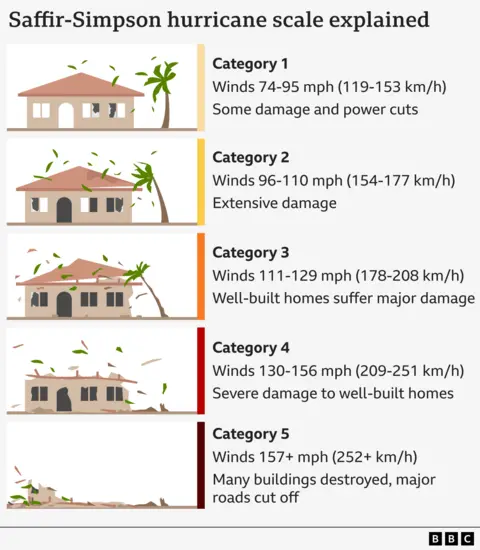
Graphic explaining the Saffir-Simpson scale of hurricane categories. Category 1 has peak sustained wind speeds of 74 miles per hour and can cause minor damage and potential power outages; category 2 above 96 miles per hour and can cause extensive damage to property; category 3 above 111 miles per hour and even well-built homes will sustain major damage; category 4 above 130 miles per hour and will cause severe damage to well-build homes; and category 5 has wind speeds above 157 miles per hour and will destroy many buildings as well as cutting off communities.

How do hurricanes form?

Hurricanes, typhoons and cyclones begin as atmospheric disturbances – such as, for example, a tropical wave, an area of low pressure where thunderstorms and clouds develop.

As warm, moist air rises from the ocean surface, winds begin to spin. The process is linked to how the Earth’s rotation affects winds in tropical regions just away from the equator.

For a hurricane to develop and keep spinning, the sea surface generally needs to be at least 27C to provide enough energy, and the winds need to not vary much with height.

If all these factors come together, an intense hurricane can form, although the exact causes of individual storms are complex.
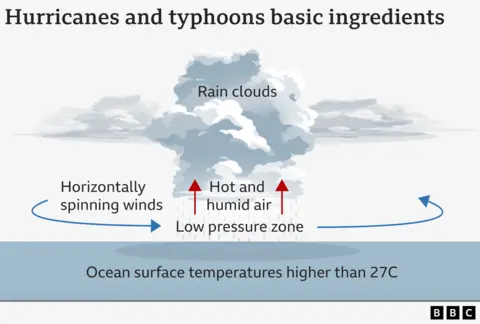
Graphic of ingredients typically needed for a hurricane. Ocean surface waters warmer than 27 degrees celsius, cause hot and humid air to rise, leading to a low pressure zone. Out in the ocean this can result in winds beginning to spin around the depression.

Have hurricanes been getting worse?

Globally, the frequency of tropical cyclones has not increased over the past century, and in fact the number may have fallen – although long-term data is limited in some regions.

But it is “likely” that a higher proportion of tropical cyclones across the globe have reached category three or above over the past four decades, meaning they reach the highest wind speeds, according to the UN’s climate body, the IPCC.
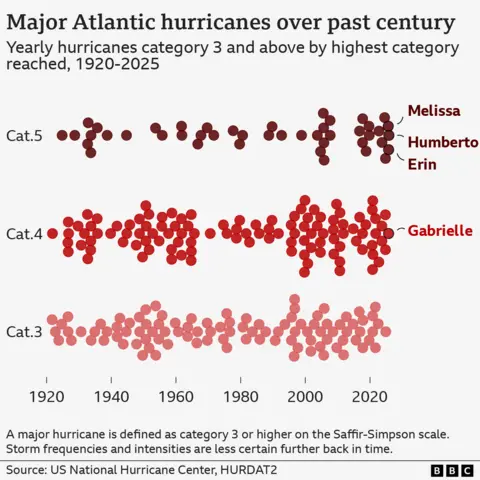
Graphic showing the increasing number of category three, four and five hurricanes in the North Atlantic. Each hurricane is displayed as a red dot, organised by year and category. The hurricanes of 2025 - Melissa, Humberto, Erin and Gabrielle - are marked on the right.

Watch: Are hurricanes in the US getting worse?

How is climate change affecting hurricanes?

Assessing the precise influence of climate change on individual tropical cyclones can be challenging due to the complexity of these storm systems.

But rising temperatures can affect these storms in several ways.

Firstly, warmer ocean waters mean storms can pick up more energy, leading to higher wind speeds.

Maximum wind speeds of hurricanes between 2019 and 2023 were boosted by an estimated 19mph (30km/h) on average as a result of human-driven ocean warming, according to a recent study.

Secondly, a warmer atmosphere can hold more moisture, leading to more intense rainfall.

Climate change made the extreme rainfall from Hurricane Harvey in 2017 around three times more likely, according to one estimate.
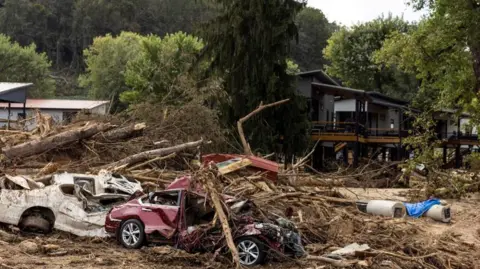
Reuters Fallen trees and debris on top of a crumpled red and white car. There is a house in the background largely intact.Reuters

The winds and rain from Hurricane Helene in 2024 were likely worsened by climate change, scientists at the World Weather Attribution group found

Finally, sea-levels are rising, mainly due to a combination of melting glaciers and ice sheets, and the fact that warmer water takes up more space. Local factors can also play a part. This means storm surges happen on top of already elevated sea levels, worsening coastal flooding.

For example, it is estimated that flood heights from Hurricane Katrina in 2005 – one of America’s deadliest storms – were 15-60% higher than they would have been in the climate conditions of 1900.

Overall, the IPCC concludes that there is “high confidence” that humans have contributed to increases in precipitation associated with tropical cyclones, and “medium confidence” that humans have contributed to the higher probability of a tropical cyclone being more intense.

How might hurricanes change in the future?

The number of tropical cyclones globally is unlikely to increase, according to the IPCC.

But as the world warms, it says it is “very likely” they will have higher rates of rainfall and reach higher top wind speeds. This means a higher proportion would reach the most intense categories, four and five.

The more global temperatures rise, the more extreme these changes will tend to be.

The proportion of tropical cyclones reaching category four and five may increase by around 10% if global temperature rises are limited to 1.5C, increasing to 13% at 2C and 20% at 4C, the IPCC says – although the exact numbers are uncertain.




Source link

Tags: affectschangeClimatecycloneshurricanestyphoons

Related Posts

Rare breeding bat found roosting near South Yorkshire reservoir

August 14, 2026
0

The company said monitoring the bat boxes at the site helped confirm the conservation measures were working and could...

Romania shuts only nuclear plant as heat causes drop in Danube River level

August 13, 2026
0

Romania has shut down its only nuclear power station because of extremely low water levels in the Danube river...

How the West watched most historic solar eclipse since 1999

August 12, 2026
0

Thousands of people from across the West of England stood or sat completely still on Wednesday evening to watch...

  • Lee McGregor: Scot seeks world title in 2025 & Nathaniel Collins bout

    677 shares
    Share 271 Tweet 169
  • Belgian footballer arrested in cocaine investigation

    533 shares
    Share 213 Tweet 133
  • Next to raise prices to help pay for rising wage costs

    532 shares
    Share 213 Tweet 133
  • South Wales Police officers injured, one arrested

    525 shares
    Share 210 Tweet 131
  • Charities to get £15m fund to save surplus farm food

    516 shares
    Share 206 Tweet 129
  • Trending
  • Comments
  • Latest

Lee McGregor: Scot seeks world title in 2025 & Nathaniel Collins bout

January 16, 2025

Belgian footballer arrested in cocaine investigation

January 27, 2025

Next to raise prices to help pay for rising wage costs

January 7, 2025

World Cup 2022: TikTok brings football fever to millions of fans

0

UK economy will get worse before it gets better, warns chancellor

0

One of Central America’s most active volcanoes erupts again

0

Ice cream: How the big firms innovate to stay ahead

August 15, 2026

Temporary disposable barbecue ban over wildfire risk

August 15, 2026

Why tech bosses keep sharing their manifestos about AI

August 15, 2026

Categories

Business

Ice cream: How the big firms innovate to stay ahead

August 15, 2026
0

I'm at the research and development centre of the world's biggest publicly listed ice-cream maker, Magnum. Near Bedford in...

Read more

Temporary disposable barbecue ban over wildfire risk

August 15, 2026
News

© 2023 GODJ - NEWS CORP - news.godj.com.

Explore NEWS.GODJ.COM

  • Home
  • News
  • Sports
  • Worklife
  • Travel
  • Reel
  • Future
  • More

Follow Us

  • Home Main
  • Video
  • World
  • Top News
  • Business
  • Sport
  • Tech
  • UK
  • In Pictures
  • Health
  • Reality Check
  • Science
  • Entertainment & Arts
  • Login

© 2023 GODJ - NEWS CORP - news.godj.com.

Welcome Back!

Login to your account below

Forgotten Password?

Create New Account!

Fill the forms bellow to register

All fields are required. Log In

Retrieve your password

Please enter your username or email address to reset your password.

Log In
This website uses cookies. By continuing to use this website you are giving consent to cookies being used. Visit our Privacy and Cookie Policy.