





• Latest
  • Trending
  • All

How Australia’s deadliest animals save lives

May 17, 2025

UK electric car sales target set to be weakened

June 14, 2026

Why the US economy keeps defying the odds

June 14, 2026

What we know about US sea drone used in helicopter crew rescue mission

June 14, 2026

Fears dogs to blame for drop in little tern numbers

June 14, 2026

Sinkholes near Purley bridge halt Gatwick trains

June 14, 2026

Friends hope death of footballer leads to new cardiac arrest rule

June 14, 2026

Glasgow race attacks a 'mark against the reputation of the city'

June 14, 2026

Jade Jones could face Sheena Bathory after dominant second boxing win

June 14, 2026

Days of violence 'a stain on NI's international reputation'

June 14, 2026

Clinical Australia upset Turkey in World Cup opener

June 14, 2026

Swiss voters reject 10 million population cap, early projections say

June 14, 2026

World Cup 2026: Fifa to pay Somali referee full tournament fee

June 14, 2026
News
  • Login
  • Home
  • News
  • Sports
  • Worklife
  • Travel
  • Reel
  • Future
  • More
Sunday, June 14, 2026
No Result
View All Result

NEWS

3 °c
London
8 ° Wed
9 ° Thu
11 ° Fri
13 ° Sat
  • Home
  • Video
  • World
    • All
    • Africa
    • Asia
    • Australia
    • Europe
    • Latin America
    • Middle East
    • US & Canada

    Clinical Australia upset Turkey in World Cup opener

    Swiss voters reject 10 million population cap, early projections say

    World Cup 2026: Fifa to pay Somali referee full tournament fee

    Vincent's parents 'never say he's good enough' – so he turned to a middle-aged couple online

    Royal Marines board Russian shadow fleet oil tanker in English Channel

    Armed men kidnap high-ranking security official in Haiti

    The nuclear challenge at the heart of Trump's Iran negotiations

    New York Knicks win NBA championship for first time in over 50 years

    Bangladesh beat Australia to claim first ODI series win against six-time World Cup winners

  • UK
    • All
    • England
    • N. Ireland
    • Politics
    • Scotland
    • Wales

    Sinkholes near Purley bridge halt Gatwick trains

    Glasgow race attacks a 'mark against the reputation of the city'

    Jade Jones could face Sheena Bathory after dominant second boxing win

    Days of violence 'a stain on NI's international reputation'

    Molly Russell's dad says PM rushing social media restrictions 'deplorable'

    Eight arrests at anti-immigration and counter protest in Brighton

    Thousands gather for anti-racism rally in Belfast after disorder

    Women’s T20 World Cup: Scotland beat Ireland at Old Trafford to earn first win

    Thousands attending annual Pride Cymru festival

  • Business
    • All
    • Companies
    • Connected World
    • Economy
    • Entrepreneurship
    • Global Trade
    • Technology of Business

    UK electric car sales target set to be weakened

    Why the US economy keeps defying the odds

    Teen plans to leave uni 'debt free' after making £35,000 selling vintage football shirts

    Beauty Pie LED mask ad banned over misleading anti-wrinkle claim

    Elon Musk becomes world's first trillionaire as SpaceX soars in stock market debut

    'I was employee number one at SpaceX'

    Reporter Reads

    Elon Musk’s SpaceX raises $75bn ahead of record stock market debut

    Mike Ashley's Frasers offers £1.73bn to buy all of Hugo Boss

  • Tech
  • Entertainment & Arts

    Meghan hits red carpet at Power of Women in Hollywood

    Margot Robbie unable to speak at Saltburn premiere

    Barbra Streisand: Siri can now pronounce my name

    Wes Anderson’s The Grand Budapest Hotel inspires cinema’s look

    Taylor Swift/ Travis Kelce romance reaches White House

    The Killers booed at Georgia concert after inviting Russian fan on stage

    Watch: Memorable moments from Parkinson's star-studded show

    Tom Jones: Neighbour surprised to find singer in flat below

    Black Country Folk Festival showcases local musicians

    Watch: Australians set new world record with Tina Turner dance

  • Science
  • Health
  • In Pictures
  • Reality Check
  • Have your say
  • More
    • Newsbeat
    • Long Reads

NEWS

No Result
View All Result
Home World Australia

How Australia’s deadliest animals save lives

May 17, 2025
in Australia
13 min read
236 17
0
492
SHARES
1.4k
VIEWS
Share on FacebookShare on Twitter


Katy Watson

Australia correspondent

Watch: How snakes and spiders are milked for venom

With a pair of bright pink tweezers in hand, Emma Teni is delicately wrestling a large and leggy spider in a small plastic pot.

“He’s posing,” the spider-keeper jests as it rears up on its back legs. It is exactly what she’s trying to achieve – that way she can suck the venom from its fangs using a small pipette.

Emma works from a tiny office known as the spider milking room. On a typical day, she milks – or extracts the venom from – 80 of these Sydney funnel-web spiders.

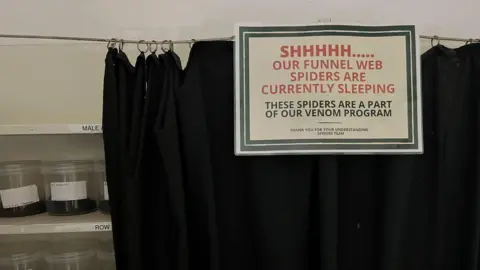
On three of the four walls there are floor-to-ceiling shelves stacked full of the arachnids, with a black curtain pulled across to keep them calm.

The remaining wall is actually a window. Through it, a small child stares, both fascinated and horrified, as Ms Teni works. Little do they know that the palm-sized spider she’s handling could kill them in a matter of minutes.

“Sydney funnel-webs are arguably the most deadly spider in the world,” Emma says matter-of-factly.

Australia is famously full of such deadly animals – and this room at the Australian Reptile Park plays a critical part in a government antivenom programme, which saves lives on a continent where it’s often joked that everything wants to kill you.

‘Spider girl’

While the quickest recorded death from a Sydney funnel-web spider was a toddler at 13 minutes, the average is closer to 76 minutes – and first aid gives you an even better chance of surviving.

So successful is the antivenom programme here at the Australian Reptile Park that nobody has been killed by one since it started in 1981.

The scheme relies, however, on members of the public either catching the spiders or collecting their egg sacs.

In a van plastered with a giant crocodile sticker, each week Ms Teni’s team drives all over Australia’s most famous city, picking up Sydney funnel-webs that have been handed in at drop-off points such as local veterinary practices.
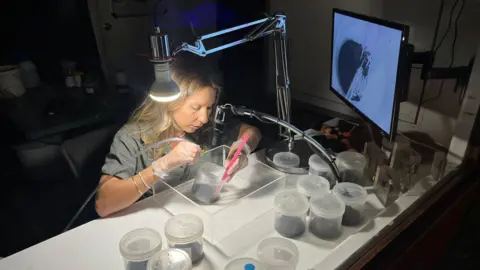

A woman sitting at a desk, holding pink tweezers and a suction pipette as she extracts venom from a spider under a spotlight on a desk surrounded by plastic containers and a monitor showing the process on video

Spider keeper Emma Teni in her office at the Australian Reptile Park…

A black curtain pulled across shelves with a partial view of plastic containers on the left. A sign says "Shhhhhh...our funnel web spiders are currently sleeping. These spiders are part of our venom programme"

Where up to 80 Sydney funnel-web spiders are milked for their venom every day

There are two reasons why these spiders are so dangerous, she explains: not only is their venom extremely potent, but they also live exclusively in a densely populated region where they’re more likely to encounter humans.

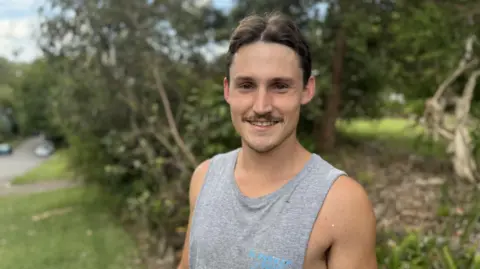
Handyman Charlie Simpson is one such person. He moved into his first home with his girlfriend a few months ago, and the keen gardener has already found two Sydney funnel-webs. He took the second spider to the vet, where Ms Teni picked it up shortly after.

“I had gloves on at the time, but realistically I should have had leather gloves on because their fangs are so big and strong,” the 26-year-old says.

“I [just thought] I had better catch it because I kept getting told you’re meant to take them back to be milked, because it’s so critical.”

“This is curing my fear of spiders,” he jokes.

As Ms Teni offloads one arachnid that was delivered to her in a Vegemite jar, she stresses her team isn’t telling Australians to go looking for the spiders and “throw themselves into danger”.

Rather, they’re asking that if someone comes across one, they safely capture it rather than kill it.

“Saying that this is the world’s most deadly spider and then [asking the public to] catch it and bring it to us does sound counter-intuitive,” she says.

“[But] that spider there now, thanks to Charlie, will… effectively save someone’s life.”
A young man with short brown hair and light moustache, wearing a grey sleeveless top, smiling and looking directly at camera with trees and grass blurred in background

Charlie Simpson says catching a Sydney funnel-web has helped him with his fear of the arachnids

All of the spiders her team collects get brought back to the Australian Reptile Park where they are catalogued, sorted by sex and stored.

Any females that get dropped off are considered for a breeding programme, which helps supplement the number of spiders donated by the public.

Meanwhile, the males, which are six to seven times more toxic than the females, are used for the antivenom programme and milked every two weeks, Emma explains.

The pipette she uses to remove the venom from the fangs is attached to a suction hose – crucial for collecting as much venom as possible, since each spider provides only small amounts.

While a few drops is enough to kill, scientists need to milk 200 of these spiders to have enough to fill one vial of antivenom.

A marine biologist by training, Emma never expected to spend her days milking spiders. In fact, she started off working with seals.

But now she wouldn’t have it any other way. Emma loves all things arachnid, and goes under various nicknames – spider girl, spider mama, even “weirdo”, as her daughter calls her.

Friends, family and neighbours rely on her for her knowledge of Australia’s creepy crawlies.

“Some girls arrive home to flowers on their doorstep,” jokes Emma. “For me it’s not unusual to arrive home to a spider in a jar.”

The best place to be bitten?

Spiders represent just one small part of what the Australian Reptile Park does. It’s also been providing snake venom to the government since the 1950s.

According to the World Health Organisation, as many as 140,000 people die across the world from snake bites every year, and three times that many are left disabled.

In Australia though, those numbers are far lower: between one and four people each year, thanks to its successful antivenom programme.

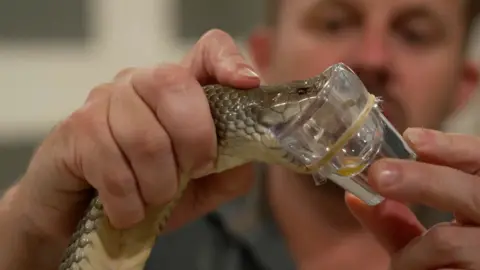
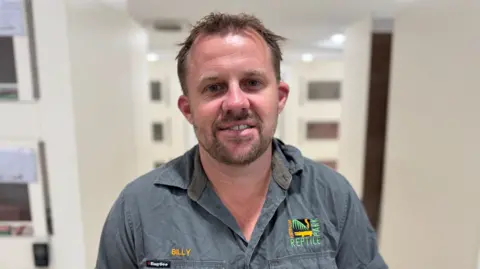
Removing a King Brown snake from its storage locker, Billy Collett, the park’s operations manager, brings it to the table in front of him.

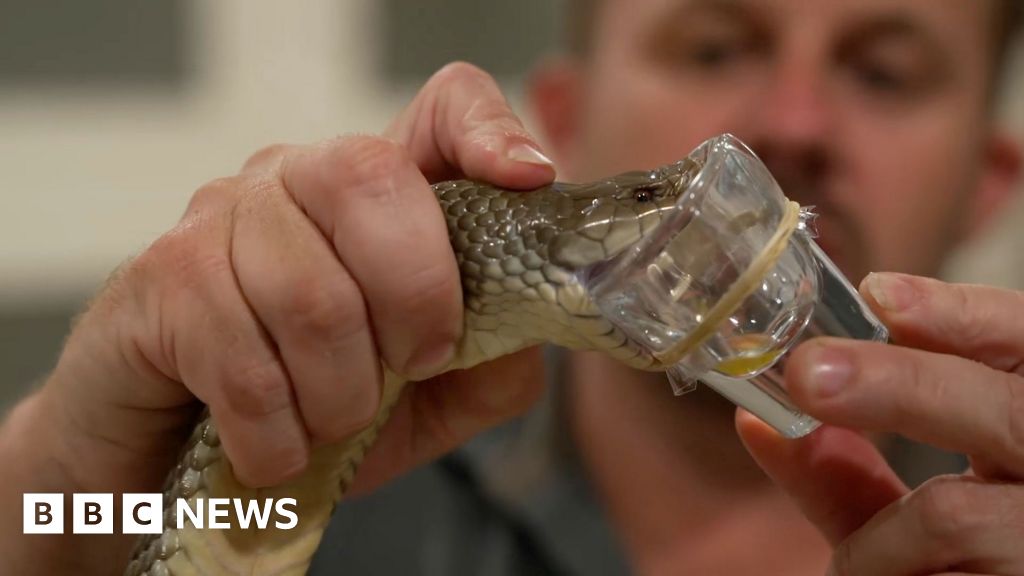
With his bare hands, he secures its head and puts its jaws over a shot glass covered in cling film.
Man holding snake as it bites into a small shot glass, releasing its venom

Mr Collett collects venom from a King Brown snake

“They are very uninclined to bite but once they go, you just see it pouring out of the fangs,” Mr Collett says, as yellow venom drips to the bottom.

“That is enough to kill all of us in the room five times over – maybe more.”

Then he switches to a more reassuring tone: “They’re not looking for people to bite. We’re too big for them to eat; they don’t want to waste their venom on us. They just want to be left alone.”

“To get bitten by a venomous snake, you’ve got to really annoy it, provoke it,” he adds, noting that bites often occur when someone is trying to kill one of the reptiles.

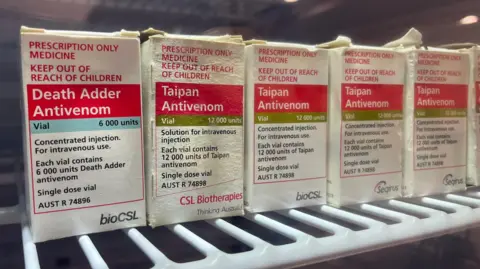
There’s a fridge in the corner of the room where the raw venom Mr Collett is collecting is stored. It’s full of vials labelled “Death Adder”, “Taipan”, “Tiger Snake” and “Eastern Brown”.

The last of these is the second-most venomous snake in the world, and the one that’s most likely to bite you here, in Australia.
Boxes of antivenom labelled "Death Adder Antivenom" and "Taipan Antivenom"

No one in Australia has been killed by a Sydney Funnel-web Spider since 1981 when the antivenom programme started

This venom gets freeze-dried and sent to CSL Seqirus, a lab in Melbourne, where it’s turned into an antidote in a process that can take up to 18 months.

The first step is to produce what’s known as hyper-immune plasma. In the case of snakes, controlled doses of the venom are injected into horses, because they are larger animals with a strong immune system.

The venom of Sydney funnel-web spiders goes into rabbits, which are immune to the toxins. The animals are injected with increasing doses to build up their antibodies. In some cases, that step alone can take almost a year.

The animal’s supercharged plasma is removed from the blood, and then the antibodies are isolated from the plasma before they’re bottled, ready to be administered.

CSL Seqirus makes 7,000 vials a year – including snake, spider, stonefish and box jellyfish antivenoms – and they are valid for 36 months. The challenge then is to ensure everyone who needs it has supplies.

“It’s an enormous undertaking,” says Dr Jules Bayliss, who leads the antivenom development team at CSL Seqirus.

“First and foremost we want to see them in major rural and remote areas that these creatures are likely to be in.”

Vials are distributed depending on the species in each area. Taipans, for example, are in northern parts of Australia, so there’s no need for their antivenom in Tasmania.

Antivenom is also given to the Royal Flying Doctors, who access some of the nation’s most remote communities, as well as Australian navy and cargo ships for sailors at risk of sea snake bites.
Man smiling and looking directly at camera, wearing a dark grey collared shirt with an Australian Reptile Park logo on the right and "Billy" on the left

Mr Collett says snakes won’t waste their venom on humans, who are too big for them to eat

Papua New Guinea also receives about 600 vials a year. The country was once connected to Australia by a land bridge, and shares many of the same snake species, so the Australian government gives the antivenom for free – snake diplomacy, if you like.

“To be honest, we probably have the most impact in Papua New Guinea, more so than Australia, because of the number of snake bites and deaths they have,” says CSL Seqirus executive Chris Larkin. To date, they reckon they’ve saved 2,000 lives.

Back at the park, Mr Collett jokes about the nickname of “danger noodles” that is sometimes given to his serpentine colleagues – a classic Australian trait of making light of something that gives so many visitors nightmares.

Mr Collett, though, is clear: these animals should not put people off from visiting.

“Snakes aren’t just cruising down the streets attacking Brits – it doesn’t work like that,” he jokes.

“If you’re going to get bitten by a snake, Australia’s the best place – we’ve got the best antivenom. It’s free. The treatment is unreal.”



Source link

Tags: animalsAustraliasDeadliestLivessave

Related Posts

Clinical Australia upset Turkey in World Cup opener

June 14, 2026
0

Watch highlights as Australia beat Turkey in their opening match, with 20-year-old Nestory Irankunda becoming the Socceroos's youngest ever...

Bangladesh beat Australia to claim first ODI series win against six-time World Cup winners

June 13, 2026
0

Second one-day international, MirpurAustralia 187-8 (42 overs): Labuschagne 55*; Mustafizur 3-27Bangladesh 195-5 (35 overs): Soumya 42, Shanto 41Bangladesh won...

Our sons are playing for two different countries at the World Cup

June 12, 2026
0

Jack and Heather Souttar are heading to the US to support their sons, who play for Scotland and Australia....

  • Lee McGregor: Scot seeks world title in 2025 & Nathaniel Collins bout

    677 shares
    Share 271 Tweet 169
  • Belgian footballer arrested in cocaine investigation

    533 shares
    Share 213 Tweet 133
  • Next to raise prices to help pay for rising wage costs

    531 shares
    Share 212 Tweet 133
  • South Wales Police officers injured, one arrested

    525 shares
    Share 210 Tweet 131
  • Charities to get £15m fund to save surplus farm food

    516 shares
    Share 206 Tweet 129
  • Trending
  • Comments
  • Latest

Lee McGregor: Scot seeks world title in 2025 & Nathaniel Collins bout

January 16, 2025

Belgian footballer arrested in cocaine investigation

January 27, 2025

Next to raise prices to help pay for rising wage costs

January 7, 2025

World Cup 2022: TikTok brings football fever to millions of fans

0

UK economy will get worse before it gets better, warns chancellor

0

One of Central America’s most active volcanoes erupts again

0

UK electric car sales target set to be weakened

June 14, 2026

Why the US economy keeps defying the odds

June 14, 2026

What we know about US sea drone used in helicopter crew rescue mission

June 14, 2026

Categories

Companies

UK electric car sales target set to be weakened

June 14, 2026
0

The new target hasn't yet been decided, with different numbers under consideration, the BBC understands. Source link

Read more

Why the US economy keeps defying the odds

June 14, 2026
News

© 2023 GODJ - NEWS CORP - news.godj.com.

Explore NEWS.GODJ.COM

  • Home
  • News
  • Sports
  • Worklife
  • Travel
  • Reel
  • Future
  • More

Follow Us

  • Home Main
  • Video
  • World
  • Top News
  • Business
  • Sport
  • Tech
  • UK
  • In Pictures
  • Health
  • Reality Check
  • Science
  • Entertainment & Arts
  • Login

© 2023 GODJ - NEWS CORP - news.godj.com.

Welcome Back!

Login to your account below

Forgotten Password?

Create New Account!

Fill the forms bellow to register

All fields are required. Log In

Retrieve your password

Please enter your username or email address to reset your password.

Log In
This website uses cookies. By continuing to use this website you are giving consent to cookies being used. Visit our Privacy and Cookie Policy.