



• Latest
  • Trending
  • All

Before and after images show glaciers vanishing before our eyes

October 5, 2025

What is Helium-3 and could we get it from the moon?

June 16, 2026

Polls open on Thursday for the Makerfield by-election

June 16, 2026

Social media ban – bold and blunt, but no silver bullet

June 16, 2026

Alessio Dionisi: Watford appoint Italian as new head coach

June 15, 2026

Fox to buy Roku streaming firm in $22bn deal

June 15, 2026

Why I sold my business to my staff

June 15, 2026

The costs and challenges facing the 2026 World Cup

June 15, 2026

New microplastics research examines River Thames pollution

June 15, 2026

Reform pledges new tax on hiring foreign workers

June 15, 2026

Gang guilty of organised crime in £4m cocaine and dirty money ring

June 15, 2026

Pensioner suffocated neighbour and recorded his dying words, court told

June 15, 2026

Reports nurses told by police to show ID to masked men during trouble – O'Neill

June 15, 2026
News
  • Login
  • Home
  • News
  • Sports
  • Worklife
  • Travel
  • Reel
  • Future
  • More
Tuesday, June 16, 2026
No Result
View All Result

NEWS

3 °c
London
8 ° Wed
9 ° Thu
11 ° Fri
13 ° Sat
  • Home
  • Video
  • World
    • All
    • Africa
    • Asia
    • Australia
    • Europe
    • Latin America
    • Middle East
    • US & Canada

    World Cup 2026: Nestory Irankunda – the refugee who quit Bayern to make Australia history

    Trump and thousands of others watch UFC fight on White House lawn

    South African TV star arrested after allegedly kidnapping man in girlfriend dispute

    Australia demands answers after girl taken hostage is shot dead by Pakistan police

    Norwegian crown princess's son found guilty of two counts of rape

    US musician Oliver Tree dies in helicopter collision in Brazil

    US and Iran agree deal to end war as Trump says Strait of Hormuz to reopen

    'Boyfriend duties call,' Trudeau says after skipping Canada match to watch Perry

    Clinical Australia upset Turkey in World Cup opener

  • UK
    • All
    • England
    • N. Ireland
    • Politics
    • Scotland
    • Wales

    Polls open on Thursday for the Makerfield by-election

    Alessio Dionisi: Watford appoint Italian as new head coach

    Reform pledges new tax on hiring foreign workers

    Gang guilty of organised crime in £4m cocaine and dirty money ring

    Pensioner suffocated neighbour and recorded his dying words, court told

    Reports nurses told by police to show ID to masked men during trouble – O'Neill

    Starmer set to ban under-16s from major social media platforms

    Hamilton says Barcelona win beyond wildest dreams

    Sinkholes near Purley bridge halt Gatwick trains

  • Business
    • All
    • Companies
    • Connected World
    • Economy
    • Entrepreneurship
    • Global Trade
    • Technology of Business

    What is Helium-3 and could we get it from the moon?

    Fox to buy Roku streaming firm in $22bn deal

    Why I sold my business to my staff

    Oil prices slide after Pakistan announces deal between US and Iran

    UK electric car sales target set to be weakened

    Why the US economy keeps defying the odds

    Teen plans to leave uni 'debt free' after making £35,000 selling vintage football shirts

    Beauty Pie LED mask ad banned over misleading anti-wrinkle claim

    Elon Musk becomes world's first trillionaire as SpaceX soars in stock market debut

  • Tech
  • Entertainment & Arts

    Meghan hits red carpet at Power of Women in Hollywood

    Margot Robbie unable to speak at Saltburn premiere

    Barbra Streisand: Siri can now pronounce my name

    Wes Anderson’s The Grand Budapest Hotel inspires cinema’s look

    Taylor Swift/ Travis Kelce romance reaches White House

    The Killers booed at Georgia concert after inviting Russian fan on stage

    Watch: Memorable moments from Parkinson's star-studded show

    Tom Jones: Neighbour surprised to find singer in flat below

    Black Country Folk Festival showcases local musicians

    Watch: Australians set new world record with Tina Turner dance

  • Science
  • Health
  • In Pictures
  • Reality Check
  • Have your say
  • More
    • Newsbeat
    • Long Reads

NEWS

No Result
View All Result
Home Science

Before and after images show glaciers vanishing before our eyes

October 5, 2025
in Science
12 min read
248 5
0
493
SHARES
1.4k
VIEWS
Share on FacebookShare on Twitter


Mark PoyntingClimate and science reporter, BBC News
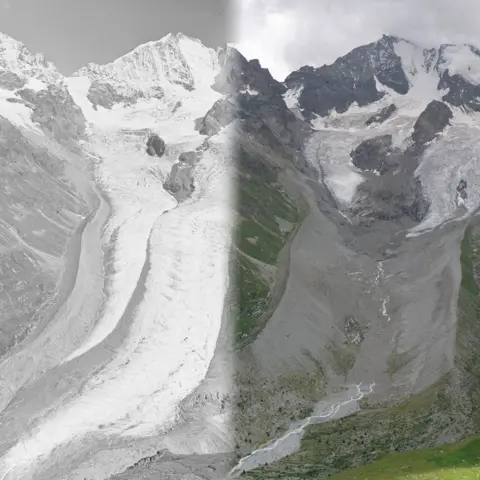
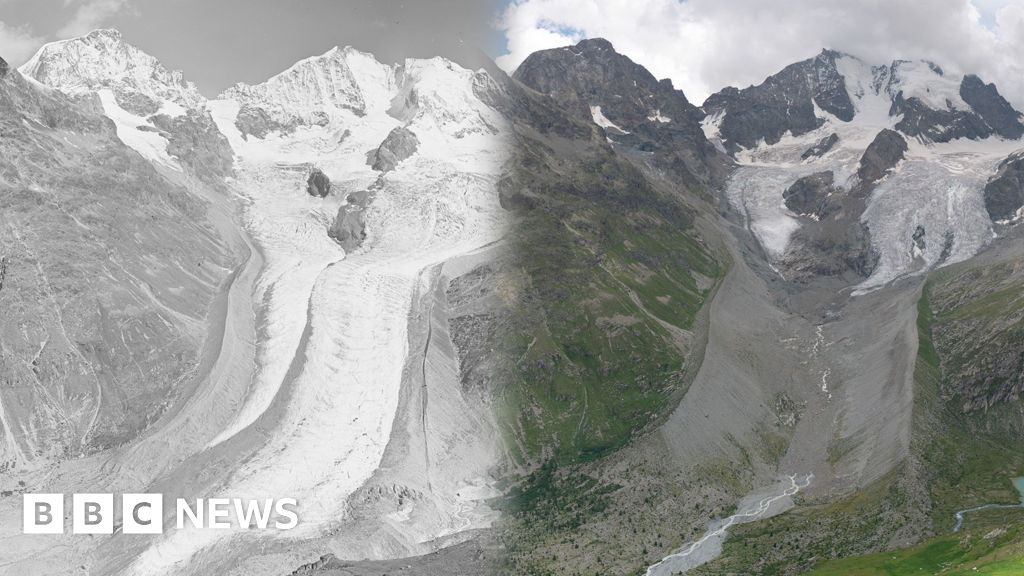
BBC Blended image comparison of the Tschierva Glacier in 1935 on the left and 2022 on the right. The glacier extends far down the valley in 1935 but has retreated way up the valley by 2022.BBC

When Matthias Huss first visited Rhône Glacier in Switzerland 35 years ago, the ice was just a short walk from where his parents would park the car.

“When I first stepped onto the ice… there [was] a special feeling of eternity,” says Matthias.

Today, the ice is half an hour from the same parking spot and the scene is very different.

“Every time I go back, I remember how it used to be,” recalls Matthias, now director of Glacier Monitoring in Switzerland (GLAMOS), “how the glacier looked when I was a child.”

There are similar stories for many glaciers all over the planet, because these frozen rivers of ice are retreating – fast.

In 2024, glaciers outside the giant ice sheets of Greenland and Antarctica lost 450 billion tonnes of ice, according to a recent World Meteorological Organization report.

That’s equivalent to a block of ice 7km (4.3 miles) tall, 7km wide and 7km deep – enough water to fill 180 million Olympic swimming pools.

“Glaciers are melting everywhere in the world,” says Prof Ben Marzeion of the Institute of Geography at the University of Bremen. “They are sitting in a climate that is very hostile to them now because of global warming.”

Switzerland’s glaciers have been particularly badly hit, losing a quarter of their ice in the last 10 years, measurements from GLAMOS revealed this week.

“It’s really difficult to grasp the extent of this melt,” explains Dr Huss.

But photos – from space and the ground – tell their own story.

Satellite images show how the Rhône Glacier has changed since 1990, when Dr Huss first visited. At the front of the glacier is a lake where there used to be ice.

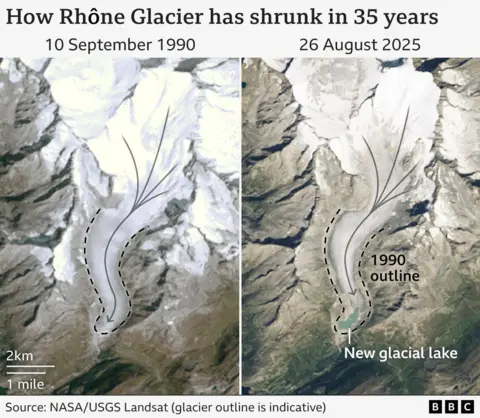
Satellite images showing how Rhône Glacier has shrunk between 1990 and 2025. The glacier flows from top to bottom of the image. The glacier front has noticeably retreated, and a glacial lake is now visible where the ice used to be.

Until recently, glaciologists in the Alps used to consider 2% of ice lost in a single year to be “extreme”.

Then 2022 blew that idea out of the water, with nearly 6% of Switzerland’s remaining ice lost in a single year.

That has been followed by significant losses in 2023, 2024 and now 2025 too.

Regine Hock, professor of glaciology at the University of Oslo, has been visiting the Alps since the 1970s.

The changes over her lifetime are “really stunning”, she says, but “what we see now is really massive changes within a few years”.

The Clariden Glacier, in north-eastern Switzerland, was roughly in balance until the late 20th Century – gaining about as much ice through snowfall as it lost to melting.

But this century, it’s melted rapidly.
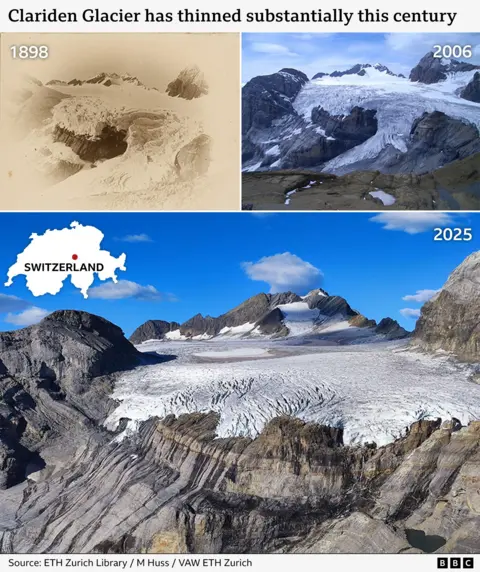
Two images showing Clariden Glacier in 1898 and 2006, above a larger image of the same glacier in 2025. The glacier has visibly shrunk between 1898 and 2006, but the changes between 2006 and 2025 are even more noticeable: the ice is thinner and has retreated.

For many smaller glaciers, like the Pizol Glacier in the north-east Swiss Alps, it’s been too much.

“This is one of the glaciers that I observed, and now it’s completely gone,” says Dr Huss. “It definitely makes me sad.”

Photographs allow us to look even further back in time.

The Gries Glacier, in southern Switzerland near the Italian border, has retreated by about 2.2km (1.4 miles) in the past century. Where the end of the glacier once stood is now a large glacial lake.
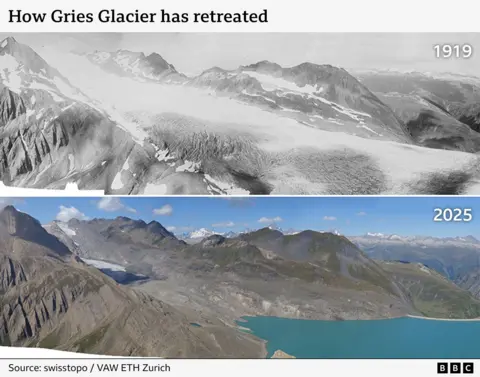
Two images of Gries Glacier, one in 1919 above and one in 2025 below. In 1919 a thick glacier is flowing from left to right, extending off the page. In 2025 the glacier only just enters at the left-hand side of the image. Where the ice once was is a large area of exposed bedrock, followed by a bright blue glacier lake.

In south-east Switzerland, the Pers Glacier once fed the larger Morteratsch Glacier, which flows down towards the valley. Now the two no longer meet.

And the largest glacier in the Alps, the Great Aletsch, has receded by about 2.3km (1.4 miles) over the past 75 years. Where there was ice, there are now trees.
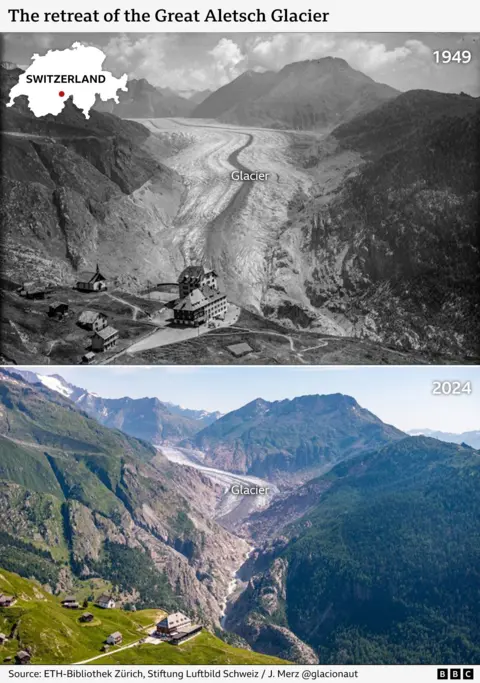
Two images of the Great Aletsch Glacier, one in 1949 above and one in 2024 below. The glacier emerges in between two steep valley walls. In 1949, the glacier extends almost all the way down the image; in 2024, it only just emerges in the background. There are trees and bedrock where there used to be ice.

Glaciers have grown and shrunk naturally for millions of years, of course.

In the cold snaps of the 17th, 18th and 19th Centuries – part of the Little Ice Age – glaciers regularly advanced.

During this time, many were considered cursed by the devil in Alpine folklore, their advances linked to spiritual forces as they threatened hamlets and farmland.

There are even tales of villagers calling on priests to talk to the spirits of glaciers and get them to move up the mountain.

Glaciers began their widespread retreat across the Alps in about 1850, though the timing varied from place to place.

That coincided with rising industrialisation, when burning of fossil fuels, particularly coal, began to heat up our atmosphere, but it’s hard to disentangle natural and human causes that far back in time.

Where there is no real doubt is that the particularly rapid losses of the past 40 years or so are not natural.

Without humans warming the planet – by burning fossil fuels and releasing huge amounts of carbon dioxide (CO2) – glaciers would be expected to be roughly stable.

“We can only explain it if we take into account CO2 emissions,” confirms Prof Marzeion.

What is even more sobering is that these large, flowing bodies of ice can take decades to fully adjust to the rapidly warming climate. That means that, even if global temperatures stabilised tomorrow, glaciers would continue to retreat.

“A large part of the future melt of the glaciers is already locked in,” explains Prof Marzeion. “They are lagging climate change.”

But all is not lost.

Half of the ice remaining across the world’s mountain glaciers could be preserved if global warming is limited to 1.5C above “pre-industrial” levels of the late 1800s, according to research published this year in the journal Science.

Our current trajectory is leading us towards warming of about 2.7C above pre-industrial levels by the end of this century – which would see three-quarters of ice lost eventually.

That extra water going into rivers and eventually the oceans means higher sea levels for coastal populations around the world.

But the loss of ice will be particularly acutely felt by mountain communities dependent on glaciers for fresh water.

Glaciers are a bit like giant reservoirs. They collect water as snowfall – which turns into ice – during cold, wet periods, and release it as meltwater during warm periods.

This meltwater helps to stabilise river flows during hot, dry summers – until the glacier disappears.

The loss of that water resource has knock-on effects for all those who rely on glaciers – for irrigation, drinking, hydropower and even shipping traffic.

Switzerland is not immune from those challenges, but the implications are much more profound for the high mountains of Asia, referred to by some as the Third Pole due to the volume of ice.

About 800 million people rely at least partly on meltwater from glaciers there, particularly for agriculture. That includes the upper Indus river basin, which serves parts of China, India, Pakistan, and Afghanistan.

In regions with drier summers, meltwater from ice and snow can be the only significant source of water for months.

“That’s where we see the biggest vulnerability,” says Prof Hock.

So how do scientists feel when confronted by the future prospects of glaciers in a warming world?

“It’s sad,” says Prof Hock. “But at the same time, it’s also empowering. If you decarbonise and reduce the [carbon] footprint, you can preserve glaciers.

“We have it in our hands.”

Top image: Tschierva Glacier, Swiss Alps, in 1935 and 2022. Credit: swisstopo and VAW Glaciology, ETH Zurich.

Additional reporting by Dominic Bailey and Erwan Rivault.

Thin, green banner promoting the Future Earth newsletter with text saying, “The world’s biggest climate news in your inbox every week”. There is also a graphic of an iceberg overlaid with a green circular pattern.


Source link

Tags: eyesglaciersImagesshowvanishing

Related Posts

New microplastics research examines River Thames pollution

June 15, 2026
0

Three litres of surface water will be collected from seven publicly accessible riverside locations along the Thames - Teddington,...

Fears dogs to blame for drop in little tern numbers

June 14, 2026
0

It has been the worst year for dogs getting too close to the nesting birds, a wildlife trust says....

Calls to restore chalk grassland for rare insects

June 13, 2026
0

Buglife says the project aims to restore more than 30 hectares of the vital ecosystem. Source link

  • Lee McGregor: Scot seeks world title in 2025 & Nathaniel Collins bout

    677 shares
    Share 271 Tweet 169
  • Belgian footballer arrested in cocaine investigation

    533 shares
    Share 213 Tweet 133
  • Next to raise prices to help pay for rising wage costs

    531 shares
    Share 212 Tweet 133
  • South Wales Police officers injured, one arrested

    525 shares
    Share 210 Tweet 131
  • Charities to get £15m fund to save surplus farm food

    516 shares
    Share 206 Tweet 129
  • Trending
  • Comments
  • Latest

Lee McGregor: Scot seeks world title in 2025 & Nathaniel Collins bout

January 16, 2025

Belgian footballer arrested in cocaine investigation

January 27, 2025

Next to raise prices to help pay for rising wage costs

January 7, 2025

World Cup 2022: TikTok brings football fever to millions of fans

0

UK economy will get worse before it gets better, warns chancellor

0

One of Central America’s most active volcanoes erupts again

0

What is Helium-3 and could we get it from the moon?

June 16, 2026

Polls open on Thursday for the Makerfield by-election

June 16, 2026

Social media ban – bold and blunt, but no silver bullet

June 16, 2026

Categories

Business

What is Helium-3 and could we get it from the moon?

June 16, 2026
0

One company planning to extract helium-3 from the moon is Interlune, based in Seattle. "We've spent the last four...

Read more

Polls open on Thursday for the Makerfield by-election

June 16, 2026
News

© 2023 GODJ - NEWS CORP - news.godj.com.

Explore NEWS.GODJ.COM

  • Home
  • News
  • Sports
  • Worklife
  • Travel
  • Reel
  • Future
  • More

Follow Us

  • Home Main
  • Video
  • World
  • Top News
  • Business
  • Sport
  • Tech
  • UK
  • In Pictures
  • Health
  • Reality Check
  • Science
  • Entertainment & Arts
  • Login

© 2023 GODJ - NEWS CORP - news.godj.com.

Welcome Back!

Login to your account below

Forgotten Password?

Create New Account!

Fill the forms bellow to register

All fields are required. Log In

Retrieve your password

Please enter your username or email address to reset your password.

Log In
This website uses cookies. By continuing to use this website you are giving consent to cookies being used. Visit our Privacy and Cookie Policy.