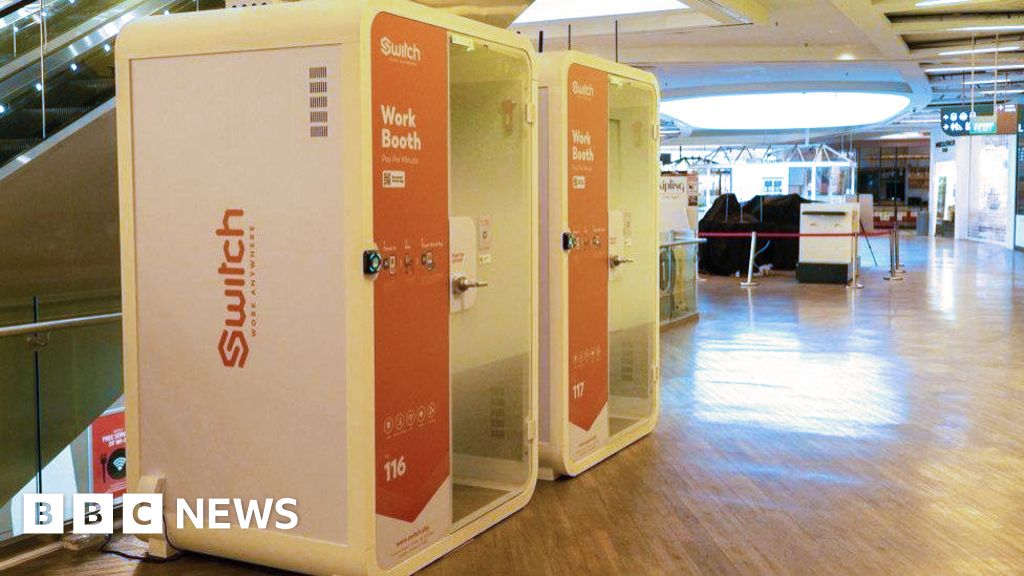












But could they really take off in Europe and North America, where many workers are accustomed to larger working spaces?
UK business psychologist Jess Baker thinks they could be popular with those looking for a cheap alternative to working from home.
“Cultural differences may mean that Westerners would have to get used to these compact working spaces,” she says. “And while I’m honestly wondering if I’ll have to clear up the previous occupant’s half-empty coffee cup, I am also looking forward to trying one out.”
It should be noted that food and drink isn’t allowed in Switch booths, and customers are expected to wipe them down after using them, although there aren’t any staff on hand to enforce the rule. Switch says the “space provider” is responsible for cleaning, which in the case of the pod I visited was the operator of the shopping centre.
Fellow UK business psychologist Stuart Duff, a partner at Pearn Kandola, also thinks they may be popular. “As we increase in our need for private and cheap working spaces, our concern about size and space will quickly be outweighed by the value of privacy and convenience.”
From my own experience, the booth in a Singapore shopping centre was a good place to get work done for an hour or two. But then the stores began to open.
After the staff at the electronics outlet next to the pod finished switching off a seemingly endless string of alarms, they turned on the music.
It wasn’t so loud that work was impossible, but it was loud enough for the song-identification app Shazam to tell me I was listening to pop stars Demi Lovato and Cardi B.
As I left, there was a flustered-looking man checking out of the pod next to mine. He shook his head, complained about the music and then marched off.
I felt the same. One reason I came here was to avoid noisy neighbours.
Still, the booths seem potentially useful. I would consider using one again, but probably not the same one.
Additional reporting by Will Smale.