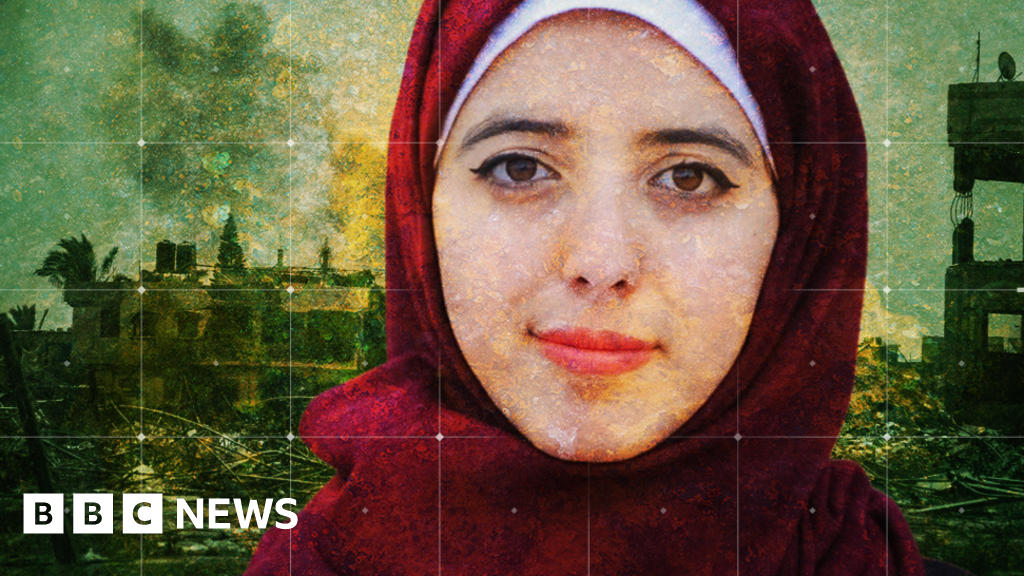












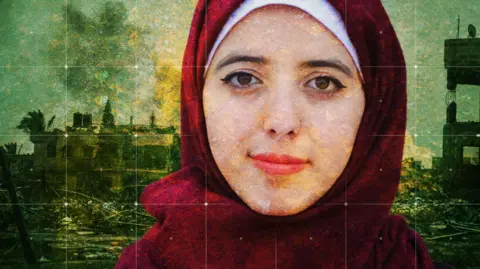
 Asmaa Tayeh
For six years the BBC’s Paul Adams has been in contact with a young graduate in Gaza. Her text messages give a unique insight into the terrors and small triumphs she has experienced during the current conflict, and her fears for the future.
My phone lights up. It is Asmaa. “Still alive,” she writes.
It is 19 March 2024 and after several weeks of silence, Asmaa Tayeh has reappeared on WhatsApp.
“Sorry. Bad internet connection and dangerous days.” And then silence. For another two months.
It has been like this since 7 October. Long disappearances, punctuated by flurries of text messages, as the 28-year-old emerges, briefly, amid the nightmare of Gaza’s longest war.
It is always late at night. Somewhere, Asmaa has found a signal. Far away in London, my phone pings as the messages tumble in.

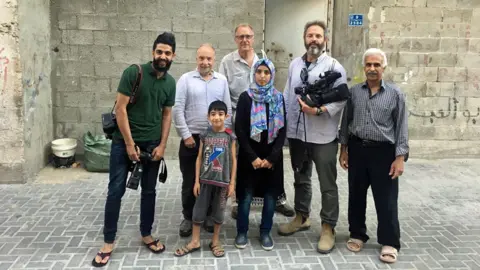
I met Asmaa in 2018. I was in Gaza, reporting on daily protests at the border fence with Israel, where thousands of mostly young Palestinians angrily commemorated their ancestors’ displacement during Israel’s War of Independence, 70 years earlier.
Asmaa was not part of the protests. I found her at her family’s home a few miles away in Jabalia, quietly writing stories, some of which I had read online, about daily life in a place she both loved and hated.
Her laptop was a cherished portal to the world outside. She had only ever known the Gaza Strip and its stifling sense of isolation. From her spartan room, she watched vloggers and Youtubers casually exploring places she could only dream of.
As a recent graduate in a place with few job prospects and frequent outbreaks of extreme violence, the exotic images flashing onto her computer screen were intoxicating but painful.
“They show me how handcuffed I am,” she wrote that year.
A refugee camp of tents and tin shacks in the 1950s, Jabalia had long since morphed into a small city, more than 100,000 people crammed together in a place of tall buildings, teeming alleyways and open sewers.
Despite her narrow confines, the young Asmaa was hopeful.
In September 2022, she launched her own business, Star Café, an online coffee delivery service. Her social media feeds suggested an optimistic young entrepreneur, finally achieving long-cherished goals and planning for the future.
 Asmaa Tayeh/Instagram
A year later, on 6 October 2023, in an Instagram post artfully depicting her branded products alongside a vase of roses and a manicured hand, she thanked God for “the blessing of self-employment”.
But what she didn’t know was that a meteor was hurtling in her direction, about to obliterate everything.
The following day, Hamas gunmen stormed across the border fence, killing about 1,200 Israelis and foreigners in nearby communities and at the Nova music festival.
Israel’s response was like nothing Gazans had ever seen before. Its military would go on to kill tens of thousands of people, displace more than 80% of the population, and render large parts of the Gaza Strip uninhabitable.
Three days later, on 10 October, Asmaa got in touch.
“Hey Paul. It’s nice to hear from you. We are unharmed,” she messaged.
“But to be honest, I don’t feel safe at all. We could be bombed at any minute.”
Despite hearing airstrikes hitting nearby targets, Asmaa was hopeful the war would soon be over.
But this was not a repeat of earlier Gaza wars. Within days, Israeli planes dropped leaflets, telling everyone in the northern Gaza Strip – more than one million people – to move south.
 Asmaa Tayeh
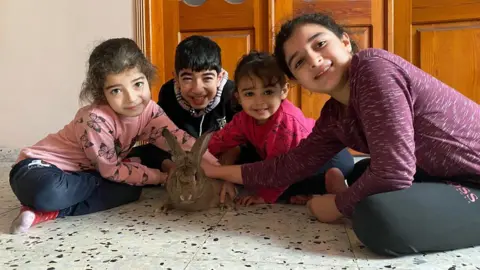
Jabalia started to empty, but Asmaa’s family – 13 people spanning three generations – stayed put, fearing going south would prove a one-way journey.
For the descendants of refugees who were forced or fled from their homes in 1948, never to return, the thought of history repeating itself stirred deep fears.
Only her grandparents, elderly and frail, travelled, eventually finding shelter in Rafah.
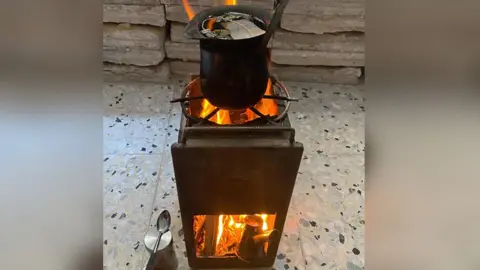
With electricity cut, food in freezers spoiling, and communications increasingly difficult, the family used a small generator every couple of days to charge mobiles and monitor the news.
Asmaa’s messages were becoming increasingly sporadic.
“It’s dangerous all over the Gaza Strip,” she told me on 15 October.
At the end of October, Jabalia experienced its worst airstrikes so far. Israel said it had targeted underground Hamas structures and killed large numbers of fighters.
The scenes were apocalyptic, with civilians and rescue workers searching for survivors through vast craters and wrecked buildings.
Asmaa vanished. My WhatsApp messages were no longer being read. I assumed the worst.
But six weeks later, she suddenly reappeared. “I’m still alive, by God’s miracles,” she wrote on 12 December.
It did, indeed, feel miraculous.
 Asmaa Tayeh
In a torrent of messages that followed, Asmaa described the previous chaotic weeks. The family’s reluctant decision to leave Jabalia, efforts to head south thwarted by the intensity of the fighting, terrifying journeys through a city at war.
“I saw so much that I cannot find words to describe,” she said.
“The streets are scary and the smell of death is everywhere. People are getting skinny and sick. I feel like I’m living inside a horror movie.”
When forced to walk, the family would spread out along the road, hoping this would improve their chances of survival.
“We kept distance between us, so if any air strike comes, not all of us will die.”
During a week-long ceasefire in late November, the family had briefly returned to the house in Jabalia.
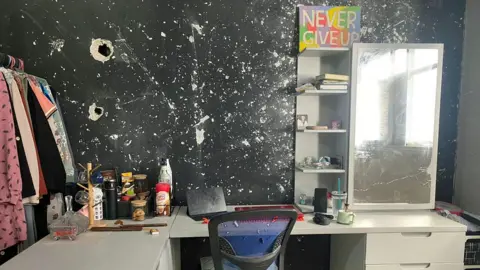
The top floor was gone. Asmaa’s own room, which had doubled up as her Star Café office and studio, was pockmarked by shrapnel.
When the ceasefire collapsed on 1 December, they fled once more, finding refuge in a printing shop in Gaza City where one of Asmaa’s brothers had worked before the war. It was filthy, reeked of paint, and had no kitchen, mattresses, or water.
“We basically lived with rats,” she says.
When it was safe enough to go outside, they would walk, sometimes for hours, searching for clean water – especially vital to make up the formula for Asmaa’s two-month-old nephew.
 Asmaa Tayeh
But after less than three weeks in the shop, Asmaa got a phone call from the Israeli army. She was used to the army’s recorded messages and leaflets dropped from the sky, with instructions to leave areas about to be attacked.
But this time she found herself talking to a real person.
The man said Israel was about to start an operation nearby. For her safety, and that of her family, she needed to leave.
“I wanted to curse him, but I couldn’t.”
She says she was curious, after two-and-a-half months of war, to find herself speaking to an Israeli. She imagined what it must feel like to spend your whole day making the same phone call over and over.
“I felt like there is on the other side an employee who’s sick of his work.”
For all the horrifying immediacy of the war consuming the north, this was as close as Asmaa ever came to meeting an Israeli soldier. Part of her wishes that she’d had more contact.
“I’m really curious about the way they’re fighting, how they look at us, how they understand the struggle,” she told me later.
“I feel like I need to dive inside their minds.”
 Asmaa Tayeh
At the end of December, as the bulk of the fighting moved south, the family made its weary way back to the house in Jabalia.
“We started the new year in the best way ever – all together in our partially-destroyed home.”
Asmaa’s father, a retired carpenter, spent the following weeks repairing the damage, fixing windows, doors and cupboards.
But food was in desperately short supply. International aid agencies warned that famine was looming. Asmaa noticed that people in Jabalia were starting to look gaunt.
Asmaa’s family had stocked up on canned goods. But flour, meat, fruit and vegetables had all disappeared from the markets. Aid agencies were struggling to bring humanitarian relief to the north.
The family eked out their dwindling rations, ate twice a day, and drank tea without sugar – something practically unheard of among Palestinians.
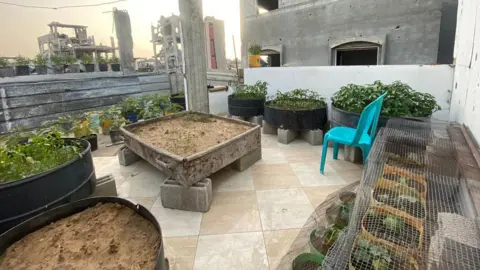
On the roof of the house, where her brother’s room had once stood, her father started growing vegetables.
Asmaa had lost 9kg (almost 20lb) and felt her appetite ebbing away. But slowly, the humanitarian situation started to improve. Air drops and new aid routes into the north kept famine at bay.
Flour was back. The family had chicken and tomatoes for the first time in months.
There was more water, too. Enough for the occasional shower.
“We started to feel a little bit settled down.”
But then the war came back.
 Asmaa Tayeh
On 12 May, the Israeli army returned to Jabalia, saying intelligence indicated Hamas was once more operating out of the area.
Asmaa was bewildered.
“Only days ago, they were talking about a very possible ceasefire,” she wrote, “and suddenly I woke to ‘Let’s pack, we have to leave asap.’”
The family went west, to an area known as al-Nasr, near the coast, where her grandparents had lived before the war.
Al-Nasr was a wasteland, much of it reduced to rubble months earlier. But her grandparents’ house was intact. Long-since looted following their departure for the south, but somehow undamaged.
The family moved in and settled down, wondering how long this third dislocation would last.
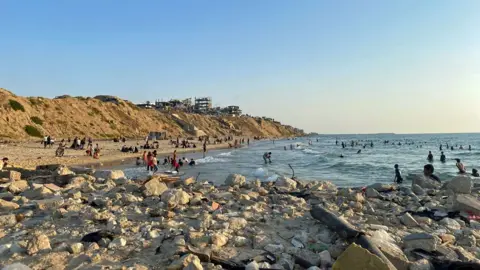
One day, driven by curiosity, Asmaa walked to the nearby beach, where she marvelled at the sight of Gazans frolicking in the waves, despite the ominous presence of Israeli gunboats patrolling offshore.
“We’ve started to feel careless,” she told me. “We don’t care for our lives any more. That’s how tired we are.”
 Asmaa Tayeh
On 19 May came the news that Asmaa had long dreaded. Her grandfather had died the day before, aged 91. After being forced to move repeatedly, he and his wife had recently settled in a tent in al-Mawasi, a desperately overcrowded place of dismal conditions, where many Palestinians had fled after the Israeli army began an operation in Rafah at the start of the month.
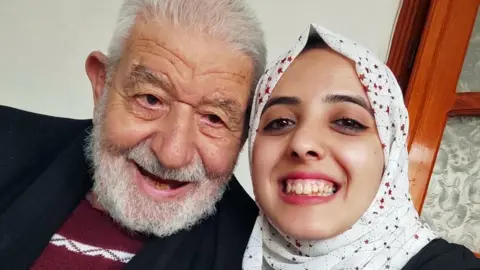
Sheltering in his abandoned house, Asmaa felt bereft. She hadn’t seen her grandfather since just before the war, when she had persuaded him to pose for a selfie.
“I was so happy that I managed to take that memory.”
Israeli forces finally left Jabalia on 1 June. Four days later, the family trudged back through streets so ravaged they were barely recognisable, to find their home still standing but increasingly battle-scarred.
The whole process – of cleaning, repairing and planting – had to start again, made harder this time by the fact that a missile had destroyed the workshop where her father kept all his tools.

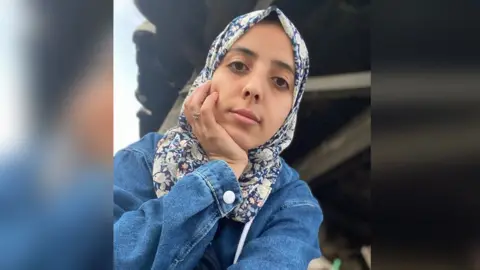
For months, Asmaa and I had only ever communicated by text. Finally, in early July, we spoke on the phone. Two long conversations in which Asmaa took me through her Gazan odyssey and described how it had changed her.
Each time, her voice faded in and out and the line crackled, creating the impression of enormous distance.
Each time, Israeli drones, ubiquitous since this war began, could be heard buzzing in the background.
Asmaa said survival was a mixed blessing. Everyone in the house was alive. But the war wasn’t over and the threat of death was constant.
“I feel anxious all the time, thinking that there will be one day in which I will lose something,” she said. “I mean, our turn will come.”
 Asmaa Tayeh
Gaza, where Asmaa had nurtured her dreams, had been devastated. But it wasn’t the physical changes that were absorbing her the most.
Society, she said, had been utterly transformed. The constant shocks of death, displacement and trauma leaving whole neighbourhoods teetering on the brink of disintegration.
Tight-knit communities had been blown apart, she said, with family members and neighbours scattered up and down the length of the Gaza Strip, and beyond.
Sometimes, in the struggle for survival, Gazans had turned on themselves. A total breakdown in law and order leaving gangs and rival families to battle it out for control of precious resources.
“It’s becoming really normal to see people even killing each other,” Asmaa said.
But if war had brought out the worst in people, it had also brought out the best.
In Jabalia, Asmaa said, people were sharing food and water, exchanging the latest news and information on where to charge mobile phones. With basic foodstuffs once again in short supply, women were swapping improvised recipes.
“Everyone is really taking care of each other.”
Asmaa said it would take decades for Gazans to recover the meagre, confined, life they knew before 7 October. Defiant talk of reconstruction and renewal, she said, felt delusional.
As for herself, Asmaa’s only dream now was to escape.
“I don’t have any hope in this place,” she told me. “I’m not the same person any more. I don’t think I’ll recover.”