










 BBC
BBCFour homeless people have died on the streets of Belfast since charity the Welcome Organisation was forced to close its headquarters after an arson attack.
A car was rammed into the shutters of the Welcome Organisation’s Townsend Street centre on 23 July before being set on fire.
Threatening graffiti was then sprayed on a wall warning workers they would be shot if they repaired the west Belfast building.
The charity has now said the centre will be closed “indefinitely” due to the danger to staff and service users.
The Irish National Liberation Army (INLA) has been blamed for the attack.
As the organisation tries to adapt to its new circumstances, the reality for those who are homeless has not changed.
BBC News NI spent 24 hours with the outreach team at the Welcome Organisation to understand how the charity is coping as demand for homeless services surge.
Resources ‘the same as a decade ago’
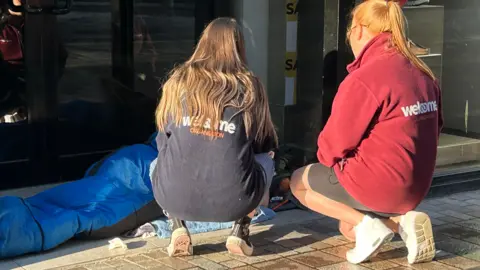
Outreach manager Ellie Hippsley works with her team to support the most vulnerable people living on the streets in the city.
Her job is very complex and the rise in homelessness and drug use has made the role even more difficult.
“We are seeing a real increase in homelessness and in drug taking,” she said.
“We have met that increase with the same resources we had available to us 10 years ago.
“We have the same staffing numbers, we have the same finances coming in and we’re still responding.”

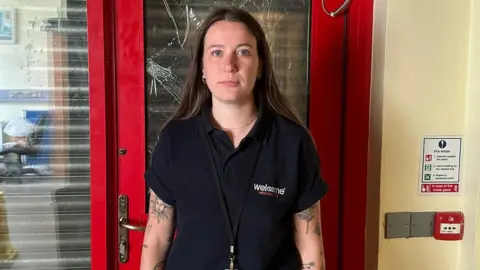
The change in the types of drugs people are using in Belfast is very obvious.
Cocaine is the drug of choice now due to its availability, and most people are injecting it.
The UK government previously said 84% of those injecting drugs in Northern Ireland were injecting cocaine.
That’s compared to just over 5% in 2018.
“People are injecting 20 to 30 times a day – that’s 20 to 30 new holes in your body,” Ellie said.
“People are more confident when they are using cocaine, they’re more brazen.”
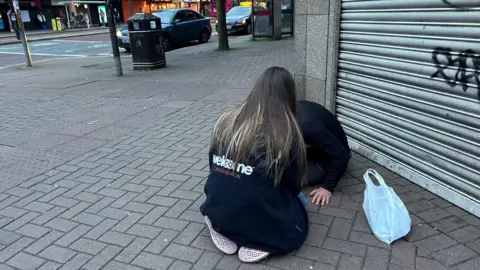
With four people dying on the streets in a week, the outreach team are concerned.
“Not all of these were drug-related deaths, one was a blind man with quite complicated health issues,” Ellie said.
“He was released from Maghaberry [prison] with no GP, no medication and a long history of heart attacks.
“He died in his tent.”
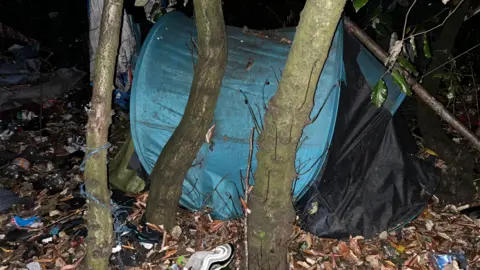
The issue is complex, and many members of the team stressed that a home would not solve everyone’s problems.
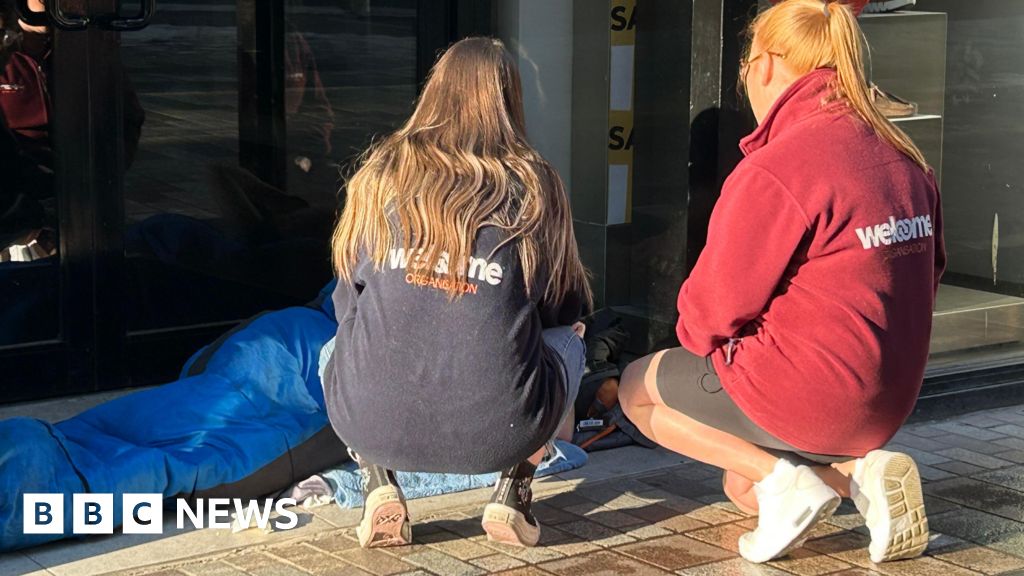
That is the case for one woman we met sleeping in a shop doorway in the city centre.
Susan (not her real name) has a tenancy in Belfast, but she chooses to sleep in a sleeping bag in the city centre.
She has complex needs and is also dependent on drugs.
“I know it sounds mad to people but I just can’t settle in a house,” she said.
“It’s too quiet, I don’t like being alone.
“I am used to sleeping on the streets, I’ve been doing this for 13 years”.
One wage away from homelessness
Although many living on the streets have complex lives with drug and alcohol dependencies, others just need a home.
Amanda and Ronnie McCracken missed two payments on their rent and were made homeless.
They spent three weeks in temporary accommodation, but are now living on the streets after that fell through.
At the time of speaking, they were living in CS Lewis Square in east Belfast.
“I wouldn’t wish this on my worst enemy, it’s a nightmare,” Ronnie said.
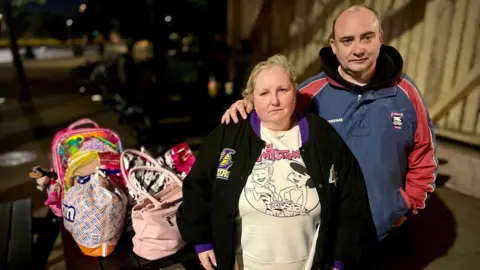
The couple spent two nights in Belfast city centre, but said the experience was “terrifying”.
“The first night we didn’t sleep, we sat up on a bench cold and afraid,” Ronnie said.
“The second night we found a spot behind a bin to stay.
“I never believed the saying you’re only one wage slip away from being homeless and it is really true.”
‘I don’t feel safe’
As the shift drew to a close for the outreach team, the night had just begun for those sleeping on the streets of Belfast.
A few hours later, the team were back on the road again “checking everyone was alive and well”.
The outreach team received a phone call to say that Amanda and Ronnie had been robbed.
Their last remaining possessions were gone.
“I am broken, I cannot believe someone would do this to us,” Amanda said.
“I don’t feel safe anymore.
“When a person is down and for someone to kick us like that, it’s just the final straw for me.
“There’s nowhere for us to feel safe.”
‘A perfect storm’
Homeless Connect is the representative body for the homelessness sector in Northern Ireland.
Its chief executive, Nicola McCrudden, warns that up to 19 projects are currently at risk of closure or reduced services.
“We’ve been working on quarterly budgets, that’s no way to plan for services and that’s no way to plan for a co-ordinated response to homelessness,” Ms McCrudden told BBC’s Good Morning Ulster programme.
The sector is facing “a real crisis situation”, she said, describing the situation as “a perfect storm”.
In this year’s budget proposal, the Department for Communities (DfC) was given £111m – or 15.5% – less in day-to-day spending than what it asked for.
The Northern Ireland Housing Executive (NIHE) – which is mostly funded by the DfC – has outlined a number of expected cuts, such as “greatly reduced” homelessness services, as early as October.
In a statement, the NIHE said the current budget allocation “poses significant risks” for a number of strategic programmes and services.
“Wraparound and prevention homeless services, currently provided by voluntary and community organisations, may have to be greatly reduced due to rising demand for temporary accommodation, the provision of which is a statutory obligation,” it said.
The NIHE added it is “committed to providing the services and support that are so needed in this sector” however, there is “no doubt” it faces a “very real challenge and barrier” moving forward.
Ms McCrudden said there needs to be a “concerted effort” to invest in housing, health and prevention services to help tackle homelessness and street activity.
“If we don’t get the funding from government to be able to do that, my concern is that we will see more people on the streets and that’s not something that any of us in the sector want to see.
“We need to turn the curve on this.”
What’s next for the Welcome Centre?
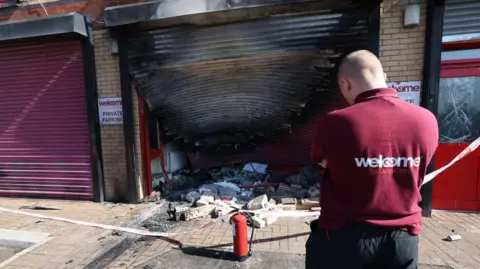 Pacemaker
The worry now is that homelessness services like the Welcome Organisation’s out-of-hours services will be cut.
The Welcome Organisation’s chairperson Jude Whyte said the charity was using a women’s refuge as a “make shift” drop-in centre during the day instead of its former premises.
“The drop-in centre is closed indefinitely, it’s just too dangerous for our service users and staff to go back,” he said.
He said the organisation was urgently looking for new premises in a non-residential area, but a big question remains – where can it go?