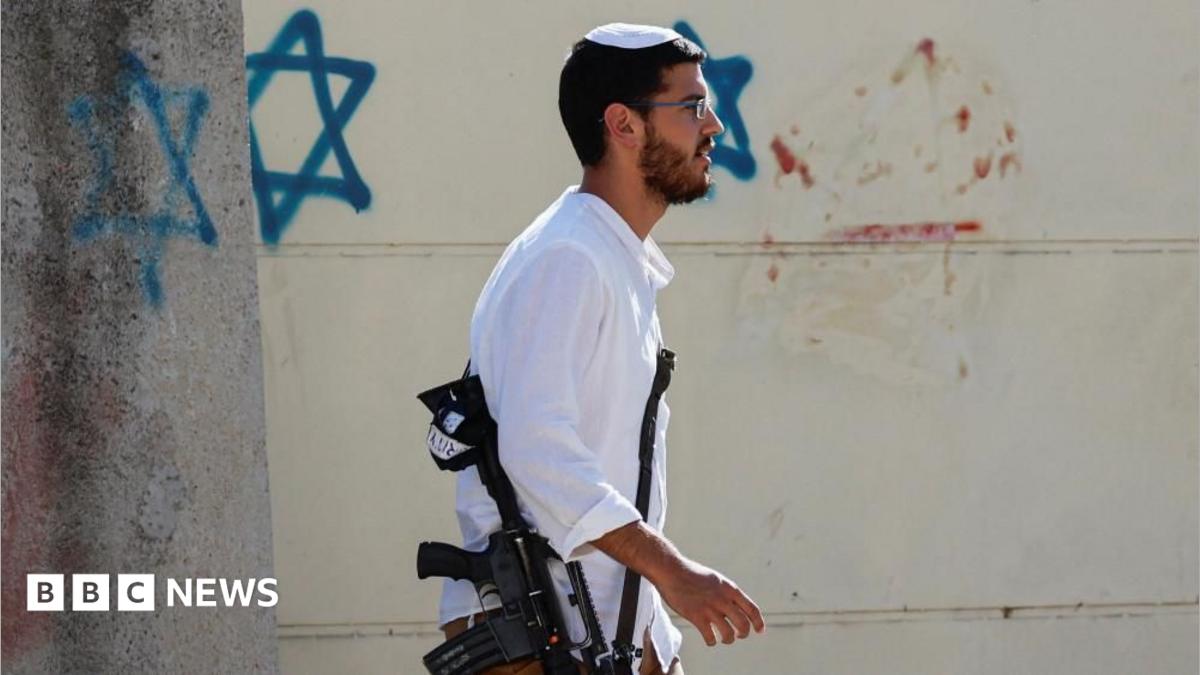














Samer is partially blind and has a leg injury that makes moving difficult.
“Fear dominates everything. We are completely defenceless,” he said. “All of them have weapons. I’m bringing concrete blocks to close off this side of the house because I’m afraid for my children.”
Samer has watched settlements – and settler attacks – grow in other parts of the West Bank over the past few years, despite international pressure.
“Europe has no time for us, America is preoccupied with Iran, China has no interest,” his analysis began. “Russia is busy with Ukraine, the United Nations is finished, and the Arab countries have their own internal problems.”
“Democratic systems are over, they’re finished,” he concluded, anger and bitterness leaking out. “Civilisation, progress and modernity are lies.”
Alongside the new settlements around Jenin, two new Israeli military bases are rapidly going up – construction vehicles churning up dust behind high concrete walls topped with watchtowers and barbed wire, Israeli flags flapping in the wind.
A military outpost is also being built on seized Palestinian land beside Jenin Refugee Camp – the first Israeli military base to be built on land under full Palestinian Authority control since the Oslo Accords were signed in 1993.
Israel’s military evacuated thousands of residents from Jenin Refugee camp before occupying it in 2025.
The Israel Defence Forces confirmed that construction of the outpost in Jabriyat had been ordered “in accordance with operational needs”.
The Palestinian Authority Governor for Jenin, Kamal Abu al-Rub, told me he was worried that Israel’s seizure of land around the refugee camp signalled a plan to house settlers there, right in the heart of a Palestinian city, dividing it up like Hebron or Jerusalem.
He described the past two decades without settlers around Jenin as “bliss”.
“Now, we live in the hell orchestrated by them and their assaults,” he said. “It limits our movement. They cut off roads, bulldoze lands and cut down trees.”
The speed of change here is breathtaking.
A few weeks ago, I sat drinking coffee in a café on the road that runs from Kadim through the northern West Bank to Israel: now that café – and dozens of Palestinian shops and businesses around it – are just piles of rubble along the road; demolished by the Israeli army.
The countdown to Israeli elections in October marked in the number of Palestinian buildings demolished, the number of new settler caravans.