







 Getty Images
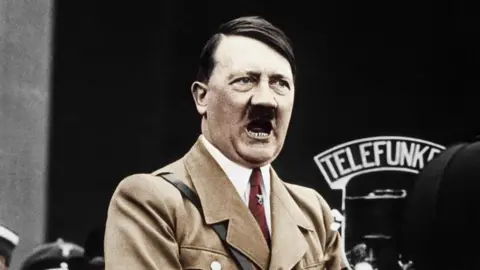
Groundbreaking DNA analysis of Adolf Hitler’s blood has uncovered some extraordinary findings about the dictator’s ancestry and possible health conditions.
Painstaking scientific testing by a team of international experts has been able to debunk a rumour on whether Hitler had Jewish ancestry (he didn’t) and determine that he had a genetic disorder which affects the development of sexual organs – all from an old blood-stained swatch of fabric.
While clickbait headlines have focused on whether the Nazi dictator had a micropenis and only one testicle, more serious are the findings that his DNA showed “very high” scores – in the top 1% – for a predisposition to autism, schizophrenia and bipolar disorder.
Does this mean he had these neurological conditions? Absolutely not, say the experts – it’s not a diagnosis.
But nevertheless, concerns have been raised about stigmatisation and how ethical the research was, prompting the question – should it have been done at all?
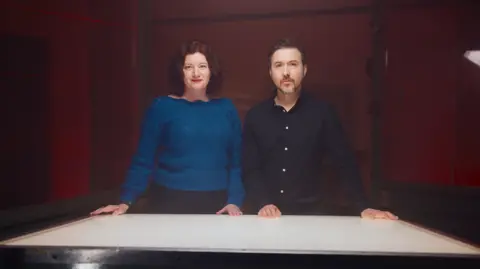
“I agonised over it,” says Prof Turi King within the first few minutes of Saturday’s Channel 4 documentary on the research, Hitler’s DNA: Blueprint of a Dictator.
The genetics expert told the BBC that when she was first approached to take part in the project several years ago, she was very aware of the potential implications on studying the DNA of someone like Adolf Hitler – “I’m not interested in sensationalising things”.
But, she says, it was likely to be done by someone at some point, and at least under her watch she could ensure the research was done with academic rigour and with all the “caveats and guardrails in place”.
Prof King is no stranger to high-profile and sensitive projects – she led the genetic investigation to establish the identity of Richard III’s skeleton after it was discovered buried under a car park in Leicester in 2012.

 Gettysburg Museum of History
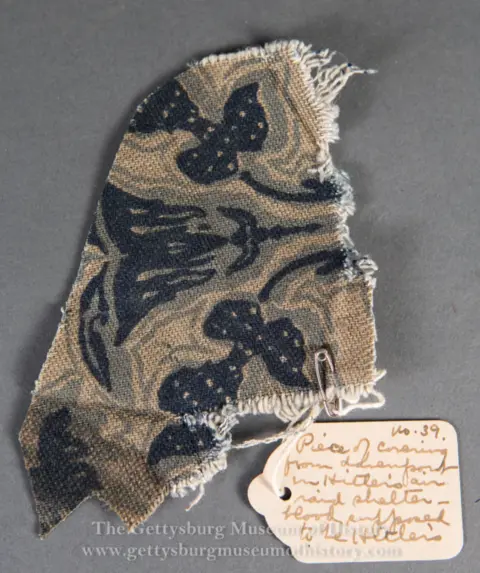
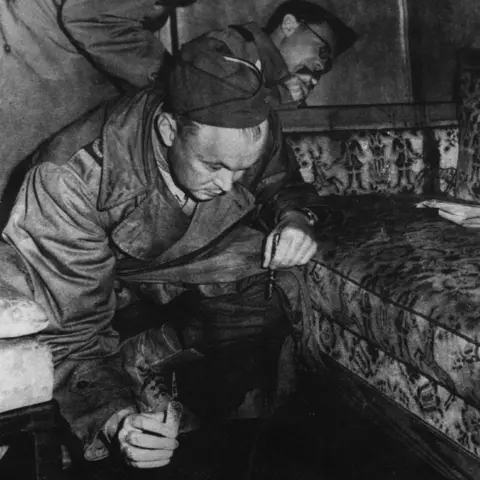
The bloodied swatch of fabric – now 80 years old – was cut out of the sofa in Hitler’s underground bunker, where he killed himself when Allied forces descended on Berlin at the end of World War Two.
While inspecting the bunker, Colonel Roswell P Rosengren of the US army saw an opportunity to get a unique war trophy and he pocketed the fabric. It’s now framed and on display at the Gettysburg Museum of History in the US.
The scientists are confident it really is Hitler’s blood, because they were able to perfectly match the Y-chromosome with a DNA sample from a male relative that had been collected a decade prior.
The results, which are now under peer review, are indeed fascinating.
It is the first time Hitler’s DNA has been identified, and over the course of four years, scientists were able to sequence it to see the genetic makeup of one of the world’s most horrific tyrants.
What is certain, experts say, is that Hitler did not have Jewish ancestry – a rumour that had been circulating since the 1920s.
Another key finding is that he had Kallmann syndrome, a genetic disorder that, among other things, can affect puberty and the development of sexual organs. In particular, it can lead to a micropenis and undescended testes – which, if you know the British war-time song, had been another rumour flying around about Hitler.
Kallmann syndrome can also affect the libido, which is particularly interesting, said historian and Potsdam University lecturer Dr Alex Kay, who is featured in the documentary.
“It tells us a lot about his private life – or more accurately, that he didn’t have a private life,” he explains.
Historians have long debated why Hitler was so completely devoted to politics, “to the almost total exclusion of any kind of private life”, and this could help to explain that.
These kinds of findings, the experts say, are what make them both fascinating and useful. As Prof King puts it: “the marrying of history and genetics”.
 Tom Barnes/Channel 4
More complicated and controversial are the results suggesting Hitler may have had one or more neurodiverse or mental health conditions.
Looking at his genome, and comparing it with polygenic scores, they found that Hitler had a high predisposition for autism, ADHD, schizophrenia and bipolar disorder.
This is where the science gets complex.
Polygenic scoring combs through a person’s DNA and calculates how likely they may be to develop a disease. It can be useful to detect an individual’s predisposition to conditions like heart disease and common cancers. But it compares their DNA with a large population sample, and therefore the findings can be far less certain when it comes down to an individual.
Throughout the documentary, which the BBC has seen, the experts are at pains to reiterate that the DNA analysis is not a diagnosis, but an indication of predisposition – it does not mean Hitler had any of these conditions.
But some genetic scientists have raised concerns that the findings are an oversimplification.
Denise Syndercombe Court, professor of forensic genetics at Kings College London, feels they have “gone too far in their assumptions”.
“In terms of character or behaviour, I’d have thought that’s pretty useless,” Prof Court, who tested the same blood sample in 2018, told the BBC.
She said she wouldn’t want to make any predictions as to whether someone had a particular condition from the results, because of “incomplete penetrance”.
Put simply, by fellow genetic scientist Dr Sundhya Raman: “Just because you have something encoded in your DNA, doesn’t mean you’ll express it.”
This is reflected in the documentary by Prof Simon Baron-Cohen, director of the Autism Research Centre at Cambridge University: “Going from biology to behaviour is a big jump,” he says.
“By looking at genetic results like this, there’s a risk of stigma. People out there might think, ‘Is my diagnosis being linked to somebody who did such monstrous things?'”
“The risk is reductionism down to genetics,” he says, when there are so many other factors to consider.
 Getty Images
The UK’s National Autistic Society was quick to respond, calling the findings a “cheap stunt”.
“Even worse than the shoddy science, we’re shocked at [the documentary’s] callous disregard for autistic people’s feelings,” said Tim Nicholls, assistant director of research, in a strongly worded statement.
“Autistic people deserve better than this.”
The BBC put the concerns to Channel 4 and Blink Films, the production company that made the documentary.
In a statement, it pointed out that experts like Prof Baron-Cohen “explain that how someone behaves is a product of many factors, not just their genetics but also, very importantly, their environment, everything from childhood and life experiences, how they were brought up, access to education and resources and the cultural factors around them.”
“The programme emphasises that the genetic insights revealed in the films shed light on Hitler, but they don’t tell us he was biologically predestined to behave in a particular way.”
 Stephanie Bonnas
There have also been raised eyebrows at the very name of the documentary, especially the second part: Blueprint of a Dictator.
Prof King said it wasn’t a name she would have chosen, and historian Prof Thomas Weber, who is featured in the programme, told the BBC he was surprised at the title, given they had stressed there is “no dictator gene”.
The professor, who had not seen the documentary before speaking to the BBC, said he found the DNA analysis both exciting and concerning.
“Exciting, because it confirmed a lot of things I already suspected about Hitler… but I had concerns on whether people would read too much into genetics, like trying to find the ‘evil gene’.”
He was also concerned about how it would be received, especially for people with autism and other syndromes mentioned in the programme.
There are many difficulties and pitfalls when you’re trying to make an accurate programme about complicated science for the general public.
“It’s television – it occasionally gets simplified,” said Prof King, who has a lot of experience balancing her responsibilities as a scientist with the realities of the media.
“They [the documentary makers] could have taken a different tack and gone very sensationalist but they haven’t, they’ve tried to catch some of the nuance… and we’ve put in the guardrails.”
Channel 4 defended the show’s name by saying that “DNA is colloquially known as the ‘blueprint of life’.” Additionally, its job is to “make programmes that reach a wide audience, and this programme aims to make complex scientific ideas and historical research accessible to all viewers”.
 Alamy
AlamyThere are many questions on the ethics of the project.
Should Hitler’s DNA have been examined if his permission – or that of a direct descendant – could not be given?
And how does that play into the fact that he was responsible for one of history’s worst atrocities? Does that negate his right to privacy?
“This is Hitler – he’s not some mystical character whom no one can conduct DNA research on. Who makes that decision?” Prof King argues.
Historian Subhadra Das agrees: “This is what scientists do. There are hundreds of long-dead people who have had their DNA sampled, it’s a common practice in science and archaeology – it’s how we read into it that starts to become problematic.”
Historian Dr Kay said he wasn’t concerned about the ethical angle, “as long as the facts were there and we made sure everything was double checked”.
And on whether Hitler’s DNA should have been touched: “Hitler’s been dead for 80 years. He doesn’t have any direct descendants and he didn’t have any children. He was responsible for untold suffering – we have to weigh that against the ethical dilemma of analysing his DNA.”
Interestingly, several labs in Europe declined being part of the project, and it was a facility in the US that did the testing.
The documentary-makers told the BBC that the research “has gone through the standard ethical review process for academic work” which includes reviews conducted in two countries.
 General Photographic Agency/Hulton Archive/Getty Images
So should this research have been conducted at all? The BBC spoke to a range of genetic scientists and historians, and the answer depends on who you ask.
Those in the documentary, naturally, say yes. It helps to build a more rounded profile of Hitler, a person who still fascinates and terrifies in equal measure.
“We should do whatever we can to understand past extremism,” Prof Weber believes.
“Let’s be honest,” says Dr Kay, “these topics were already out there… we haven’t suddenly planted this idea in people’s minds. People have been speculating on whether Hitler had certain disorders for decades.”
Not all historians agree.
“I think it’s a very dubious way of trying to explain what drove Hitler’s actions,” says Iva Vukusic, assistant professor of international history at Utrecht University.
Dr Vukusic, whose studies focus on the perpetration of mass violence, told the BBC she can understand why people are interested, but “whatever answers we seek are not going to be found through a DNA test”.
And while the research is interesting, it runs the risk of obscuring the real lessons of history, says Anne van Mourik, historian at the NIOD Institute in Amsterdam.
That lesson is that “normal people in certain contexts can commit, instigate or accept horrific violence”.
Focusing on Hitler’s (possible) micropenis, she says, doesn’t teach us anything about how mass violence and genocide works and why it occurs.
 Getty Images
With the study complete and the research under peer review, at some point, the full findings will be available.
Prof Weber says they should be used “extremely carefully and soberly”, but he’s hopeful that it is helpful in some way.
“That’s the nice thing about research results – it might happen in five, 150, 500 years time. This research is there for posterity and I’m confident that smart people will use them in the future.”
But we all have a responsibility on how we use these results.
Dr Kay says everyone must “follow the science” and make it clear on what we know and what we don’t.
That includes the media and how it is reported.
“Anyone watching this documentary has a responsibility to write on it accurately, to make sure they’re not contributing to the stigmatisation.
“A documentary like this doesn’t exist in a vacuum.”