










• Latest
  • Trending
  • All

Stone tool discovery suggests very first humans were inventors

November 5, 2025

Why I sold my business to my staff

June 15, 2026

The costs and challenges facing the 2026 World Cup

June 15, 2026

New microplastics research examines River Thames pollution

June 15, 2026

Reform pledges new tax on hiring foreign workers

June 15, 2026

Gang guilty of organised crime in £4m cocaine and dirty money ring

June 15, 2026

Pensioner suffocated neighbour and recorded his dying words, court told

June 15, 2026

Reports nurses told by police to show ID to masked men during trouble – O'Neill

June 15, 2026

World Cup 2026: Nestory Irankunda – the refugee who quit Bayern to make Australia history

June 15, 2026

Trump and thousands of others watch UFC fight on White House lawn

June 15, 2026

South African TV star arrested after allegedly kidnapping man in girlfriend dispute

June 15, 2026

Australia demands answers after girl taken hostage is shot dead by Pakistan police

June 15, 2026

Norwegian crown princess's son found guilty of two counts of rape

June 15, 2026
News
  • Login
  • Home
  • News
  • Sports
  • Worklife
  • Travel
  • Reel
  • Future
  • More
Monday, June 15, 2026
No Result
View All Result

NEWS

3 °c
London
8 ° Wed
9 ° Thu
11 ° Fri
13 ° Sat
  • Home
  • Video
  • World
    • All
    • Africa
    • Asia
    • Australia
    • Europe
    • Latin America
    • Middle East
    • US & Canada

    World Cup 2026: Nestory Irankunda – the refugee who quit Bayern to make Australia history

    Trump and thousands of others watch UFC fight on White House lawn

    South African TV star arrested after allegedly kidnapping man in girlfriend dispute

    Australia demands answers after girl taken hostage is shot dead by Pakistan police

    Norwegian crown princess's son found guilty of two counts of rape

    US musician Oliver Tree dies in helicopter collision in Brazil

    US and Iran agree deal to end war as Trump says Strait of Hormuz to reopen

    'Boyfriend duties call,' Trudeau says after skipping Canada match to watch Perry

    Clinical Australia upset Turkey in World Cup opener

  • UK
    • All
    • England
    • N. Ireland
    • Politics
    • Scotland
    • Wales

    Reform pledges new tax on hiring foreign workers

    Gang guilty of organised crime in £4m cocaine and dirty money ring

    Pensioner suffocated neighbour and recorded his dying words, court told

    Reports nurses told by police to show ID to masked men during trouble – O'Neill

    Starmer set to ban under-16s from major social media platforms

    Hamilton says Barcelona win beyond wildest dreams

    Sinkholes near Purley bridge halt Gatwick trains

    Glasgow race attacks a 'mark against the reputation of the city'

    Jade Jones could face Sheena Bathory after dominant second boxing win

  • Business
    • All
    • Companies
    • Connected World
    • Economy
    • Entrepreneurship
    • Global Trade
    • Technology of Business

    Why I sold my business to my staff

    Oil prices slide after Pakistan announces deal between US and Iran

    UK electric car sales target set to be weakened

    Why the US economy keeps defying the odds

    Teen plans to leave uni 'debt free' after making £35,000 selling vintage football shirts

    Beauty Pie LED mask ad banned over misleading anti-wrinkle claim

    Elon Musk becomes world's first trillionaire as SpaceX soars in stock market debut

    'I was employee number one at SpaceX'

    Reporter Reads

  • Tech
  • Entertainment & Arts

    Meghan hits red carpet at Power of Women in Hollywood

    Margot Robbie unable to speak at Saltburn premiere

    Barbra Streisand: Siri can now pronounce my name

    Wes Anderson’s The Grand Budapest Hotel inspires cinema’s look

    Taylor Swift/ Travis Kelce romance reaches White House

    The Killers booed at Georgia concert after inviting Russian fan on stage

    Watch: Memorable moments from Parkinson's star-studded show

    Tom Jones: Neighbour surprised to find singer in flat below

    Black Country Folk Festival showcases local musicians

    Watch: Australians set new world record with Tina Turner dance

  • Science
  • Health
  • In Pictures
  • Reality Check
  • Have your say
  • More
    • Newsbeat
    • Long Reads

NEWS

No Result
View All Result
Home Science

Stone tool discovery suggests very first humans were inventors

November 5, 2025
in Science
11 min read
250 3
0
492
SHARES
1.4k
VIEWS
Share on FacebookShare on Twitter


Pallab Ghosh profile image

Pallab GhoshScience Correspondent

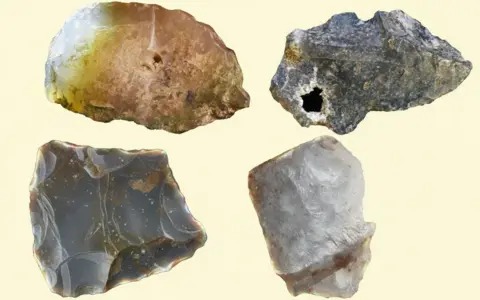
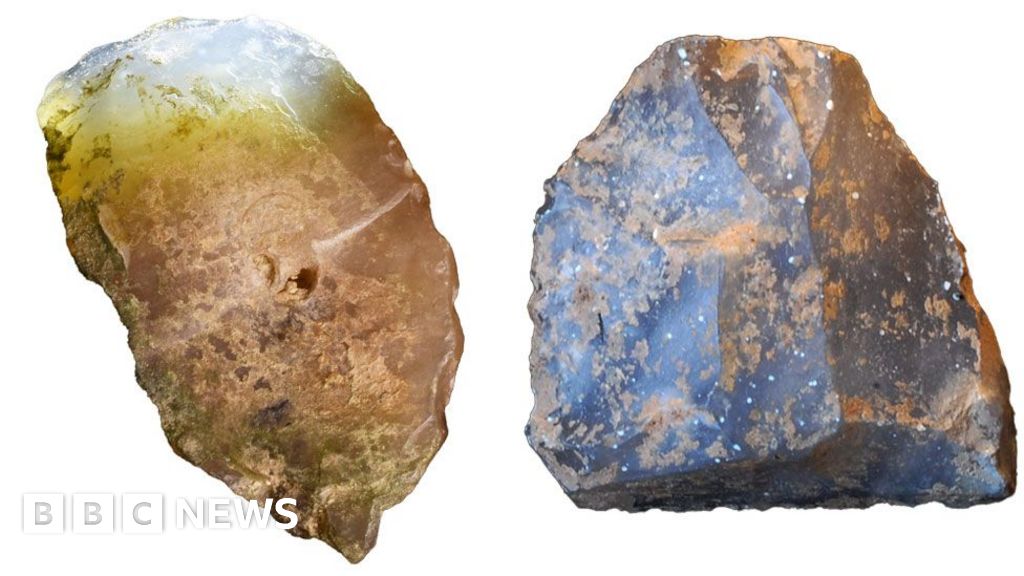
David Braun Composite image of four stone tools on a pale yellow background. The top left stone displays a rich blend of golden and earthy hues with a polished appearance and distinct surface features. The top right stone is darker, rugged, and features a prominent cavity, giving it a unique and weathered character. The bottom right stone appears translucent and pearlescent, with gentle gradients of white and pale brown that highlight its smooth fractured surfaces. The bottom left stone stands out with glassy reflections, angular facets, and traces of ancient flaking visible against its blue-grey background.David Braun

They look like simple stones, but they were state of the art tools millions of years ago, made with great skill and precison

The very first humans millions of years ago may have been inventors, according to a discovery in northwest Kenya.

Researchers have found that the primitive humans who lived 2.75 million years ago at an archaeological site called Namorotukunan used stone tools continuously for 300,000 years.

Evidence previously suggested that early human tool use was sporadic: randomly developed and quickly forgotten.

The Namorotukunan find is the first to show that the technology was passed down through thousands of generations.

According to Prof David Braun, of George Washington University, in Washington DC, who led the research, this find, published in the journal Nature Communications, provides incredibly strong evidence for a radical shake-up in our understanding of human evolution.

“We thought that tool use could have been a flash in the pan and then disappeared. When we see 300,000 years of the same thing, that’s just not possible,” he said.

“This is a long continuity of behaviour. That tool use in (humans and human ancestors) is probably much earlier and more continuous than we thought it was.”
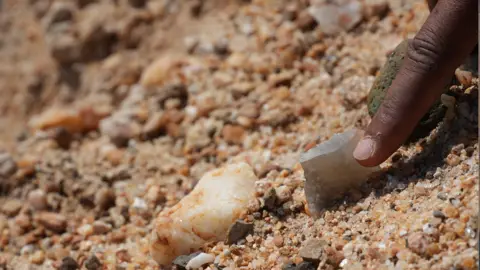
David Braun A person's hand is pointing to or holding a sharp stone tool that is partially buried in sandy, gravelly ground. The scene is very close up, showing the texture of the dirt and small rocks around the tool. The focus suggests the discovery or examination of a potential artifact, likely during an archaeological dig.David Braun

The stone tools were so sharp that the researchers could cut their fingers on some of them

Archaeologists spent ten years at Namorotukunan uncovering 1,300 sharp flakes, hammerstones, and stone cores, each made by carefully striking rocks gathered from riverbeds. These are made using a technology known as Oldowan and is the first widespread stone tool-making method.

The same kinds of tools appear in three distinct layers. The deeper the layer the further back the snapshot in time. Many of the stones were specially chosen for their quality, suggesting that the makers were skilled and knew exactly what they were looking for, according to the senior geoscientist on the research team, Dr Dan Palcu Rolier of the University of São Paulo in Brazil.

“What we see here in the site is an incredible level of sophistication,” he told BBC News.

“These guys were extremely astute geologists. They knew how to find the best raw materials and these stone tools are exceptional. Basically, we can cut our fingers with some of them.”

Geological evidence suggests that tool use probably helped these people survive dramatic changes in climate.

The landscape shifted from lush wetlands to dry, fire-swept grasslands and semideserts,” said Rahab N. Kinyanjui, senior scientist at the National Museums of Kenya.

Map of Kenya in East Africa, surrounded by Uganda to the west, Tanzania to the south, Ethiopia to the north, and Somalia to the east, with the Indian Ocean on its southeast coast. The map highlights a specific location named Namorotukunan Hill in northwestern Kenya, almost on the border with Ethiopia. Nairobi, the capital city of Kenya, is marked further south in the middle of the country. A small inset globe at the top left corner displays Kenya's position within Africa.

These sharp environmental changes would normally force animal populations to adapt through evolution or move away. But the toolmakers in the region managed to thrive by using technology rather than biological adaptation, according to Dr Palcu Rolier.

“Technology enabled these early inhabitants of East Turkana to survive in a rapidly changing landscape – not by adapting themselves, but adapting their ways of finding food.”

The evidence of stone tools at different layers shows that for a long and continuous period, these primitive people flew in the face of biological evolution, finding a way of controlling the world around them, rather than letting the world control them.

And this happened at the very beginning of the emergence of humanity, according to Dr Palcu Rolier.

“Tool use meant that they did not have to evolve by modifying their bodies to adapt to these changes. Instead, they developed the technology they needed to get access to the food: tools for ripping open animal carcasses and digging up plants.”
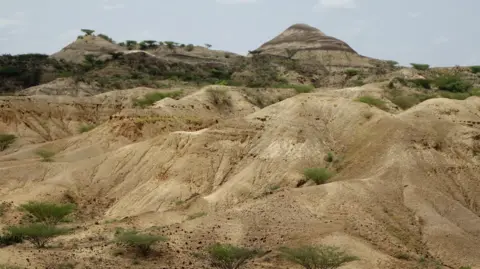
David Braun The picture shows a broad, arid landscape of tan and sandy hills with gentle slopes and eroded gullies, dotted with small green shrubs and sparse trees. In the background, there are a few dome-shaped hills and patches of vegetation, beneath a pale blue sky with scattered, wispy white clouds. The overall scene is dry and rugged, evoking a sense of ancient terrain shaped by long-gone water flowsDavid Braun

The Namorotukunan site, located in Kenya’s Turkana Basin, lies close to the ancient course of a long dried up major river which once attracted settlements of early humans and their ancestors

There is evidence for this at the site: of animal bones being broken, being cut with these stone tools, which means that through these changes, they were consistently able to use meat as a way of sustenance.

“The technology gives these early inhabitants an advantage, says Dr Palcu Rolier.

“They are able to access different types of foods as environments change, their source of sustenance is changing, but because they have this technology, they can bypass these challenges and access new food.”
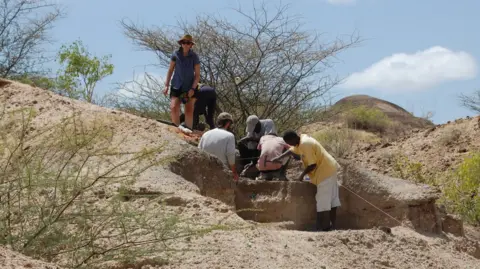
David Braun A group of people are working together at an archaeological dig site in a dry, rocky landscape with sparse vegetation. Some are kneeling and carefully examining or excavating a partially exposed layer of earth, while one stands nearby watching. Their focused activity suggests they are searching for or studying artifacts or fossils in the ground.David Braun

Archaeologists excavate a 2.58 million year old site in northern Kenya at the site of Namorotukunan

At around 2.75 million years ago, the region was populated by some of the very first humans, who had relatively small brains. These early humans are thought to have lived alongside their evolutionary ancestors: a pre-human group, called australopithecines, who had larger teeth and a mix of chimpanzee and human traits.

The tool users at Namorotukunan were most likely one of these groups or possibly both.

And the finding challenges the notion held by many experts in human evolution that continuous tool use emerged much later, between 2.4 and 2.2 million years ago, when humans had evolved relatively larger brains, according to Prof Braun.

“The argument is that we’re looking at a pretty substantial brain size increase. And so, often the assertion has been that tool use allowed them to feed this large brain.

“But what we’re seeing at Namorotukunan is that these really early tools are used before that brain size increase.”

“We have probably vastly underestimated these early humans and human ancestors. We can actually trace the roots of our ability to adapt to change by using technology much earlier than we thought, all the way to 2.75 million years ago, and probably much earlier.”




Source link

Tags: discoveryhumansinventorsStonesuggeststool

Related Posts

New microplastics research examines River Thames pollution

June 15, 2026
0

Three litres of surface water will be collected from seven publicly accessible riverside locations along the Thames - Teddington,...

Fears dogs to blame for drop in little tern numbers

June 14, 2026
0

It has been the worst year for dogs getting too close to the nesting birds, a wildlife trust says....

Calls to restore chalk grassland for rare insects

June 13, 2026
0

Buglife says the project aims to restore more than 30 hectares of the vital ecosystem. Source link

  • Lee McGregor: Scot seeks world title in 2025 & Nathaniel Collins bout

    677 shares
    Share 271 Tweet 169
  • Belgian footballer arrested in cocaine investigation

    533 shares
    Share 213 Tweet 133
  • Next to raise prices to help pay for rising wage costs

    531 shares
    Share 212 Tweet 133
  • South Wales Police officers injured, one arrested

    525 shares
    Share 210 Tweet 131
  • Charities to get £15m fund to save surplus farm food

    516 shares
    Share 206 Tweet 129
  • Trending
  • Comments
  • Latest

Lee McGregor: Scot seeks world title in 2025 & Nathaniel Collins bout

January 16, 2025

Belgian footballer arrested in cocaine investigation

January 27, 2025

Next to raise prices to help pay for rising wage costs

January 7, 2025

World Cup 2022: TikTok brings football fever to millions of fans

0

UK economy will get worse before it gets better, warns chancellor

0

One of Central America’s most active volcanoes erupts again

0

Why I sold my business to my staff

June 15, 2026

The costs and challenges facing the 2026 World Cup

June 15, 2026

New microplastics research examines River Thames pollution

June 15, 2026

Categories

Economy

Why I sold my business to my staff

June 15, 2026
0

Stockwell made the decision to sell to his employees after seeing what happened to other firms that had been...

Read more

The costs and challenges facing the 2026 World Cup

June 15, 2026
News

© 2023 GODJ - NEWS CORP - news.godj.com.

Explore NEWS.GODJ.COM

  • Home
  • News
  • Sports
  • Worklife
  • Travel
  • Reel
  • Future
  • More

Follow Us

  • Home Main
  • Video
  • World
  • Top News
  • Business
  • Sport
  • Tech
  • UK
  • In Pictures
  • Health
  • Reality Check
  • Science
  • Entertainment & Arts
  • Login

© 2023 GODJ - NEWS CORP - news.godj.com.

Welcome Back!

Login to your account below

Forgotten Password?

Create New Account!

Fill the forms bellow to register

All fields are required. Log In

Retrieve your password

Please enter your username or email address to reset your password.

Log In
This website uses cookies. By continuing to use this website you are giving consent to cookies being used. Visit our Privacy and Cookie Policy.