














 Justin RowlattClimate Editor
 BBC
BBCListen to Justin read this article
One morning last year, John Gladwin opened the cupboard under his kitchen sink and discovered a bag of soil he’d been storing there was torn to shreds.
Days later he noticed a pungent smell too. It was musty and slightly astringent, not unlike the communal bin area in his block of flats.
“I knew what it was straight away,” he says. “Rats.”
He’d often seen them scurrying around near bins. Now they were inside his home too.
“I heard them in the cupboards and behind the bath panel. One morning when I woke up they were fighting under the bath, screaming and squealing.”
Mr Gladwin, who lives in Croydon with his five children, acted immediately. He put down peppermint oil and rat poison and so far they haven’t returned. But the experience shook him. “I was worried for the children’s health, I didn’t want them catching anything.”
There was another feeling too: shame.
“It’s not nice to say we’re infested, that our family is living in a rat-infested property.”
Cleankill, the pest control company tasked with tackling the infestation on Mr Gladwin’s estate, works across the south of England. Its founder, Clive Bury says he has seen a “remarkable” increase in call outs for rat activity, estimating a 20% increase in the last two years.
Similar patterns are being reported across the country. Trade body the British Pest Control Association (BPCA) says more than half of the pest control companies who are members have seen an increased number of rat callouts over the last five years.
Rats live in drains, sewers and burrows, and emerge mostly at night, so counting them is nearly impossible and estimates on rat population figures vary. In the UK it could be anywhere from 10 million to 120 million.
What is known is that more than half a million rat infestations were reported to UK councils, between 2023 and the middle of this year, according to Freedom of Information requests gathered by repair company, Drain Detectives.
But it’s not just affecting the UK.
Rat numbers are reported to have spiked in several US cities too, including Washington DC, San Francisco and New York City, as well as in Amsterdam and Toronto.
Though they’re not inherently dirty animals, rats scavenge in sewers and bins and can pass on serious diseases to humans. Leptospirosis (Weil’s disease) is transmitted through their urine, and hantavirus can be spread by breathing in infected droppings. They can also eat their way through farm produce and contaminate food supplies.
So, given rats have shown themselves to be wily in avoiding being caught – what would it really take to stop them? Or are we too far gone to prevent rats from overrunning our cities?
Rising temperatures, rising rat activity
Bobby Corrigan calls himself an urban rodentologist. He started out as an exterminator in New York City and has spent his life immersed in rats.
“I ended up in sewers, trying to hang poison baits to kill rats.”
Years later, while studying rats in college, he went to extreme lengths to understand their behaviours – once he slept on the floor of a rat-infested barn to observe it first hand.
What astonished him was their complex social structure, and evidence of what he believed to be signs of altruism. “I saw young rats carrying food and giving it to older rats that couldn’t get around,” he remembers.
He was also determined to understand the reasons for the rise.
There are many possible reasons for this. Niall Gallagher, technical manager at the BPCA, says our growing appetite for fast food, the fact some councils collect rubbish less frequently, as well as road and building works disturbing the sewer network, all contribute.
But there is evidence that rising temperatures might also be at play.
Scientific evidence has found that rat populations are sensitive to temperature but Dr Corrigan, who previously worked at the New York City Department of Health as a research scientist, together with researchers from the University of Richmond, Virginia, set out to find out whether the rise in rat activity correlated to temperature increases.
Their study examined 16 cities, mostly in North America, and the results, published in the journal Science Advances earlier this year, found that 11 of them recorded significant increases in rat activity over a period of between seven and 17 years.
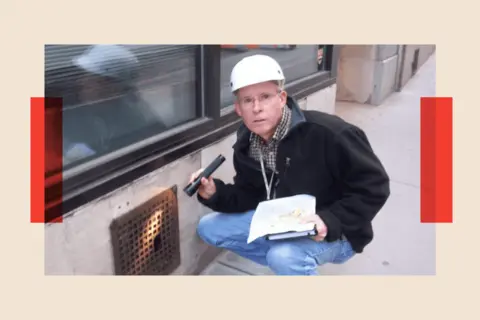 Bobby Corrigan
In Washington DC the increase was almost 400%, in San Francisco it was 300%, Toronto 180% and New York 160%. Only three cities saw declines, including Tokyo and New Orleans.
“Cities experiencing greater temperature increases over time saw larger increases in rats,” the study found. Those increases approached 2C in some places during the study period.
Dr Corrigan believes that – as long as temperatures continue to rise, and in particular winters become warmer – the increase in rat numbers is likely to continue.
And global temperatures are indeed set to rise between at least 1.9C and 2.7C above the pre-industrial average by 2100, according to Climate Action Tracker, a group of independent climate researchers.
Phenomenal breeders – until it’s cold
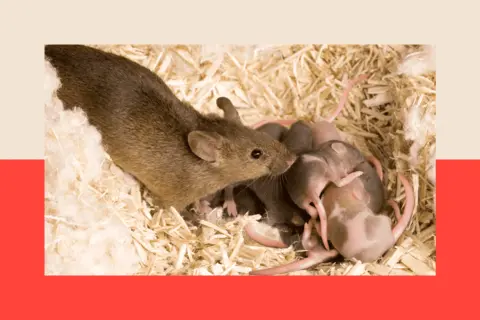
Rats are phenomenal breeders. A female typically has around six litters a year, each with up to 12 pups.
Those rats can start breeding after nine weeks, meaning two rats can potentially create more than 1,000 offspring in a single year.
 Universal Images Group via Getty Images
Researchers say numbers are particularly prone to increase in cities. That’s because their heat-trapping tarmac and buildings tend to warm more quickly than rural areas.
And the trend of people moving from rural areas to cities is playing a part too, according to Dr Corrigan. “Land is disappearing like crazy, and we’re putting up buildings so we reduce their [rats] habitat in the wild,” he says.
Extra buildings means more nooks, pipes and drains for rats to live in. Which all adds to the challenge of how to best control growing populations.
A surprising superpower
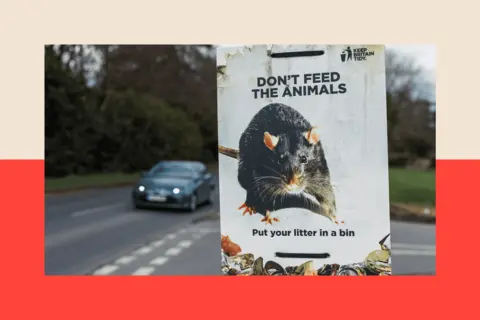
One of the curious facts about rats – and one begins to explain why poison baits often don’t work – is that they cannot vomit.
In theory this means that once rat poison is ingested, they can’t get rid of it. But rats are also “neophobic” or fearful of new things, according to Professor Steven Belmain, a professor of ecology at the University of Greenwich. He believes the two points are related.
It is something of a “superpower”, he says, as when they come across a potential food they don’t just dive in.
“They will only try a little bit. So once they understand that they don’t feel ill, they’ll realise, ‘okay, I can eat that’.
“You could argue that this cautious approach to life has stood them well.”
 Getty Images
Dr Alan Buckle of the University of Reading has spent 30 years working to develop new rat poisons but – he tells me with a laugh – “I failed”.
If a poison tastes bad or causes any discomfort or pain to a rat, they will not eat more. Which is why slower-acting substances, mainly anticoagulants – drugs that stop blood forming into clots – are used.
These take up to a week to act, giving enough time for rats to eat a lethal dose. But they are recognised as a cruel way to die, killing the rats by causing internal bleeding.
What’s more, in recent years rats have developed genetic mutations that give them some immunity to these powerful drugs too.
Some researchers are looking at the possibility of using oral contraceptives as an alternative, more humane way to prevent rat numbers growing further.
On patrol with the Rat Tsar
Few know this challenge better than Kathleen Corradi, a former schoolteacher who was appointed the city’s Rat Tsar by the New York Mayor in 2023.
An estimated three million rats live in the five boroughs and Corradi was reportedly awarded $3.5m (£2.6m) to increase public awareness about rat mitigation.
She started what she calls a “rat academy” that teaches people how to stop their neighbourhood from being overrun by rats.
 New York City Hall
“They take a rat walk with me, where we go out into neighbourhoods, and we talk about human behaviour and we talk about rat behaviour,” she told the BBC earlier this month.
“We talk about how it all comes together and what they could be doing in their neighbourhoods.”
Her team also urged New York residents to phone in if they see rats or evidence of behaviours likely to encourage rats. Inspectors investigate the reports and order action, with stiff fines if it isn’t taken.
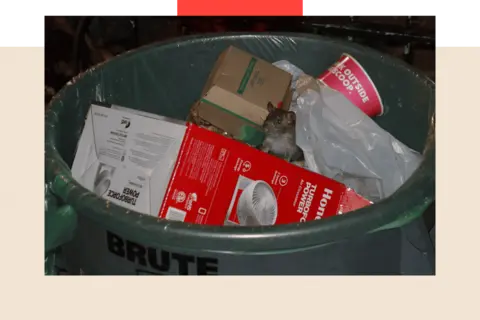
And there was another crucial change – instead of putting their rubbish out on the street in plastic bags, now most New Yorkers are obliged to put their waste in rat-proof bins.
 Getty Images
Corradi is now leaving the role, but she says the approach is showing some progress.
Ultimately, she explained, “cutting off rats’ food source is the key to a sustained reduction”.
Overflowing bins and fast food
Back in Croydon, Alex Donnovan, a pest controller for Cleankill, leads me into the backyard of the estate where John Gladwin lives. It is just after dawn, and he gestures for me to stay still and keep quiet.
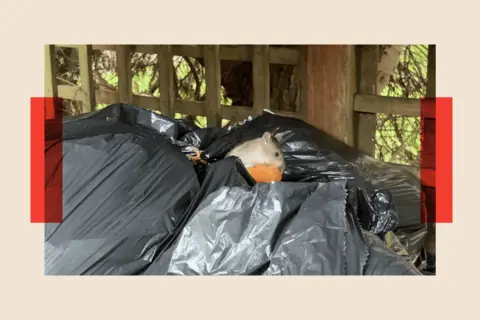
Moments later, there is a rustling and a rat darts from beneath the concrete walkway towards the communal bins. Next, the head of a large rat emerges from a burrow at the end of the garden.
During the two hours we spent on the estate, some rats climbed high into a tree, while a particularly brazen one jumped into a bin and pulled a hunk of food from a plastic bag while I watched on, less than a metre away.
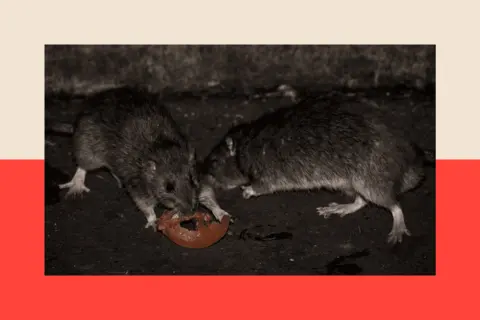
Mr Donnovan believes it is almost impossible to get control of an infestation of this scale. “There’s just so much food.” He gestures to bins overflowing with rubbish bags.
“Even if we put down rodenticide, they won’t eat it. They are just not interested… Once these bins are infested with rats, the bin men don’t want to collect it either.”

Warmer temperatures may well help fuel growing rat populations but our overflowing bins, fondness for fast food and fractured communities all add to the challenge of keeping it under control.
In the UK there are more people than ever are living in closer proximity. The Office for National Statistics projects the population will increase from 67.6 million in 2022 to 72.5 million by 2032, with the proportion living in urban areas growing too.
So, instead of hoping poison will do the trick, the solution could come down to something far more straightforward.
 AFP via Getty Images
“If we take care of our city environment, then we won’t have to worry about being so inhumane to them,” argues Dr Corrigan.
“By not giving [rats access to] the food and scraps, then we don’t have to poison them and kill them and torture them and all the crazy things we do to them.”
The challenge now is how to do that, and at speed. After all, as he puts it, we have already “underestimated them”.
“We ignored rats and let them get out of hand… and now we are paying the price.”
Additional reporting: Florence Freeman
BBC InDepth is the home on the website and app for the best analysis, with fresh perspectives that challenge assumptions and deep reporting on the biggest issues of the day. And we showcase thought-provoking content from across BBC Sounds and iPlayer too. You can send us your feedback on the InDepth section by clicking on the button below.