









• Latest
  • Trending
  • All

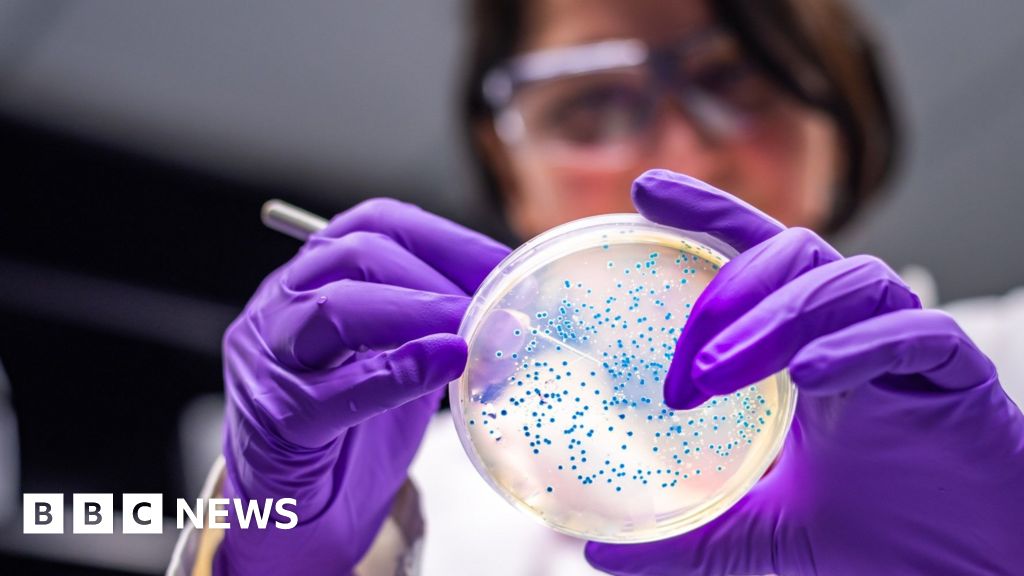
The bacteria turning waste plastic into painkillers

September 26, 2025

Ice cream: How the big firms innovate to stay ahead

August 15, 2026

Temporary disposable barbecue ban over wildfire risk

August 15, 2026

Why tech bosses keep sharing their manifestos about AI

August 15, 2026

European Athletics Championships 2026: Keely Hodgkinson takes 800m silver behind Swiss rival Audrey Werro

August 15, 2026

Electric vehicle sales targets could be cut after pressure from car makers

August 14, 2026

Business Daily – Taking Stock: The cost of heatwaves

August 14, 2026

Major oil slick washes up on Iran coast after Hormuz ship strike

August 14, 2026

Rare breeding bat found roosting near South Yorkshire reservoir

August 14, 2026

Killer who will not say where wife's body is to stay in prison

August 14, 2026

Amy Hunt: Can getting glammed up really improve your performance?

August 14, 2026

Arrests and road closed over suspected abduction in East Lothian

August 14, 2026

Tân mawr ger Llanymddyfri yn gorfodi nifer o bobl i adael eu tai

August 14, 2026
News
  • Login
  • Home
  • News
  • Sports
  • Worklife
  • Travel
  • Reel
  • Future
  • More
Saturday, August 15, 2026
No Result
View All Result

NEWS

3 °c
London
8 ° Wed
9 ° Thu
11 ° Fri
13 ° Sat
  • Home
  • Video
  • World
    • All
    • Africa
    • Asia
    • Australia
    • Europe
    • Latin America
    • Middle East
    • US & Canada

    Australia v Bangladesh: Steve Smith benefits from reprieve but tourists dominate day one of first Test

    Builders unearth €9m gold loot sealed in walls of Belgian property

    Chad’s Succès Masra: Former prime minister given state pardon

    Japan: Record rain in Chiba kills eight as thousands stranded at Narita Airport

    Engine parts smashed Ryanair window that man’s head was sucked out of, report says

    Stolen Matisse artworks recovered by police in Brazil

    Israeli settlers besieging Palestinian families in West Bank village

    Concern grows over conditions on USS Abraham Lincoln

    Australian army whistleblower released on parole after more than two years in jail

  • UK
    • All
    • England
    • N. Ireland
    • Politics
    • Scotland
    • Wales

    Temporary disposable barbecue ban over wildfire risk

    European Athletics Championships 2026: Keely Hodgkinson takes 800m silver behind Swiss rival Audrey Werro

    Killer who will not say where wife's body is to stay in prison

    Arrests and road closed over suspected abduction in East Lothian

    Tân mawr ger Llanymddyfri yn gorfodi nifer o bobl i adael eu tai

    Ardoyne: Police defend response to north Belfast incidents

    'Welcome to one of the most bizarre by-elections in recent history'

    European Athletics Championships 2026: Amy Hunt wins 200m gold as Dina Asher-Smith claims bronze

    'Releasing my son's killer early would be a slap in the face'

  • Business
    • All
    • Companies
    • Connected World
    • Economy
    • Entrepreneurship
    • Global Trade
    • Technology of Business

    Ice cream: How the big firms innovate to stay ahead

    Electric vehicle sales targets could be cut after pressure from car makers

    Business Daily – Taking Stock: The cost of heatwaves

    US says dozens of countries helped China dodge Trump’s tariffs

    RBSI announces around 50 job cuts in Jersey

    UK economy grows but experts warn of challenging months ahead

    Twitch users can now block Amazon from using their content to train AI

    Burnham warned Iran war could hit UK growth next year

    First wave of ‘pounds for pylons’ energy discount sites revealed

  • Tech
  • Entertainment & Arts

    Meghan hits red carpet at Power of Women in Hollywood

    Margot Robbie unable to speak at Saltburn premiere

    Barbra Streisand: Siri can now pronounce my name

    Wes Anderson’s The Grand Budapest Hotel inspires cinema’s look

    Taylor Swift/ Travis Kelce romance reaches White House

    The Killers booed at Georgia concert after inviting Russian fan on stage

    Watch: Memorable moments from Parkinson's star-studded show

    Tom Jones: Neighbour surprised to find singer in flat below

    Black Country Folk Festival showcases local musicians

    Watch: Australians set new world record with Tina Turner dance

  • Science
  • Health
  • In Pictures
  • Reality Check
  • Have your say
  • More
    • Newsbeat
    • Long Reads

NEWS

No Result
View All Result
Home Tech

The bacteria turning waste plastic into painkillers

September 26, 2025
in Tech
10 min read
235 18
0
492
SHARES
1.4k
VIEWS
Share on FacebookShare on Twitter


Zoe CorbynTechnology Reporter, San Francisco
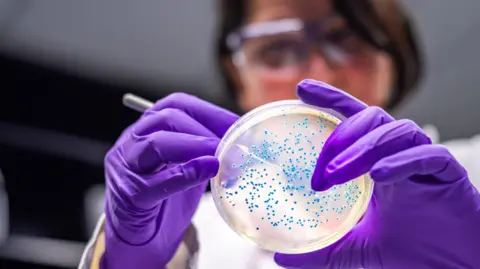
Getty Images A female scientist wearing purple gloves examines a petri dish container e.coli.Getty Images

E. coli has been used in many discoveries in genetics and molecular biology

Earlier this year an extraordinary new way of using waste plastic made headlines.

A common bacterium was genetically engineered to eat a plastic-derived molecule and then digest it to produce the everyday painkiller, paracetamol.

The microbe used by Stephen Wallace, professor of chemical biotechnology at the University of Edinburgh, was Escherichia coli, better known as E. coli.

The rod-shaped bacterium is found in the intestines of humans and animals, and you might be more familiar with it as an unpleasant bug that can make us ill.

Prof Wallace chose it automatically because certain strains of E. coli that aren’t pathogenic are used extensively in biotechnology and engineering biology laboratories to test whether something might work.

E. coli is the field’s main “workhorse” says Prof Wallace, who has also genetically engineered it in the lab to turn plastic waste into vanilla flavour and fatberg waste from sewers into perfume.

“If you want to prove something is possible with biology, E.coli is a natural first stage,” he says.

The microbe’s use isn’t just confined to the lab. Industrially, vats of genetically engineered E. coli act like living factories producing a variety of products from pharmaceuticals like insulin, vital for diabetes management, to various platform chemicals used to make fuels and solvents.

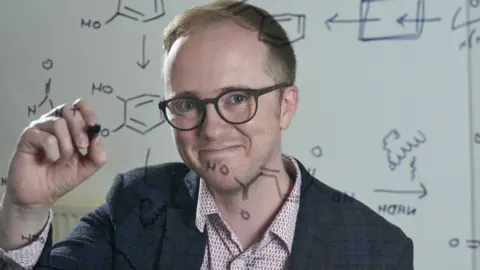
University of Edinburgh Smiling Professor Stephen Wallace writes chemical formulae on a see-through display board.University of Edinburgh

Prof Wallace has engineered E.coli to produce vanilla flavour and perfume

But how did E. coli come to be such a mainstay of biotechnology, why is it so useful and what might its future hold?

E. coli’s dominance stems from its role as a model organism for understanding general biological principles, says Thomas Silhavy, a professor of molecular biologist at Princeton University, who has been performing studies in the bacterium for about 50 years and has documented its history.

Other familiar model organisms include mice, fruit flies and baker’s yeast. Yeast, like E. coli, has also become an invaluable tool in biotechnology, both in the lab and industrially – but it has a more complex cell structure and different applications.

E. coli was first isolated in 1885 by a German paediatrician, Theodor Escherich, studying infant gut microbes. Fast growing and easy to work with, scientists began to use it to study basic bacterial biology.

Then in the 1940s, “serendipity” catapulted it into the big time, says Prof Silhavy.

A non-pathogenic E. coli strain (K-12) was used to demonstrate bacteria did not just divide, but could undergo ‘bacterial sex’ where they share and recombine genes to gain new traits.

It was a landmark discovery and E. coli became the “very favourite organism of everybody”, he says.

It saw E. coli go on to play a central role in many more discoveries and milestones in genetics and molecular biology.

It was used to help decipher the genetic code, and in the 1970s it became the first organism to be genetically engineered when foreign DNA was inserted into it – laying the foundation for modern biotechnology.
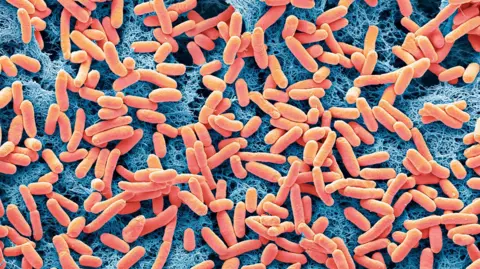
Getty Images Dozens of E.coli bacteria under a microscope, looking like red capsulesGetty Images

E. coli is fast growing and easy to work with

It also solved a problem with insulin production. Insulin from cattle and pigs had been used to treat diabetes, but caused allergic reactions in some patients.

But in 1978 the first synthetic human insulin was produced using E. coli, a huge breakthrough.

In 1997, it became one of the first organisms to have its entire genome sequenced, making it easier to understand and manipulate.

Adam Feist, a professor at the University of California, San Diego who evolves microbes for industrial applications, says he appreciates E. coli for its many useful features.

Beyond the vast knowledge accumulated about its genetics and the tools that make it easy to engineer, the bacterium grows quickly and predictably on a wide variety of substrates. It isn’t “finicky” like some, can be frozen and revived without trouble, and is unusually good at hosting foreign DNA.

“The more I work with more microorganisms, the more I appreciate just how robust E. coli is,” he says.

Cynthia Collins is a senior director at Ginkgo Bioworks, a company that helps firms develop their biotech products, and has assisted them in using E. coli industrially.

While the menu of organisms available for large-scale manufacturing is somewhat broader than it was a few decades ago – when E. coli was often the only choice – it can frequently still be a “good choice” depending on the product, says Dr Collins. (Even with the most intensive bioengineering, E. coli can’t produce everything).

“It’s very economical; you can pump out a lot,” she says, noting that if the bacterium is producing something toxic to the cells, tolerance can often be engineered in.
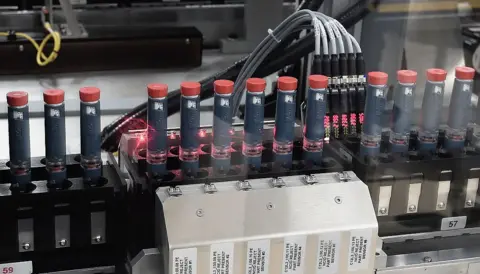
AFP via Getty Images Test tubes on a production lineAFP via Getty Images

E. coli is used in the production of insulin

Yet there are some who wonder if E. coli’s dominance might be stifling us from finding the very best biotech solutions for our problems.

Paul Jensen, a microbiologist and engineer at the University of Michigan, studies bacteria that live in our mouths. He recently analysed just how understudied most other bacteria have been relative to E. coli.

His point is while we are forging ahead with ever more extensive engineering of E. coli to do remarkable things, there could be other microbes out there that do those things naturally – and better – that aren’t getting a look in and we are missing out on benefitting from because they aren’t being sought out or studied.

Bioprospecting in landfills, for example, might turn up microbes that have started eating not only plastic but all sorts of other waste, he says. And there could be bacteria out there that do things – like making cement or rubber – we haven’t even imagined. Just the bacteria that live in our mouths outshine E. coli for acid tolerance he notes.

“We are just so deep with E. coli that we are not investigating enough,” he says.

There are some alternatives people are working on to increase options – including Vibrio natriegens (V. nat), which has begun to gain attention as a potential competitor to E. coli.

V. nat was first isolated from a salt marsh in the US state of Georgia back in the 1960s but remained largely neglected in culture collections and freezers until the mid-2010s when it was recognized for its ultra-fast growth rate – twice that of E. coli – which could be a significant industrial advantage.

It is also far more efficient at taking in foreign DNA, says Buz Barstow, a biological and environmental engineer at Cornell University, who is among those developing the organism, and says its capability compared to E. coli is like “going from a horse to a car”.

Driving Dr Barstow’s V. nat focus is he wants to see microbes used to tackle big sustainability challenges – from producing jet fuel from carbon dioxide and green electricity to mining rare earth metals. “Simply put, E. coli won’t get us to any of these visions. V. natriegens might,” he says.

This year his lab spun out a company, Forage Evolution, which is working on tools to make it easier for researchers to engineer it in the lab.

V. nat does offer attractive properties, Prof Feist acknowledges, but those genetic tools needed for broad use are, as yet, missing, and it has yet to prove itself at scale. “E. coli is a tough thing to replace,” he says.



Source link

Tags: bacteriapainkillersplasticturningwaste

Related Posts

Why tech bosses keep sharing their manifestos about AI

August 15, 2026
0

This past week, Meta CEO Mark Zuckerberg published a 6,500 word open letter, external entitled "The Future is for...

Bumble divides users by ditching its signature ‘women-first’ chat rule

August 14, 2026
0

Reddit's popular r/Bumble community - where half a million people share dating stories and discuss app features - has...

Why Japanese firms are being so slow to use AI

August 13, 2026
0

However, critics argue that at each of these businesses only a tiny proportion of staff are actually using the...

  • Lee McGregor: Scot seeks world title in 2025 & Nathaniel Collins bout

    677 shares
    Share 271 Tweet 169
  • Belgian footballer arrested in cocaine investigation

    533 shares
    Share 213 Tweet 133
  • Next to raise prices to help pay for rising wage costs

    532 shares
    Share 213 Tweet 133
  • South Wales Police officers injured, one arrested

    525 shares
    Share 210 Tweet 131
  • Charities to get £15m fund to save surplus farm food

    516 shares
    Share 206 Tweet 129
  • Trending
  • Comments
  • Latest

Lee McGregor: Scot seeks world title in 2025 & Nathaniel Collins bout

January 16, 2025

Belgian footballer arrested in cocaine investigation

January 27, 2025

Next to raise prices to help pay for rising wage costs

January 7, 2025

World Cup 2022: TikTok brings football fever to millions of fans

0

UK economy will get worse before it gets better, warns chancellor

0

One of Central America’s most active volcanoes erupts again

0

Ice cream: How the big firms innovate to stay ahead

August 15, 2026

Temporary disposable barbecue ban over wildfire risk

August 15, 2026

Why tech bosses keep sharing their manifestos about AI

August 15, 2026

Categories

Business

Ice cream: How the big firms innovate to stay ahead

August 15, 2026
0

I'm at the research and development centre of the world's biggest publicly listed ice-cream maker, Magnum. Near Bedford in...

Read more

Temporary disposable barbecue ban over wildfire risk

August 15, 2026
News

© 2023 GODJ - NEWS CORP - news.godj.com.

Explore NEWS.GODJ.COM

  • Home
  • News
  • Sports
  • Worklife
  • Travel
  • Reel
  • Future
  • More

Follow Us

  • Home Main
  • Video
  • World
  • Top News
  • Business
  • Sport
  • Tech
  • UK
  • In Pictures
  • Health
  • Reality Check
  • Science
  • Entertainment & Arts
  • Login

© 2023 GODJ - NEWS CORP - news.godj.com.

Welcome Back!

Login to your account below

Forgotten Password?

Create New Account!

Fill the forms bellow to register

All fields are required. Log In

Retrieve your password

Please enter your username or email address to reset your password.

Log In
This website uses cookies. By continuing to use this website you are giving consent to cookies being used. Visit our Privacy and Cookie Policy.