
















Environment correspondent

 Getty Images
Successive governments have failed to deal with the threat posed by spreading sewage sludge containing toxic chemicals on farmers’ fields, a former chair of the Environment Agency has told the BBC.
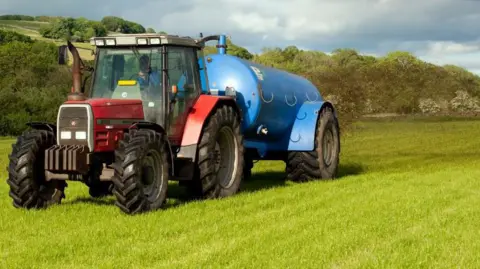
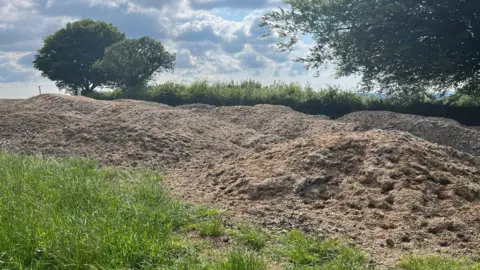
About 3.5 million tonnes of sludge – the solid waste produced from human sewage at treatment plants – is put on fields every year as cheap fertiliser.
But campaigners have long warned about a lack of regulation and that sludge could be contaminated with cancer-linked chemicals, microplastics, and other industrial pollutants.
Emma Howard Boyd, who led the EA from 2016 to 2022, says the agency had been aware since 2017 that the sludge can be contaminated with substances, including ‘forever chemicals’.
“Forever chemicals” or PFAS are a group of synthetic chemicals which come from things like non-stick saucepans. They don’t degrade quickly in nature and have been linked to cancer.
Documents seen by BBC News suggest the water industry is now increasingly concerned that farmers could stop accepting the sludge to spread and that water firms have been lobbying regulators and making contingency plans in case rules change.
Ms Howard Boyd says efforts to update rules, which date back to 1989, to include new contaminants were “continually frustrated by the lack of ministerial appetite to deal with this issue.” In a public letter signed by more than 20 others she called on the current Environment Minister Steve Reed, to act now.
The Department for Environment Food and Rural Affairs (Defra) told the BBC regulations around sludge spreading are being looked at. The water companies trade body Water UK told the BBC they were aware of the concerns but that no legal standards for contaminants had been set by the government.
 BBC/Jonah Fisher
Unlike the cleaned water that is discharged from wastewater treatment plants, the sewage sludge, or biosolid as the industry calls it, is considered “exempted waste”.
That means the treatment focuses mainly on killing bacteria and testing for heavy metals in the sludge.
There is no routine testing for chemicals, including “forever chemicals”, which have been developed over the last three decades and are getting into the sewage network from both from domestic and industrial users.
“I think the big concern is because these substances (forever chemicals) are so persistent they’ll stay around in the soil for hundreds, if not thousands of years,” says Alistair Boxall, professor of environmental science at York University.
“It may be in 10 years’ time that we start understanding that these molecules are causing harm,” he said. “Then we’re going to be in a bit of a mess, because we’ll be in a situation where we’ll have soils in the UK that will have residues of these molecules in them, and at the moment we have no way of cleaning that up.”
In 2022, the US state of Maine became the first state to ban the spreading of sludge contaminated with “forever chemicals” after high levels were found in water, soil and crops.
Reports and emails shown to the BBC by Greenpeace’s Unearthed investigation unit and obtained using Freedom of Information Act requests, reveal the water industry is acutely aware that attitudes are changing and is both lobbying government and making contingency plans.
The companies are concerned on two fronts: that general rules regarding the spreading of sludge on land (so called Farming Rules for Water) may soon be tightened due to fears that it’s polluting watercourses and that farmers’ concerns about the chemicals in the sludge might make them unwilling to put it on their fields.
The water industry has already commissioned reports looking at what might happen if the spreading is restricted.
One of them predicts that the “most likely” scenario is a shortfall of about three million hectares in land needed to spread the sludge. The water industry says that would lead to them either incinerating it or putting it into landfill. Both options would bring extra costs that would be passed on to billpayers.
“This investigation is yet more proof that we can’t trust the privatised water companies to deal with waste responsibly,” Reshima Sharma from Greenpeace said.
“So long as they can get away with it, they will just pass any problems on to our countryside and pocket the money they should be investing in solutions.”
 Getty Images
In 2017 a report commissioned by the Environment Agency found that sludge contained potentially harmful substances, including microplastics and “forever chemicals”, at levels that “may present a risk to human health” and may create soil that is “unsuitable for agriculture”.
It said that “perhaps the biggest risk to the landbank” is from the spreading of physical contaminants such as microplastics into agricultural soil. The report also said it had heard evidence from EA staff indicating that some companies may be using wastewater treatment plants to “mask disposal of individual high risk waste streams not suitable for land spreading”.
“EA colleagues were continually frustrated by the lack of ministerial appetite to deal with this issue,” Ms Howard Boyd, who was chair of the regulator at the time, told the BBC in an email.
“EA proposals since 2020 to reform the regulations were treated with a lack of urgency, hampered by delays in passing requests up to the relevant ministers for decision-making, and a consistent failure by successive secretaries of state to take the matter seriously.”
The letter Ms Howard Boyd has signed jointly signed was organised by campaign group Fighting Dirty. It calls the contents of the sewage sludge a “dirty secret” and demands that Environment Secretary Steve Reed take action.
 BBC/Jonah Fisher
Sewage sludge is cheaper than other fertilisers, and can sometimes be free, though farmers may have to spread it themselves.
Julie Lewis-Thompson tells me it has “the smell of death”.
“It lingers in the air for somewhere around two to three weeks,” she tells me when I go to visit in her home on Dartmoor in the south-west of England.
She’s gathered together a group of neighbours who’ve all had direct experience of sewage sludge being spread near their properties. Before we start recording there’s a long discussion about whether they should speak out for fear of upsetting nearby farmers and the contractors who spread the sludge, who are often local.
Many of their concerns are about the smell and about potential contamination of their water sources. One young woman leaves in tears saying it had made her sick.
“The fact it’s spread for free ought to raise a few eyebrows,” Richard Smallwood, a local beef and sheep farmer who doesn’t use sewage sludge, tells me.
“If we’re starting to produce food on grassland and arable land which is filled up to the ear holes with PFAS compounds and nano and micro-plastics that find their way into the food chain I think my job’s over before I begin.”
 BBC/Kevin Church
With the alternatives to sewage sludge disposal costly, there’s broad agreement that the recycling of sludge into fertiliser has to be made to work.
“In principle, I think using properly treated human sewage to spread on the land, put it back into the ground for growing food in the UK, that’s the right thing to do,” Hugh Fearnley-Whittingstall, the cook, writer and broadcaster, tells me at his small farm and café in east Devon. He’s also signed the protest letter to the environment minister.
“We know it’s happening. Our farmers are rightly worried. We’ve got to take action. Government’s got to take action,” Mr Fearnley-Whittingstall says.
“That means regulations are not voluntary regulations or guidelines, [they should be] legally enforceable regulations that stop these pollutants getting into the sewage and onto our land.”
Despite the concerns there are still plenty of farmers who see the sludge as a cheap way to fertilise their fields.
Will Oliver is on the National Farmers Union Crops Board. He says he applies about 800 tonnes of sewage sludge every year to fields where he grows maize destined for animal feed.
The water company provides the sludge for free and Mr Oliver says he’s careful how much he uses and trusts the company to make sure it doesn’t have chemical contamination.
“If we can be sensible with how it’s used and spread on the land, it can be positive for farmers and for the water companies,” he says.
“I’m doing it because it’s adding value. It’s improving our organic matter. It’s benefitting the crop that I’m growing, and it’s reducing my spend on bagged fertilisers.”
The Department for the Environment, Food and Rural Affairs did not contest anything the former chair of the EA Ms Howard Boyd told the BBC.
“We need to see the safe and sustainable use of sludge in agriculture to help clean up our waterways,” a spokesperson said.
“The Independent Water Commission will explore a range of issues, including the regulatory framework for sludge spreading, and we continue to work closely with the Environment Agency, water companies and farmers in this area.”
Water UK represents the water companies of England and Wales, and a spokesperson said: “Although there are some concerns that some bioresources may contain contaminants, such as microplastics and forever chemicals (PFAS), there are no legal standards for them and, in some cases, no agreed assessment techniques.”
“Any standards and techniques are a matter for the government and the regulator and need to be based on firm evidence and detailed scientific research.”