• Login
  • Home
  • News
  • Sports
  • Reel
  • World

    Trump says US-Iran deal to be signed on Sunday as Tehran casts doubt on timing

    King leads tributes to 'giant of the art world' David Hockney

    Pope Leo visits Canary Islands to highlight perilous journeys of migrants

    Bill Gates says Epstein wanted personal relationship, but he 'never reciprocated'

    Trump says Iran shot down US helicopter and vows to respond

    'City's gonna be crazy:' Knicks run electrifies NYC, as Trump's attendance locks down arena

    Trump abruptly ends NBC interview after clash over 'rigged election' claim

    Hegseth attacks Europe over ‘invasion’ of migrants in D-Day speech

    Everest guide survived six-day ordeal by eating chocolate and 'chewing ice'

  • Worklife
  • Travel
  • Future
  • More
    • Culture
    • Music
No Result
View All Result

Welcome to World News & Todays Top News Stories

Sunday, June 14, 2026
  • Home
  • News
  • Sports
  • Reel
  • World

    Trump says US-Iran deal to be signed on Sunday as Tehran casts doubt on timing

    King leads tributes to 'giant of the art world' David Hockney

    Pope Leo visits Canary Islands to highlight perilous journeys of migrants

    Bill Gates says Epstein wanted personal relationship, but he 'never reciprocated'

    Trump says Iran shot down US helicopter and vows to respond

    'City's gonna be crazy:' Knicks run electrifies NYC, as Trump's attendance locks down arena

    Trump abruptly ends NBC interview after clash over 'rigged election' claim

    Hegseth attacks Europe over ‘invasion’ of migrants in D-Day speech

    Everest guide survived six-day ordeal by eating chocolate and 'chewing ice'

  • Worklife
  • Travel
  • Future
  • More
    • Culture
    • Music
No Result
View All Result
No Result
View All Result
ADVERTISEMENT

Meta plans globe-spanning sub-sea internet cable

February 17, 2025
in Technology
6 min read
0


Liv McMahon

Technology reporter

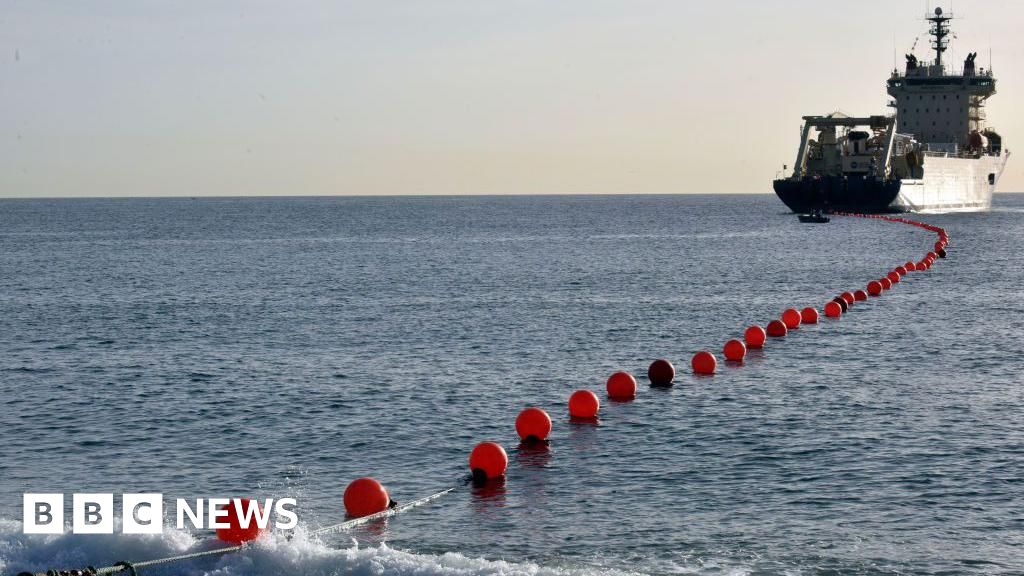
Getty Images A boat in the distance with a cable connected by orange bollards floating on the sea.Getty Images

Meta has announced plans to build a 50,000km (31,000 mile) sub-sea cable across the world.

The tech giant said Project Waterworth – connecting the US, India, South Africa, Brazil and other regions – will be the world’s longest underwater cable project when completed.

Meta, which owns Facebook, Instagram and WhatsApp, has sought to extend its presence in technology beyond social media, including in artificial intelligence (AI) and the infrastructure that supports it.

It said its new cable project would provide “industry-leading connectivity” to five major continents and help support its AI projects.

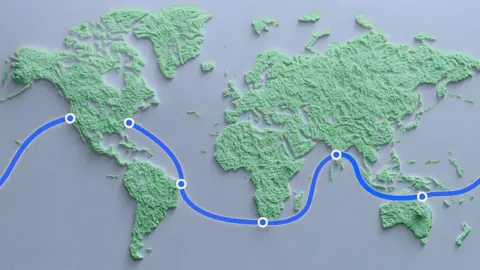
Meta A Meta illustration of Project Waterworth shows a thick blue line connecting points in the US, South America, Africa, India and Australia on a global map.Meta

Meta says the multi-billion dollar project aims to boost connectivity along the world’s “digital highways”.

“This project will enable greater economic co-operation, facilitate digital inclusion, and open opportunities for technological development in these regions,” Meta said in a blog post.

The cable would be the longest to date that uses a 24 fibre-pair system, giving it a higher capacity, according to the firm.

Sub-sea cables have become increasingly important as they provide the means to power a variety of digital services and transfer data worldwide at speed.

One regularly-cited statistic suggests more than 95% of the world’s internet traffic is transferred through undersea cables.

Telecommunications market research firm TeleGeography says there are currently more than 600 publicly-known sub-sea cable systems worldwide.

This includes the 2Africa cable, backed by Meta and mobile network operators such as Orange, Vodafone and China Mobile, which links three continents and spans 45,000km.

Tech’s bigger stake

Related posts

Farage says Reform has contacted X 'to highest level' over fake AI ads

June 14, 2026

Elon Musk's stratospheric rise to trillionaire status – in charts

June 13, 2026

Tech firms that serve as major providers of web services have invested huge sums in cable infrastructure.

Google said in 2024 it would build the first sub-sea cable connecting Africa and Australia, and announced a $1bn investment to boost connectivity to Japan with two new sub-sea cables in the Pacific Ocean.

“Over the past decade there has been a shift in which these cables are increasingly laid by large technology companies,” Professor Vili Lehdonvirta of the Oxford Internet Institute told the BBC.

He said this is in contrast to the past, where underwater cables were laid and financed by large groups of national telecoms firms, due to their considerable investment needs.

Prof Lehdonvirta said this reflects the growing size and position of big tech firms to be able to fund such infrastructure independently – something that “may be significant to policy makers concerned with concentration in digital markets”.

Telecoms and technology industry analyst Paolo Pescatore said it spoke to Meta’s ambitions.

“Meta has shown a strong desire to own more of the connectivity slice,” he told the BBC.

“This is a further demonstration as it seeks to leapfrog rivals in providing users with an unique experience by tightly integrating hardware, software, platform and its growing aspirations in connectivity,” he added.

Protecting against threats

The rising importance of sub-sea cables has increased concerns over their vulnerability to attacks or accidents.

Following a spate of severed cables, experts have said undersea communications infrastructure is a growing arena for geopolitical tensions and conflict.

Nato launched a mission in January to increase surveillance of ships in the Baltic Sea after damage to critical undersea cables last year.

A UK parliamentary committee recently issued a call for evidence about the UK’s resilience in the face of potential disruption.

This said pointed to growing concern over “Russian and Chinese capabilities to hold undersea infrastructure at risk – particularly during periods of heightened tension or conflict”.

Meta said in its blog post announcing Project Waterworth it would lay its cable system up to 7,000 meters deep and “use enhanced burial techniques in high-risk fault areas, such as shallow waters near the coast, to avoid damage from ship anchors and other hazards”.

Prof Lehdonvirta said the project appeared to diverge from more established routes, such as by skipping Europe and China and avoiding “geopolitical hotspots” in the Suez canal and South China sea.

And he said connecting the US with major, contested markets in the Southern hemisphere could be viewed as “bolstering US economic and infrastructural power abroad”.


Source link

Previous Post

Could Musk damage OpenAI even if his $100bn bid for it fails?

Next Post

AMERICAN REACTS TO Why do Australians love to go barefoot? – BBC REEL

Next Post

AMERICAN REACTS TO Why do Australians love to go barefoot? - BBC REEL

Leave a Reply Cancel reply

Your email address will not be published. Required fields are marked *

Recent News

  • Farage says Reform has contacted X 'to highest level' over fake AI ads
  • Molly Russell's dad says PM rushing social media restrictions 'deplorable'
  • Trump says US-Iran deal to be signed on Sunday as Tehran casts doubt on timing

Category

  • Business
  • Have your say
  • In Pictures
  • Politics
  • Reel
  • Sports
  • Technology
  • Top News
  • World
  • Home
  • News
  • Sports
  • Reel
  • World

    Trump says US-Iran deal to be signed on Sunday as Tehran casts doubt on timing

    King leads tributes to 'giant of the art world' David Hockney

    Pope Leo visits Canary Islands to highlight perilous journeys of migrants

    Bill Gates says Epstein wanted personal relationship, but he 'never reciprocated'

    Trump says Iran shot down US helicopter and vows to respond

    'City's gonna be crazy:' Knicks run electrifies NYC, as Trump's attendance locks down arena

    Trump abruptly ends NBC interview after clash over 'rigged election' claim

    Hegseth attacks Europe over ‘invasion’ of migrants in D-Day speech

    Everest guide survived six-day ordeal by eating chocolate and 'chewing ice'

  • Worklife
  • Travel
  • Future
  • More

© 2023 GODJ - NEWS CORP - news.godj.com.

  • Home
  • News
  • Sport
  • Reel
  • Travel
  • WorkLife
  • Future
  • World
  • Technology
  • Login

© 2023 GODJ - NEWS CORP - news.godj.com.

Welcome Back!

Login to your account below

Forgotten Password?

Create New Account!

Fill the forms bellow to register

All fields are required. Log In

Retrieve your password

Please enter your username or email address to reset your password.

Log In